Olms Constanze, Yahiaoui-Doktor Maryam, Remmerbach Torsten W, Stingu Catalina Suzana
Department of Prosthodontics and Material Science, University of Leipzig, 04103 Leipzig, Germany.
Institute for Medical Informatics, Statistics and Epidemiology (IMISE), University of Leipzig, 04107 Leipzig, Germany.
Dent J (Basel). 2018 Jun 15;6(2):20. doi: 10.3390/dj6020020.
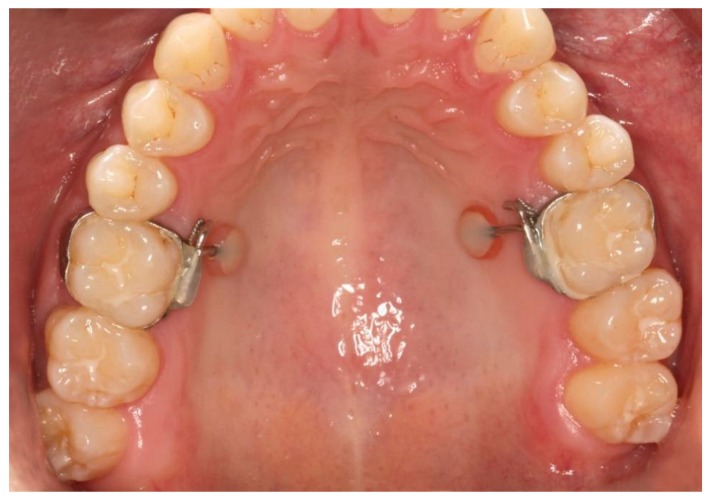
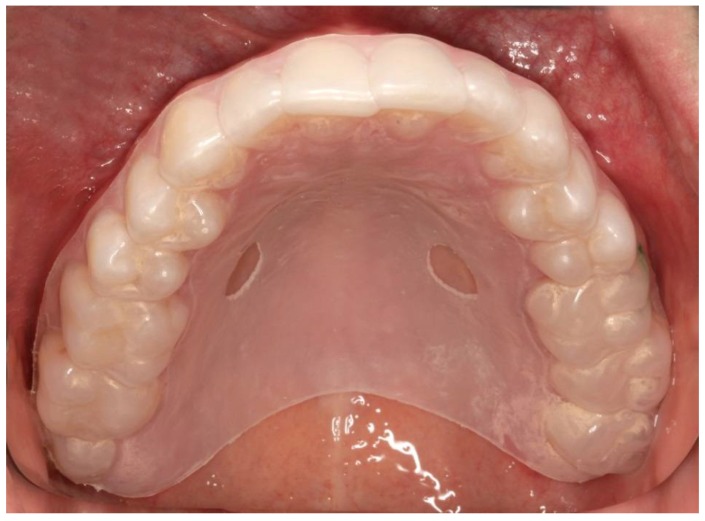
Currently, there is minimal clinical data regarding biofilm composition on the surface of denture bases and the clinical tissue compatibility. Therefore, the aim of this experimental study was to compare the bacterial colonization and the tissue compatibility of a hypoallergenic polyamide with a frequently used PMMA resin tested intraorally in a randomized split-mouth design. Test specimens made of polyamide ( = 10) and PMMA ( = 10) were attached over a molar band appliance in oral cavity of 10 subjects. A cytological smear test was done from palatal mucosa at baseline and after four weeks. The monolayers were inspected for micronuclei. After four weeks in situ, the appliance was removed. The test specimens were immediately cultivated on non-selective and selective nutrient media. All growing colonies were identified using VITEK-MS. The anonymized results were analyzed descriptively. A total of 110 different bacterial species could be isolated, including putative pathogens. An average of 17.8 different bacterial species grew on the PMMA specimens, and 17.3 on the polyamide specimens. The highest number of different bacterial species was = 24, found on a PMMA specimen. On the two specimens, a similar bacterial distribution was observed. Micronuclei, as a marker for genotoxic potential of dental materials, were not detected. This study indicates that the composition of bacterial biofilm developed on these resins after four weeks is not influenced by the type of resin itself. The two materials showed no cytological differences. This investigation suggests that polyamide and PMMA are suitable for clinical use as denture base material.
目前,关于义齿基托表面生物膜组成和临床组织相容性的临床数据极少。因此,本实验研究的目的是采用随机分口设计,在口腔内比较一种低过敏性聚酰胺与常用的聚甲基丙烯酸甲酯(PMMA)树脂的细菌定植情况和组织相容性。由聚酰胺(n = 10)和PMMA(n = 10)制成的测试标本附着在10名受试者口腔中的磨牙带装置上。在基线和四周后从腭黏膜进行细胞学涂片检查。检查单层细胞中的微核。原位放置四周后,取出装置。将测试标本立即接种在非选择性和选择性营养培养基上。使用VITEK-MS鉴定所有生长的菌落。对匿名结果进行描述性分析。总共分离出110种不同的细菌,包括潜在病原体。PMMA标本上平均生长17.8种不同细菌,聚酰胺标本上平均生长17.3种。在一个PMMA标本上发现不同细菌种类的最高数量为n = 24。在这两个标本上观察到相似的细菌分布。未检测到作为牙科材料遗传毒性潜力标志物的微核。本研究表明,四周后在这些树脂上形成的细菌生物膜组成不受树脂本身类型的影响。这两种材料在细胞学上没有差异。本研究表明,聚酰胺和PMMA作为义齿基托材料适用于临床。