Department of Psychosomatic Medicine and Psychotherapy, Universitätsklinik Ulm, Ulm, Germany.
Institute of Epidemiology II, Helmholtz Zentrum München, German Research, Center for Environmental Health, Ingolstädter Landstr. 1, 85764, Neuherberg, Germany.
BMC Public Health. 2018 Jun 18;18(1):754. doi: 10.1186/s12889-018-5621-4.
Job insecurity has been associated with impaired self-rated health (SRH) in cross-sectional studies, but prospective findings with short, medium and long-term follow-up yielded mixed findings. Therefore, the aim of the present study was to assess the long-term association between perceived job insecurity and SRH, after controlling for baseline levels of health status and life-style choices. Furthermore, three different follow-up periods (14, 19 and 24 years) were considered.
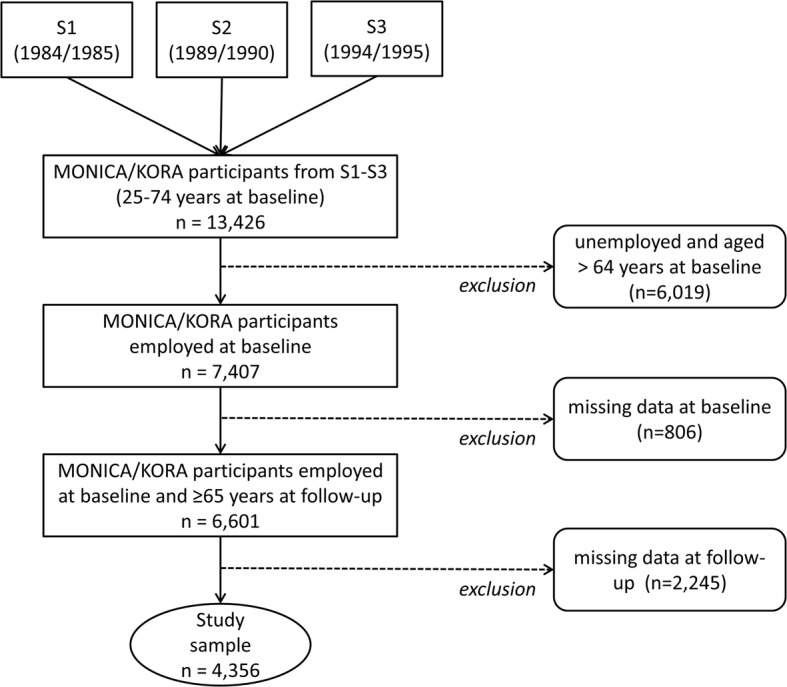
Data were derived from the prospective population-based MONICA/KORA cohort study (southern Germany). N = 4356 participants (2622 men and 1734 women), aged between 25 and 64 years at baseline, were included in the sample, mean follow-up was after 19.1 years. Job insecurity, SRH and risk factors were assessed at baseline during three independent surveys (1984-1995). SRH was additionally assessed in 2009. The association of job insecurity and impaired SRH at follow-up was estimated using logistic regression analyses.
Overall, perceiving job insecurity at baseline was significantly associated with a 20% higher risk of developing impaired SRH at follow-up in the pooled analysis (OR = 1.20, 95% CI = 1.01-1.43, p = .034), even after controlling for baseline SRH, socio-demographic characteristics, lifestyle, clinical and work-related factors. The association was strongest and significant after 14 years (OR = 1.58, 95% CI 1.17-2.13, p = .003) and weaker and not significant to 19 (OR = 1.20, 95% CI 0.89-1.62, p = .24) and 24 years (OR = 0.98, 95% CI 0.73-1.32, p = .89) of follow-up in the fully adjusted models.
We found that perceived job insecurity during working life was independently and significantly associated with impaired SRH both cross-sectionally as well as after 14 years, but not after 19 and 24 years.
工作不安全感与自我报告健康状况受损有关,这在横断面研究中已有报道,但前瞻性研究结果,包括短期、中期和长期随访,结果喜忧参半。因此,本研究旨在评估在控制基线健康状况和生活方式选择的情况下,感知到的工作不安全感与自我报告健康状况之间的长期关联。此外,还考虑了三个不同的随访期(14、19 和 24 年)。
数据来自前瞻性人群为基础的 MONICA/KORA 队列研究(德国南部)。纳入样本的 4356 名参与者(2622 名男性和 1734 名女性)年龄在基线时为 25-64 岁,平均随访时间为 19.1 年。工作不安全感、自我报告健康状况和危险因素在基线时通过三个独立的调查进行评估(1984-1995 年)。2009 年还评估了自我报告健康状况。使用逻辑回归分析估计基线时的工作不安全感与随访时自我报告健康状况受损之间的关联。
总体而言,在合并分析中,基线时感知到的工作不安全感与随访时自我报告健康状况受损的风险增加 20%显著相关(OR=1.20,95%CI=1.01-1.43,p=0.034),即使在控制基线时的自我报告健康状况、社会人口统计学特征、生活方式、临床和工作相关因素后也是如此。该关联在 14 年后最强且显著(OR=1.58,95%CI 1.17-2.13,p=0.003),在 19 年后较弱且不显著(OR=1.20,95%CI 0.89-1.62,p=0.24),在 24 年后则无统计学意义(OR=0.98,95%CI 0.73-1.32,p=0.89)。在完全调整的模型中。
我们发现,工作生涯中感知到的工作不安全感与自我报告健康状况受损无论是在横断面还是 14 年后均独立且显著相关,但在 19 年和 24 年后则不相关。