Zak A, Siwinska N, Slowikowska M, Borowicz H, Szpot P, Zawadzki M, Niedzwiedz A
Department of Internal Medicine and Clinic of Diseases of Horses, Dogs and Cats, Faculty of Veterinary Medicine, Wroclaw University of Environmental and Life Sciences, pl. Grunwaldzki 47, 50-366, Wroclaw, Poland.
Department of Forensic Medicine, Wroclaw Medical University, ul. Mikulicza-Radeckiego 4, 50-345, Wroclaw, Poland.
BMC Vet Res. 2018 Jun 19;14(1):193. doi: 10.1186/s12917-018-1518-9.
Capsaicin and dihydrocapsaicin are alkaloids with analgesic effects in humans and animals. When used locally, both of them minimalise pain sensation by defunctionalising nerve endings. According to the Federation Equestrian International Prohibited Substances List, these are substance banned in horse competitions. The aim of the study was to determine the detection time of capsaicin in both plasma and serum after long-term use of a gel recommended for commercial use and applied as intended. The objective of the study was to select the best material for the detection of capsaicin as a doping substance in horses.
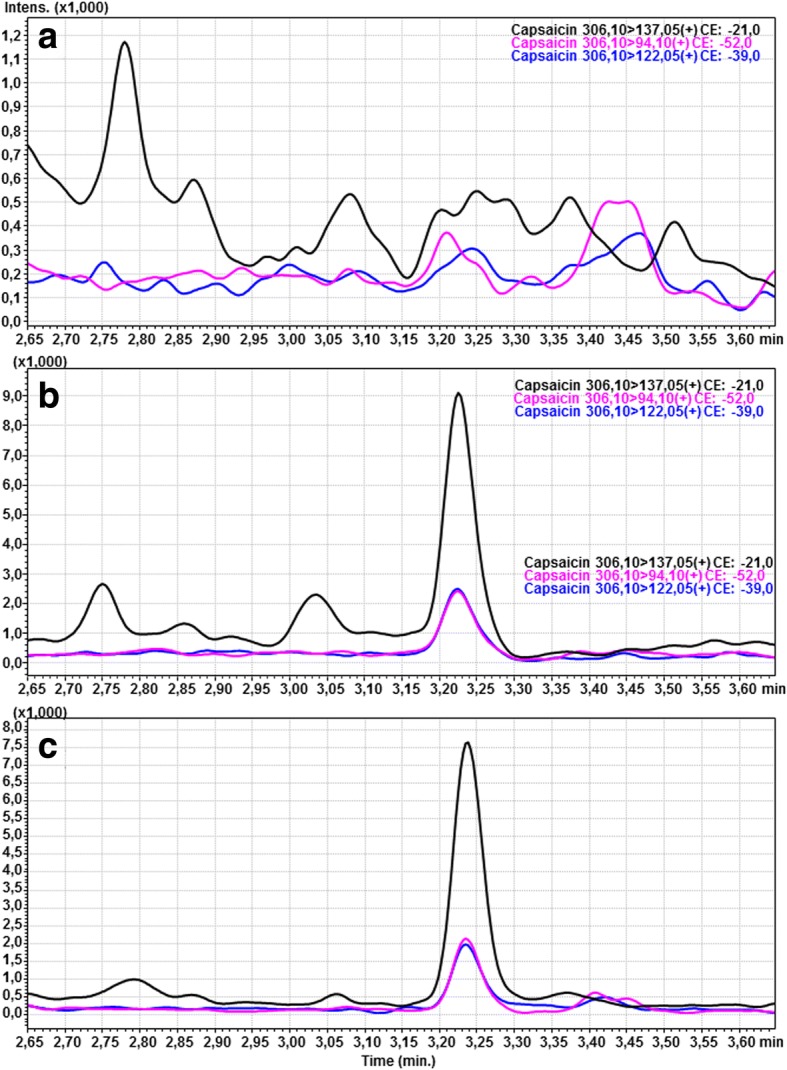
Nine healthy mature horses were administered 0.1% capsaicin topically in the form of a commercial analgesic gel (15 g of the gel per limb) to the front limbs every 24 hours for five days with a polar fleece bandage. Blood serum and plasma were collected prior to gel application and in the 12th, 18th, 24th, 36th, 42nd, 48th, 60th, 84th, 108th, 132nd, 156th hour after the gel application. Qualitative and quantitative analysis was performed using ultra-high performance liquid chromatography coupled with a triple quadrupole mass spectrometry (UHPLC-QqQ-MS/MS).
The concentration of capsaicin in the serum samples did not exceed the lower limit of quantification. Capsaicin was not detected in the plasma samples during the entire study period. Dihydrocapsaicin was not detected in blood serum or plasma.
The presented results suggest that capsaicin is not detected in horse serum in the 24-hour-periodfollowing its last application according to the dosage regimen used by owners and veterinarians for therapy rather than doping, based on a five day gel application and a polar bandage.
辣椒素和二氢辣椒素是对人和动物具有镇痛作用的生物碱。局部使用时,它们通过使神经末梢功能丧失来减轻疼痛感。根据国际马术联合会禁用物质清单,这些物质在马匹比赛中被禁止使用。本研究的目的是确定长期按推荐剂量和预期用途使用商用凝胶后,血浆和血清中辣椒素的检测时间。本研究的目标是选择用于检测马匹中作为兴奋剂的辣椒素的最佳材料。
九匹健康的成年马,每24小时在前肢以商用镇痛凝胶(每肢15克凝胶)的形式局部给予0.1%辣椒素,持续五天,并用极地羊毛绷带包扎。在涂抹凝胶前以及涂抹凝胶后的第12、18、24、36、42、48、60、84、108、132、156小时采集血清和血浆。使用超高效液相色谱-三重四极杆质谱联用仪(UHPLC-QqQ-MS/MS)进行定性和定量分析。
血清样本中辣椒素的浓度未超过定量下限。在整个研究期间,血浆样本中未检测到辣椒素。血清或血浆中未检测到二氢辣椒素。
根据主人和兽医用于治疗而非兴奋剂目的的给药方案,即五天的凝胶涂抹和极地绷带包扎,本研究结果表明,在最后一次涂抹辣椒素后的24小时内,马血清中未检测到辣椒素。