• 文献检索
  • 文档翻译
  • 深度研究
  • 学术资讯
  • Suppr Zotero 插件Zotero 插件
  • 邀请有礼
  • 套餐&价格
  • 历史记录
应用&插件
Suppr Zotero 插件Zotero 插件浏览器插件Mac 客户端Windows 客户端微信小程序
定价
高级版会员购买积分包购买API积分包
服务
文献检索文档翻译深度研究API 文档MCP 服务
关于我们
关于 Suppr公司介绍联系我们用户协议隐私条款
关注我们

Suppr 超能文献

核心技术专利:CN118964589B侵权必究
粤ICP备2023148730 号-1Suppr @ 2026

文献检索

告别复杂PubMed语法,用中文像聊天一样搜索,搜遍4000万医学文献。AI智能推荐,让科研检索更轻松。

立即免费搜索

文件翻译

保留排版,准确专业,支持PDF/Word/PPT等文件格式,支持 12+语言互译。

免费翻译文档

深度研究

AI帮你快速写综述,25分钟生成高质量综述,智能提取关键信息,辅助科研写作。

立即免费体验

穿戴踝足矫形器的慢性脑卒中患者的机器人辅助步态训练与背屈辅助的随机对照试验。

Randomized controlled trial of robot-assisted gait training with dorsiflexion assistance on chronic stroke patients wearing ankle-foot-orthosis.

机构信息

Department of Biomedical Engineering, The Chinese University of Hong Kong, ShaTin, Hong Kong.

Department of Biomedical Engineering, The Hong Kong Polytechnic University, Hung Hom, Hong Kong.

出版信息

J Neuroeng Rehabil. 2018 Jun 19;15(1):51. doi: 10.1186/s12984-018-0394-7.

DOI:10.1186/s12984-018-0394-7
PMID:29914523
原文链接:https://pmc.ncbi.nlm.nih.gov/articles/PMC6006663/
Abstract

BACKGROUND

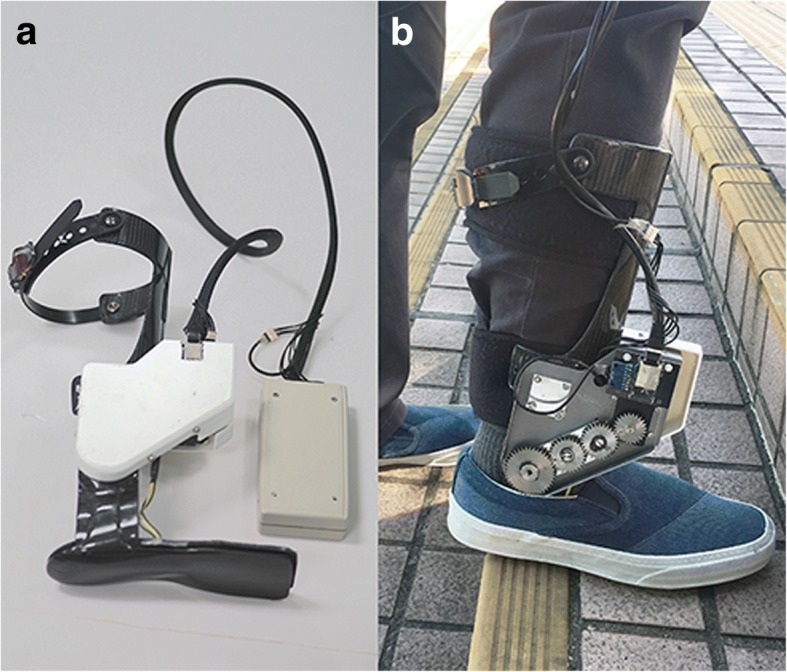
Robot-assisted ankle-foot-orthosis (AFO) can provide immediate powered ankle assistance in post-stroke gait training. Our research team has developed a novel lightweight portable robot-assisted AFO which is capable of detecting walking intentions using sensor feedback of wearer's gait pattern. This study aims to investigate the therapeutic effects of robot-assisted gait training with ankle dorsiflexion assistance.

METHODS

This was a double-blinded randomized controlled trial. Nineteen chronic stroke patients with motor impairment at ankle participated in 20-session robot-assisted gait training for about five weeks, with 30-min over-ground walking and stair ambulation practices. Robot-assisted AFO either provided active powered ankle assistance during swing phase in Robotic Group (n = 9), or torque impedance at ankle joint as passive AFO in Sham Group (n = 10). Functional assessments were performed before and after the 20-session gait training with 3-month Follow-up. Primary outcome measure was gait independency assessed by Functional Ambulatory Category (FAC). Secondary outcome measures were clinical scores including Fugl-Meyer Assessment (FMA), Modified Ashworth Scale (MAS), Berg Balance Scale (BBS), Timed 10-Meter Walk Test (10MWT), Six-minute Walk Test (SMWT), supplemented by gait analysis. All outcome measures were performed in unassisted gait after patients had taken off the robot-assisted AFO. Repeated-measures analysis of covariance was conducted to test the group differences referenced to clinical scores before training.

RESULTS

After 20-session robot-assisted gait training with ankle dorsiflexion assistance, the active ankle assistance in Robotic Group induced changes in gait pattern with improved gait independency (all patients FAC ≥ 5 post-training and 3-month follow-up), motor recovery, walking speed, and greater confidence in affected side loading response (vertical ground reaction force + 1.49 N/kg, peak braking force + 0.24 N/kg) with heel strike instead of flat foot touch-down at initial contact (foot tilting + 1.91°). Sham Group reported reduction in affected leg range of motion (ankle dorsiflexion - 2.36° and knee flexion - 8.48°) during swing.

CONCLUSIONS

Robot-assisted gait training with ankle dorsiflexion assistance could improve gait independency and help stroke patients developing confidence in weight acceptance, but future development of robot-assisted AFO should consider more lightweight and custom-fit design.

TRIAL REGISTRATION

ClinicalTrials.gov NCT02471248 . Registered 15 June 2015 retrospectively registered.

摘要

背景

机器人辅助踝足矫形器(AFO)可以在脑卒中后步态训练中立即提供主动的踝关节辅助。我们的研究团队开发了一种新型的轻便便携式机器人辅助踝足矫形器,它可以通过检测穿戴者步态模式的传感器反馈来检测行走意图。本研究旨在探讨具有踝关节背屈辅助的机器人辅助步态训练的治疗效果。

方法

这是一项双盲随机对照试验。19 名患有运动障碍的慢性脑卒中患者参与了 20 次机器人辅助步态训练,为期约五周,包括 30 分钟的地面行走和上下楼梯练习。机器人辅助 AFO 在摆动相期间为机器人组(n=9)提供主动动力踝关节辅助,或为假手术组(n=10)提供被动踝关节扭矩阻抗。在 20 次步态训练前后进行功能评估,并在 3 个月的随访时进行。主要结局测量是由功能性步行分类(FAC)评估的步态独立性。次要结局测量包括 Fugl-Meyer 评估(FMA)、改良 Ashworth 量表(MAS)、伯格平衡量表(BBS)、10 米步行测试(10MWT)、6 分钟步行测试(SMWT),并辅以步态分析。所有的结果测量都是在患者脱下机器人辅助 AFO 后进行的无辅助步行时进行的。采用重复测量协方差分析检验训练前与临床评分的组间差异。

结果

在接受 20 次具有踝关节背屈辅助的机器人辅助步态训练后,机器人组的主动踝关节辅助改变了步态模式,提高了步态独立性(所有患者训练后和 3 个月随访时 FAC≥5),运动功能恢复,行走速度提高,对患侧负重反应的信心增强(垂直地面反作用力增加+1.49 N/kg,最大制动力增加+0.24 N/kg),初始接触时足跟触地而不是平足触地(足部倾斜增加+1.91°)。假手术组在摆动期报告患侧运动范围减小(踝关节背屈-2.36°和膝关节屈曲-8.48°)。

结论

具有踝关节背屈辅助的机器人辅助步态训练可以提高步态独立性,并帮助脑卒中患者增强对承重的信心,但未来的机器人辅助 AFO 应考虑更轻便和定制的设计。

试验注册

ClinicalTrials.gov NCT02471248。于 2015 年 6 月 15 日回顾性注册。
https://cdn.ncbi.nlm.nih.gov/pmc/blobs/00e4/6006663/ce8a4f065fec/12984_2018_394_Fig4_HTML.jpg
https://cdn.ncbi.nlm.nih.gov/pmc/blobs/00e4/6006663/d1977cc5280b/12984_2018_394_Fig1_HTML.jpg
https://cdn.ncbi.nlm.nih.gov/pmc/blobs/00e4/6006663/7c7540bf7dc5/12984_2018_394_Fig2_HTML.jpg
https://cdn.ncbi.nlm.nih.gov/pmc/blobs/00e4/6006663/5451dc03500f/12984_2018_394_Fig3_HTML.jpg
https://cdn.ncbi.nlm.nih.gov/pmc/blobs/00e4/6006663/ce8a4f065fec/12984_2018_394_Fig4_HTML.jpg
https://cdn.ncbi.nlm.nih.gov/pmc/blobs/00e4/6006663/d1977cc5280b/12984_2018_394_Fig1_HTML.jpg
https://cdn.ncbi.nlm.nih.gov/pmc/blobs/00e4/6006663/7c7540bf7dc5/12984_2018_394_Fig2_HTML.jpg
https://cdn.ncbi.nlm.nih.gov/pmc/blobs/00e4/6006663/5451dc03500f/12984_2018_394_Fig3_HTML.jpg
https://cdn.ncbi.nlm.nih.gov/pmc/blobs/00e4/6006663/ce8a4f065fec/12984_2018_394_Fig4_HTML.jpg

相似文献

1
Randomized controlled trial of robot-assisted gait training with dorsiflexion assistance on chronic stroke patients wearing ankle-foot-orthosis.穿戴踝足矫形器的慢性脑卒中患者的机器人辅助步态训练与背屈辅助的随机对照试验。
J Neuroeng Rehabil. 2018 Jun 19;15(1):51. doi: 10.1186/s12984-018-0394-7.
2
Effects of wearable ankle robotics for stair and over-ground training on sub-acute stroke: a randomized controlled trial.可穿戴式脚踝机器人用于亚急性中风患者上下楼梯及地面行走训练的效果:一项随机对照试验
J Neuroeng Rehabil. 2021 Jan 29;18(1):19. doi: 10.1186/s12984-021-00814-6.
3
Design of an exoskeleton ankle robot for robot-assisted gait training of stroke patients.用于中风患者机器人辅助步态训练的外骨骼脚踝机器人设计。
IEEE Int Conf Rehabil Robot. 2017 Jul;2017:211-215. doi: 10.1109/ICORR.2017.8009248.
4
A randomized controlled trial on providing ankle-foot orthoses in patients with (sub-)acute stroke: Short-term kinematic and spatiotemporal effects and effects of timing.一项关于为(亚)急性中风患者提供踝足矫形器的随机对照试验:短期运动学和时空效应以及时机的影响。
Gait Posture. 2017 Jun;55:15-22. doi: 10.1016/j.gaitpost.2017.03.028. Epub 2017 Mar 30.
5
The effects of peroneal nerve functional electrical stimulation versus ankle-foot orthosis in patients with chronic stroke: a randomized controlled trial.慢性卒中患者中腓总神经功能性电刺激与踝足矫形器的效果比较:一项随机对照试验
Neurorehabil Neural Repair. 2014 Sep;28(7):688-97. doi: 10.1177/1545968314521007. Epub 2014 Feb 13.
6
Overground wearable powered exoskeleton for gait training in subacute stroke subjects: clinical and gait assessments.地上可穿戴动力外骨骼在亚急性中风患者步态训练中的应用:临床和步态评估。
Eur J Phys Rehabil Med. 2019 Dec;55(6):710-721. doi: 10.23736/S1973-9087.19.05574-6. Epub 2019 Feb 4.
7
Ankle-foot orthosis with dorsiflexion resistance using spring-cam mechanism increases knee flexion in the swing phase during walking in stroke patients with hemiplegia.使用弹簧凸轮机构的踝足矫形器具有背屈阻力,可增加偏瘫中风患者行走时摆动相的膝关节屈曲。
Gait Posture. 2020 Sep;81:27-32. doi: 10.1016/j.gaitpost.2020.06.029. Epub 2020 Jul 2.
8
Ankle-foot orthosis with an oil damper versus nonarticulated ankle-foot orthosis in the gait of patients with subacute stroke: a randomized controlled trial.带油压阻尼器的踝足矫形器与非关节踝足矫形器在亚急性脑卒中患者步态中的比较:一项随机对照试验。
J Neuroeng Rehabil. 2022 May 26;19(1):50. doi: 10.1186/s12984-022-01027-1.
9
Spatiotemporal, kinematic and kinetic assessment of the effects of a foot drop stimulator for home-based rehabilitation of patients with chronic stroke: a randomized clinical trial.基于时空、运动学和动力学评估的家用足下垂刺激器对慢性脑卒中患者康复效果的随机临床试验。
J Neuroeng Rehabil. 2022 Jun 7;19(1):56. doi: 10.1186/s12984-022-01036-0.
10
Novel design for a dynamic ankle foot orthosis with motion feedback used for training in patients with hemiplegic gait: a pilot study.一种具有运动反馈的动态踝足矫形器的新颖设计,用于偏瘫步态患者的训练:一项初步研究。
J Neuroeng Rehabil. 2020 Aug 18;17(1):112. doi: 10.1186/s12984-020-00734-x.

引用本文的文献

1
Effect of the Kickstart exoskeleton lower extremity walking system on improving lower extremity walking ability in subacute stroke patients: a randomized controlled trial.Kickstart外骨骼下肢行走系统对改善亚急性脑卒中患者下肢行走能力的影响:一项随机对照试验
J Neuroeng Rehabil. 2025 Jul 9;22(1):155. doi: 10.1186/s12984-025-01676-y.
2
Early efficacy observation of suspended lower-limb rehabilitation robot-assisted therapy in patients with intensive care unit-acquired weakness: a study protocol for a self-controlled randomised controlled trial.重症监护病房获得性肌无力患者悬吊式下肢康复机器人辅助治疗的早期疗效观察:一项自身对照随机对照试验的研究方案
BMJ Open. 2025 May 30;15(5):e093934. doi: 10.1136/bmjopen-2024-093934.
3

本文引用的文献

1
Design of an exoskeleton ankle robot for robot-assisted gait training of stroke patients.用于中风患者机器人辅助步态训练的外骨骼脚踝机器人设计。
IEEE Int Conf Rehabil Robot. 2017 Jul;2017:211-215. doi: 10.1109/ICORR.2017.8009248.
2
Electromechanical-assisted training for walking after stroke.中风后步行的机电辅助训练
Cochrane Database Syst Rev. 2017 May 10;5(5):CD006185. doi: 10.1002/14651858.CD006185.pub4.
3
Repetitive task training for improving functional ability after stroke.中风后通过重复任务训练改善功能能力
Electromechanical-assisted training for walking after stroke.
中风后行走的机电辅助训练
Cochrane Database Syst Rev. 2025 May 14;5(5):CD006185. doi: 10.1002/14651858.CD006185.pub6.
4
A wearable ankle-assisted robot for improving gait function and pattern in stroke patients.一种用于改善中风患者步态功能和模式的可穿戴脚踝辅助机器人。
J Neuroeng Rehabil. 2025 Apr 22;22(1):89. doi: 10.1186/s12984-025-01624-w.
5
Effect of robot-assisted training for lower limb rehabilitation on lower limb function in stroke patients: a systematic review and meta-analysis.机器人辅助训练对脑卒中患者下肢康复及下肢功能的影响:一项系统评价和荟萃分析
Front Hum Neurosci. 2025 Mar 5;19:1549379. doi: 10.3389/fnhum.2025.1549379. eCollection 2025.
6
Improving patient outcomes in acute and subacute stroke using a wearable device-assisted rehabilitation system: a randomized controlled trial.使用可穿戴设备辅助康复系统改善急性和亚急性脑卒中患者的预后:一项随机对照试验。
J Int Med Res. 2024 Oct;52(10):3000605241281425. doi: 10.1177/03000605241281425.
7
Immediate changes in stroke patients' gait following the application of lower extremity elastic strap binding technique.应用下肢弹性绑带技术后中风患者步态的即时变化
Front Physiol. 2024 Sep 11;15:1441471. doi: 10.3389/fphys.2024.1441471. eCollection 2024.
8
Soft ankle exoskeleton to counteract dropfoot and excessive inversion.用于抵消足下垂和过度内翻的软性脚踝外骨骼。
Front Neurorobot. 2024 Aug 21;18:1372763. doi: 10.3389/fnbot.2024.1372763. eCollection 2024.
9
Optimizing Rehabilitation Outcomes for Stroke Survivors: The Impact of Speed and Slope Adjustments in Anti-Gravity Treadmill Training.优化中风幸存者的康复效果:反重力跑步机训练中速度和坡度调整的影响
Medicina (Kaunas). 2024 Mar 27;60(4):542. doi: 10.3390/medicina60040542.
10
How robot-assisted gait training affects gait ability, balance and kinematic parameters after stroke: a systematic review and meta-analysis.机器人辅助步态训练对脑卒中后步态能力、平衡和运动学参数的影响:系统评价和荟萃分析。
Eur J Phys Rehabil Med. 2024 Jun;60(3):400-411. doi: 10.23736/S1973-9087.24.08354-0. Epub 2024 Apr 22.
Cochrane Database Syst Rev. 2016 Nov 14;11(11):CD006073. doi: 10.1002/14651858.CD006073.pub3.
4
Minimal clinically important difference of the lower-extremity fugl-meyer assessment in chronic-stroke.慢性卒中下肢Fugl-Meyer评估的最小临床重要差异
Top Stroke Rehabil. 2016 Aug;23(4):233-9. doi: 10.1179/1945511915Y.0000000003. Epub 2016 Apr 16.
5
Energy Expenditure and Cost During Walking After Stroke: A Systematic Review.中风后步行时的能量消耗与成本:一项系统综述。
Arch Phys Med Rehabil. 2016 Apr;97(4):619-632.e1. doi: 10.1016/j.apmr.2015.11.007. Epub 2015 Dec 11.
6
Descending neural drives to ankle muscles during gait and their relationships with clinical functions in patients after stroke.中风后患者步态期间对踝关节肌肉的下行神经驱动及其与临床功能的关系。
Clin Neurophysiol. 2016 Feb;127(2):1512-1520. doi: 10.1016/j.clinph.2015.10.043. Epub 2015 Nov 3.
7
Gait post-stroke: Pathophysiology and rehabilitation strategies.中风后的步态:病理生理学与康复策略
Neurophysiol Clin. 2015 Nov;45(4-5):335-55. doi: 10.1016/j.neucli.2015.09.005. Epub 2015 Nov 4.
8
Biomechanical gait characteristics of naturally occurring unsuccessful foot clearance during swing in individuals with chronic stroke.慢性中风患者摆动期自然发生的足部 clearance 失败的生物力学步态特征。 注:这里的“clearance”不太明确具体意思,可能是“离地间隙”之类的专业术语,需结合更详细的医学背景来准确理解。
Clin Biomech (Bristol). 2015 Dec;30(10):1102-7. doi: 10.1016/j.clinbiomech.2015.08.018. Epub 2015 Sep 2.
9
The H2 robotic exoskeleton for gait rehabilitation after stroke: early findings from a clinical study.用于中风后步态康复的H2机器人外骨骼:一项临床研究的早期结果
J Neuroeng Rehabil. 2015 Jun 17;12:54. doi: 10.1186/s12984-015-0048-y.
10
Long-Term Follow-up to a Randomized Controlled Trial Comparing Peroneal Nerve Functional Electrical Stimulation to an Ankle Foot Orthosis for Patients With Chronic Stroke.一项随机对照试验的长期随访:比较慢性卒中患者腓总神经功能性电刺激与踝足矫形器的效果
Neurorehabil Neural Repair. 2015 Nov-Dec;29(10):911-22. doi: 10.1177/1545968315570325. Epub 2015 Feb 4.