RAND Corporation, 1776 Main Street, Santa Monica, CA, 90407-2138, USA.
Implement Sci. 2018 Jun 18;13(1):83. doi: 10.1186/s13012-018-0777-y.
Efforts to integrate substance use disorder treatment into primary care settings are growing. Little is known about how well primary care settings can sustain treatment delivery to address substance use following the end of implementation support.
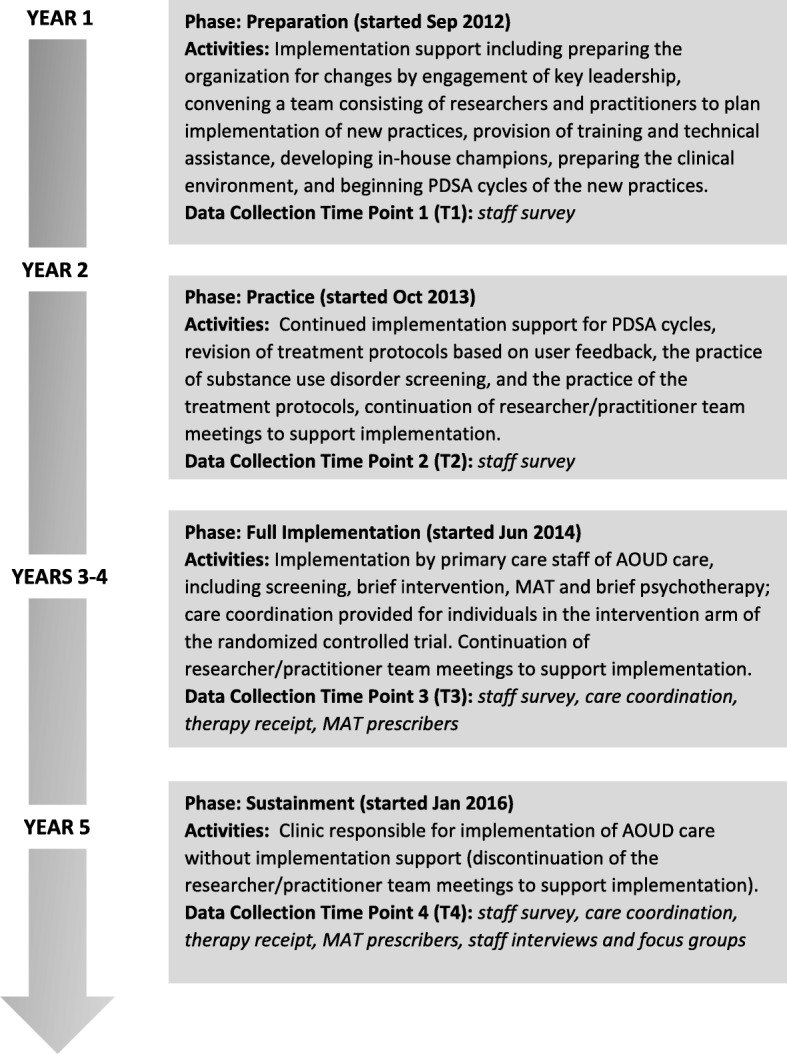
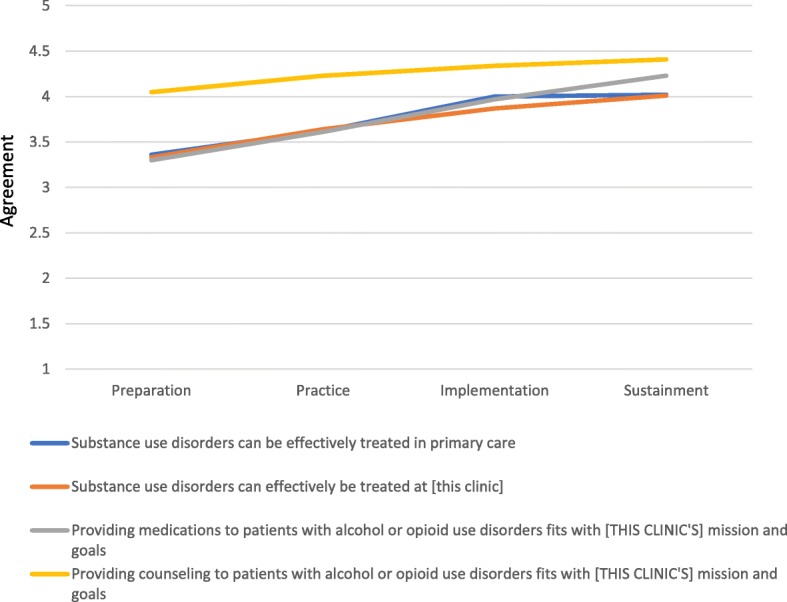
Data from two clinics operated by one multi-site federally qualified health center (FQHC) in the US, including administrative data, staff surveys, interviews, and focus groups, were used to gather information about changes in organizational capacity related to alcohol and opioid use disorder (AOUD) treatment delivery during and after a multi-year implementation intervention was executed. Treatment practices from the intervention period were compared to practices after the intervention period to examine whether the practices were sustained. Data from staff surveys and interviews were used to examine the factors related to sustainment.
The two clinics sustained multiple components of AOUD care 1 year following the end of implementation support, including care coordination, psychotherapy, and medication-assisted treatment. Some of the practices were modified over time, for example, screening became less frequent by design, while use of care coordination and psychotherapy for AOUDs expanded. Participants identified staff training and funding for medications as key challenges to sustaining treatment.
Following a multi-year implementation intervention, a large FQHC continued to deliver AOUD treatment. Access to external funding and staff support appeared to be critical elements for sustaining care over time.
clinicaltrials.gov identifier: NCT01810159.
将物质使用障碍治疗纳入初级保健环境的努力正在增加。对于在实施支持结束后,初级保健环境如何能够持续提供治疗以解决物质使用问题,知之甚少。
使用来自美国一家多站点合格的联邦健康中心(FQHC)运营的两个诊所的数据,包括行政数据、员工调查、访谈和焦点小组,收集有关在执行多年实施干预期间和之后与酒精和阿片类药物使用障碍(AOUD)治疗提供相关的组织能力变化的信息。将干预期间的治疗实践与干预后进行的治疗实践进行比较,以检查实践是否得以维持。使用员工调查和访谈的数据来检查与维持相关的因素。
在实施支持结束后 1 年,两家诊所维持了 AOUD 护理的多个组成部分,包括护理协调、心理治疗和药物辅助治疗。一些实践随着时间的推移而有所修改,例如,出于设计目的,筛查变得不那么频繁,而 AOUD 的护理协调和心理治疗的使用有所扩大。参与者确定人员培训和药物资金是维持治疗的关键挑战。
在进行了多年的实施干预之后,一家大型 FQHC 继续提供 AOUD 治疗。获得外部资金和员工支持似乎是随着时间的推移维持护理的关键要素。
clinicaltrials.gov 标识符:NCT01810159。