Zhejiang Provincial Centre for Disease Control and Prevention, 3399 Binsheng Road, Binjiang District, Hangzhou, Zhejiang, 310051, People's Republic of China.
Infect Dis Poverty. 2018 Jun 19;7(1):65. doi: 10.1186/s40249-018-0445-0.
Human infection of avian influenza virus (AIV) remains a great concern. Although live poultry markets are believed to be associated with human infections, ever more infections have been reported in rural areas with backyard poultry, especially in the fifth epidemic of H7N9. However, limited information is available on backyard poultry infection and surrounding environmental contamination.
Two surveillance systems and a field survey were used to collect data and samples in Zhejiang Province. In total, 4538 samples were collected by surveillance systems and 3171 from the field survey between May 2015 and May 2017, while 352 backyard poultry owners were interviewed in May 2017 by questionnaire to investigate factors influencing the prevalence of avian influenza A virus and other AIV subtypes. RT-PCR was used to test the nucleic acids of viruses. ArcGIS 10.1 software was used to generate maps. Univariate and logistic regression analyses were conducted to identify risk factors for AIV infection.
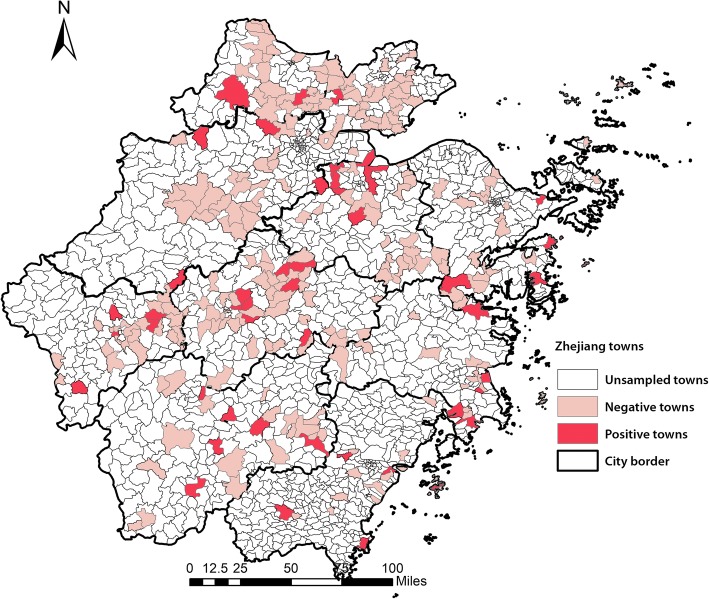
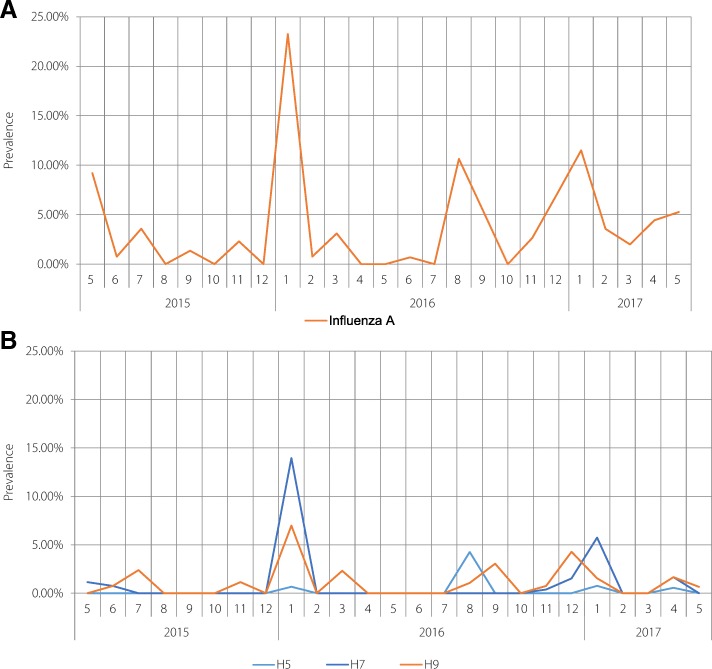
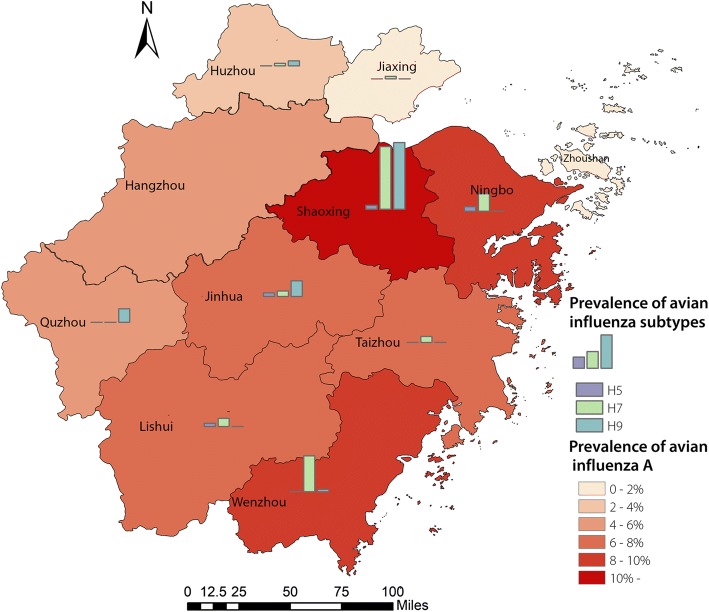
Of the 428 poultry premises observed by the surveillance system, 53 (12.38%) were positive for influenza A virus. Of the 352 samples from poultry premises observed by field survey, 13 (3.39%) were positive for influenza A virus. The prevalence of AIV was unevenly distributed and the dominant subtype differed among cities. Eastern (Shaoxing and Ningbo) and southern (Wenzhou) cities exhibited a higher prevalence of AIV (16.33, 8.94, and 7.30% respectively). Contamination of AIV subtypes was most severe in January, especially in 2016 (23.26%, 70/301). The positive rate of subtype H5/H7/H9 was 2.53% (115/4538). Subtype H5 was the least prevalent, while subtypes H7 and H9 had similar positivity rates (1.50 and 1.32% respectively). Poultry flocks and environmental samples had a similar prevalence of AIV (4.46% vs 5.06%). The type of live birds was a risk factor and the sanitary condition of the setting was a protective factor against influenza A contamination.
AIV subtypes were prevalent in backyard poultry flocks and surrounding environments in Zhejiang Province. The types of live birds and sanitary conditions of the environment were associated with influenza A contamination. These findings shine a light on the characteristics of contamination of AIV subtypes and emphasize the importance of reducing AIV circulation in backyard poultry settings.
人感染禽流感病毒(AIV)仍然是一个重大的关注点。虽然活禽市场被认为与人类感染有关,但越来越多的感染发生在农村地区的后院禽群中,尤其是在第五次 H7N9 疫情中。然而,关于后院禽群感染及其周围环境污染的信息有限。
我们采用了两个监测系统和一项实地调查来收集 2015 年 5 月至 2017 年 5 月期间浙江省的数据和样本。通过监测系统共采集了 4538 个样本,通过实地调查采集了 3171 个样本,同时于 2017 年 5 月通过问卷调查采访了 352 名后院禽群饲养者,以调查影响甲型流感病毒和其他 AIV 亚型流行的因素。我们采用 RT-PCR 检测病毒核酸。我们使用 ArcGIS 10.1 软件生成地图。我们采用单变量和逻辑回归分析来确定 AIV 感染的危险因素。
通过监测系统观察到的 428 个禽舍中,有 53 个(12.38%)流感 A 病毒检测呈阳性。通过实地调查观察到的 352 个禽舍样本中,有 13 个(3.39%)流感 A 病毒检测呈阳性。AIV 的流行情况分布不均,各城市的优势亚型也不同。东部(绍兴和宁波)和南部(温州)城市的 AIV 流行率较高(分别为 16.33%、8.94%和 7.30%)。AIV 亚型的污染在 1 月份最为严重,尤其是在 2016 年(23.26%,70/301)。H5/H7/H9 亚型的阳性率为 2.53%(115/4538)。H5 亚型的流行率最低,而 H7 和 H9 亚型的流行率相似(分别为 1.50%和 1.32%)。禽群和环境样本的 AIV 阳性率相似(4.46%比 5.06%)。活禽种类是一个危险因素,而环境的卫生条件是甲型流感污染的保护因素。
浙江省后院禽群及其周围环境中存在多种 AIV 亚型。活禽种类和环境卫生条件与甲型流感污染有关。这些发现揭示了 AIV 亚型污染的特征,并强调了减少后院禽群中 AIV 循环的重要性。