Department of Comparative Pathobiology, College of Veterinary Medicine, Purdue University, West Lafayette, IN, USA.
Department of Microbiology, Institute of Biomedical Science, University of São Paulo, São Paulo, Brazil.
Vet Res. 2018 Jun 18;49(1):49. doi: 10.1186/s13567-018-0546-6.
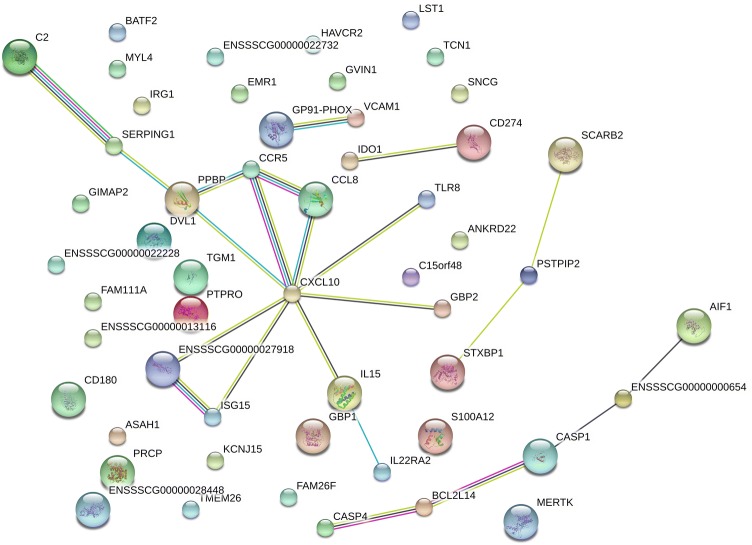
Pigs are popular animal models in biomedical research. RNA-Seq is becoming the predominant tool to investigate transcriptional changes of the pig's response to infection. The high sensitivity of this tool requires a strict control of the study design beginning with the selection of healthy animals to provide accurate interpretation of research data. Pigs chronically infected with Mycoplasma suis often show no obvious clinical signs, however the infection may affect the validity of animal research. The goal of this study was to investigate whether or not this silent infection is also silent at the host transcriptional level. Therefore, immunocompetent pigs were experimentally infected with M. suis and transcriptional profiles of whole blood, generated by RNA-Seq, were analyzed and compared to non-infected animals. RNA-Seq showed 55 differentially expressed (DE) genes in the M. suis infected pigs. Down-regulation of genes related to innate immunity (tlr8, chemokines, chemokines receptors) and genes containing IFN gamma-activated sequence (gbp1, gbp2, il15, cxcl10, casp1, cd274) suggests a general suppression of the immune response in the infected animals. Sixteen (29.09%) of the DE genes were involved in two protein interaction networks: one involving chemokines, chemokine receptors and interleukin-15 and another involving the complement cascade. Genes related to vascular permeability, blood coagulation, and endothelium integrity were also DE in infected pigs. These findings suggest that M. suis subclinical infection causes significant alterations in blood mRNA levels, which could impact data interpretation of research using pigs. Screening of pigs for M. suis infection before initiating animal studies is strongly recommended.
猪是生物医学研究中常用的动物模型。RNA-Seq 正成为研究猪感染反应转录变化的主要工具。该工具的高灵敏度要求从选择健康动物开始,严格控制研究设计,从而准确解释研究数据。慢性感染猪支原体的猪通常没有明显的临床症状,但感染可能会影响动物研究的有效性。本研究的目的是研究这种隐性感染是否在宿主转录水平上也是隐性的。因此,我们用猪支原体感染了免疫功能正常的猪,并通过 RNA-Seq 分析和比较了它们的全血转录谱。RNA-Seq 显示在感染支原体的猪中有 55 个差异表达(DE)基因。与先天免疫相关的基因(tlr8、趋化因子、趋化因子受体)和含有 IFNγ 激活序列的基因(gbp1、gbp2、il15、cxcl10、casp1、cd274)下调,表明感染动物的免疫反应受到普遍抑制。16 个(29.09%)DE 基因参与了两个蛋白质相互作用网络:一个涉及趋化因子、趋化因子受体和白细胞介素 15,另一个涉及补体级联。与血管通透性、血液凝固和内皮完整性相关的基因在感染猪中也是 DE。这些发现表明,猪支原体亚临床感染导致血液 mRNA 水平发生显著变化,这可能会影响使用猪进行的研究数据解释。强烈建议在开始动物研究之前对猪进行支原体感染筛查。