Department of Environmental Medicine, New York University School of Medicine, Tuxedo Park, NY 10987.
Department of Medicine, New York University School of Medicine, New York, NY 10016.
Proc Natl Acad Sci U S A. 2018 Jul 3;115(27):E6152-E6161. doi: 10.1073/pnas.1804869115. Epub 2018 Jun 18.
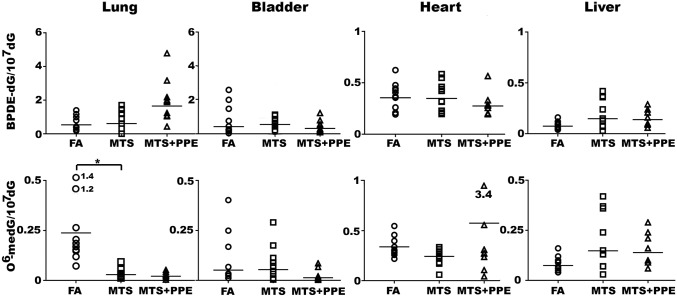
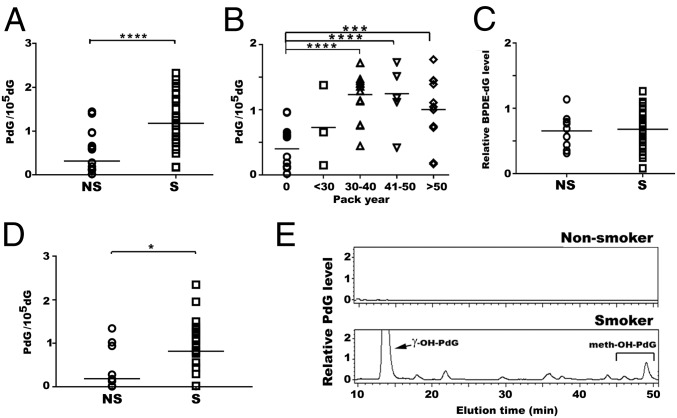
Tobacco smoke (TS) contains numerous cancer-causing agents, with polycyclic aromatic hydrocarbons (PAHs) and nitrosamines being most frequently cited as the major TS human cancer agents. Many lines of evidence seriously question this conclusion. To resolve this issue, we determined DNA adducts induced by the three major TS carcinogens: benzo()pyrene (BP), 4-(methylnitrosamine)-1-(3-pyridyl)-1-butanoe (NNK), and aldehydes in humans and mice. In mice, TS induces abundant aldehyde-induced γ-hydroxy-propano-deoxyguanosine (γ-OH-PdG) and α-methyl-γ-OH-PdG adducts in the lung and bladder, but not in the heart and liver. TS does not induce the BP- and NNK-DNA adducts in lung, heart, liver, and bladder. TS also reduces DNA repair activity and the abundance of repair proteins, XPC and OGG1/2, in lung tissues. These TS effects were greatly reduced by diet with polyphenols. We found that γ-OH-PdG and α-methyl-γ-OH-PdG are the major adducts formed in tobacco smokers' buccal cells as well as the normal lung tissues of tobacco-smoking lung cancer patients, but not in lung tissues of nonsmokers. However, the levels of BP- and NNK-DNA adducts are the same in lung tissues of smokers and nonsmokers. We found that while BP and NNK can induce BPDE-dG and -methyl-dG adducts in human lung and bladder epithelial cells, these inductions can be inhibited by acrolein. Acrolein also can reduce DNA repair activity and repair proteins. We propose a TS carcinogenesis paradigm. Aldehydes are major TS carcinogens exerting dominant effect: Aldehydes induce mutagenic PdG adducts, impair DNA repair functions, and inhibit many procarcinogens in TS from becoming DNA-damaging agents.
烟草烟雾(TS)含有许多致癌物质,其中多环芳烃(PAHs)和亚硝胺被认为是 TS 导致人类癌症的主要物质。许多证据严重质疑这一结论。为了解决这个问题,我们确定了三种主要的 TS 致癌物质:苯并()芘(BP)、4-(甲基亚硝胺)-1-(3-吡啶基)-1-丁酮(NNK)和醛,在人类和小鼠中诱导的 DNA 加合物。在小鼠中,TS 在肺部和膀胱中诱导大量的醛诱导的γ-羟基丙酰脱氧鸟苷(γ-OH-PdG)和α-甲基-γ-OH-PdG 加合物,但在心脏和肝脏中没有。TS 不会在肺部、心脏、肝脏和膀胱中诱导 BP 和 NNK-DNA 加合物。TS 还降低了肺组织中的 DNA 修复活性和修复蛋白 XPC 和 OGG1/2 的丰度。这些 TS 效应通过多酚饮食大大降低。我们发现,γ-OH-PdG 和α-甲基-γ-OH-PdG 是在烟草吸烟者的口腔细胞以及吸烟肺癌患者的正常肺部组织中形成的主要加合物,但在非吸烟者的肺部组织中没有。然而,BP 和 NNK-DNA 加合物的水平在吸烟者和非吸烟者的肺部组织中是相同的。我们发现,虽然 BP 和 NNK 可以诱导人肺和膀胱上皮细胞中的 BPDE-dG 和 -甲基-dG 加合物,但这些诱导可以被丙烯醛抑制。丙烯醛还可以降低 DNA 修复活性和修复蛋白。我们提出了一个 TS 致癌作用的范例。醛类是主要的 TS 致癌物质,发挥主导作用:醛类诱导致突变的 PdG 加合物,损害 DNA 修复功能,并抑制 TS 中的许多前致癌物质成为 DNA 损伤剂。