Department of Hematology, Qilu Hospital, Shandong University, Jinan, Shandong, China.
Institute of Hematology and Blood Diseases Hospital, Chinese Academy of Medical Sciences and Peking Union Medical College, Tianjin, China.
Blood Cancer J. 2018 Jun 15;8(7):61. doi: 10.1038/s41408-018-0093-4.
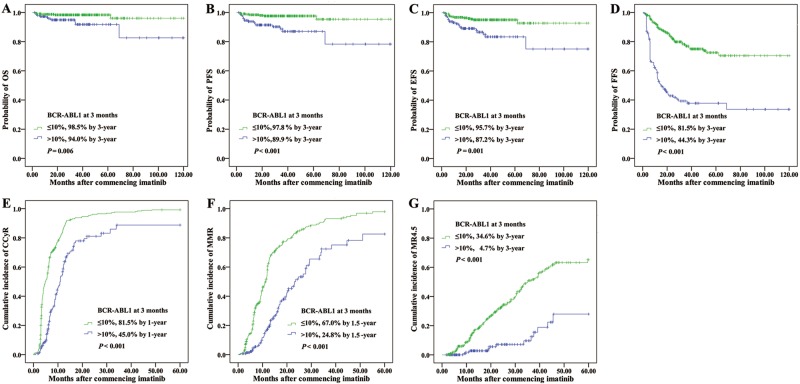
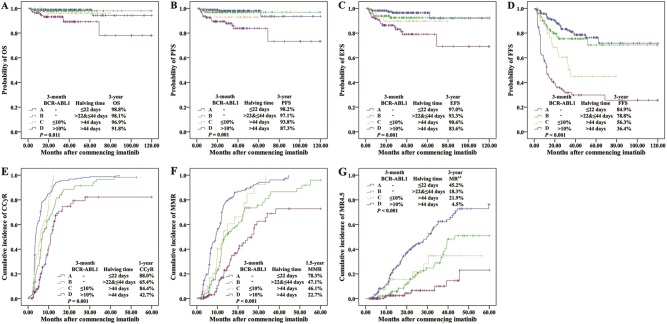
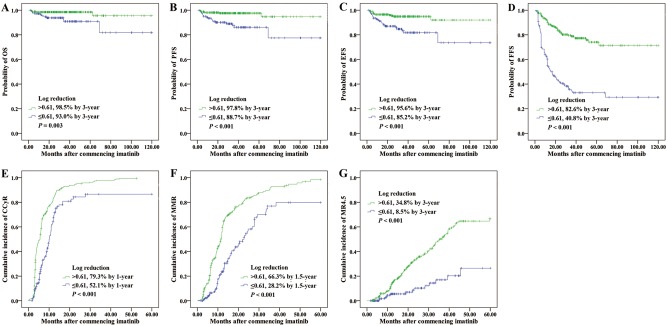
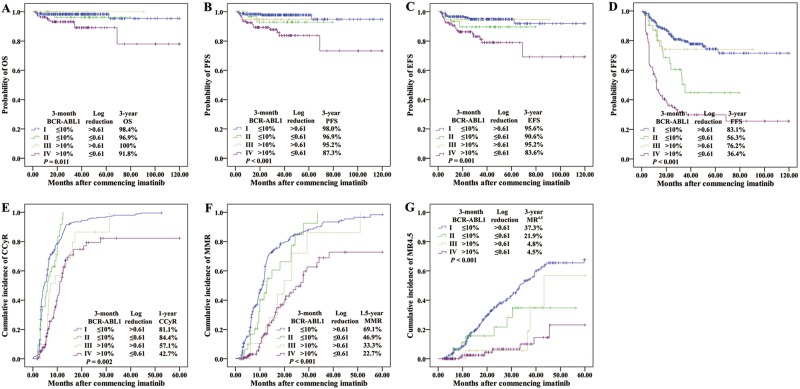
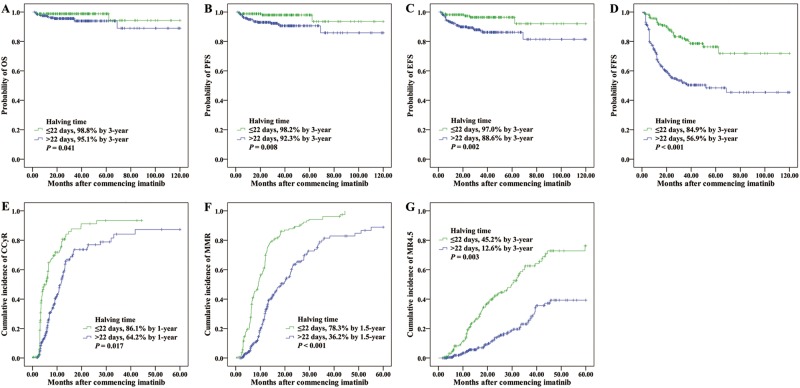
An early molecular response is spectacularly predictive of outcome in chronic myeloid leukemia (CML) and early response landmarks may identify the high-risk patients likely to be benefit from an early therapy switch. In this study, we evaluated the most relevant cutoffs for early molecular response markers (BCR-ABL1 values at 3 months, log reduction and halving time between diagnosis and 3 months) in 476 first-line imatinib-treated Chinese patients with chronic phase CML. All outcomes were significantly superior for the 324 patients with 3-month BCR-ABL1 ≤10%, so did for the 270 patients with BCR-ABL1 >0.61 log reduction. BCR-ABL1 halving time ≤22 days was identified for patients with the most favorable outcome. Moreover, the prognosis was significantly poorest for patients with both halving time >44 days and BCR-ABL1 >10%. Importantly, multivariate regression analysis demonstrated that a BCR-ABL1 log reduction calculated at 3 months of 0.61 was the only variable that significantly predicted for OS. Our results highlight the importance of rapid initial decline of BCR-ABL1 in predicting satisfactory outcome. Our data support the evidence that monitoring BCR-ABL1 values at an early time point could contribute to accurately assess response and ultimately guide clinical decisions regarding the timing of therapeutic intervention.
早期分子反应对慢性髓性白血病(CML)的预后具有显著的预测价值,早期反应标志物可能可以识别出那些可能从早期治疗转换中获益的高危患者。在这项研究中,我们评估了 476 例接受一线伊马替尼治疗的慢性期 CML 中国患者中早期分子反应标志物(3 个月时 BCR-ABL1 值、诊断至 3 个月时的对数减少和减半时间)的最相关截止值。所有结果对于 3 个月时 BCR-ABL1≤10%的 324 例患者均显著更优,对于 BCR-ABL1>0.61 对数减少的 270 例患者也如此。对于 BCR-ABL1 减半时间≤22 天的患者,其结果最佳。此外,对于减半时间>44 天和 BCR-ABL1>10%的患者,预后显著最差。重要的是,多变量回归分析表明,3 个月时 BCR-ABL1 的对数减少 0.61 是唯一显著预测 OS 的变量。我们的结果强调了快速初始 BCR-ABL1 下降在预测满意结果中的重要性。我们的数据支持这样的证据,即在早期时间点监测 BCR-ABL1 值有助于准确评估反应,并最终指导关于治疗干预时机的临床决策。