Department of Clinical and Experimental Medicine, University of Catania, 95123 Catania, Italy.
Center of Experimental Oncology and Hematology, A.O.U. Policlinico Vittorio Emanuele, 95123 Catania, Italy.
Int J Mol Sci. 2019 May 6;20(9):2226. doi: 10.3390/ijms20092226.
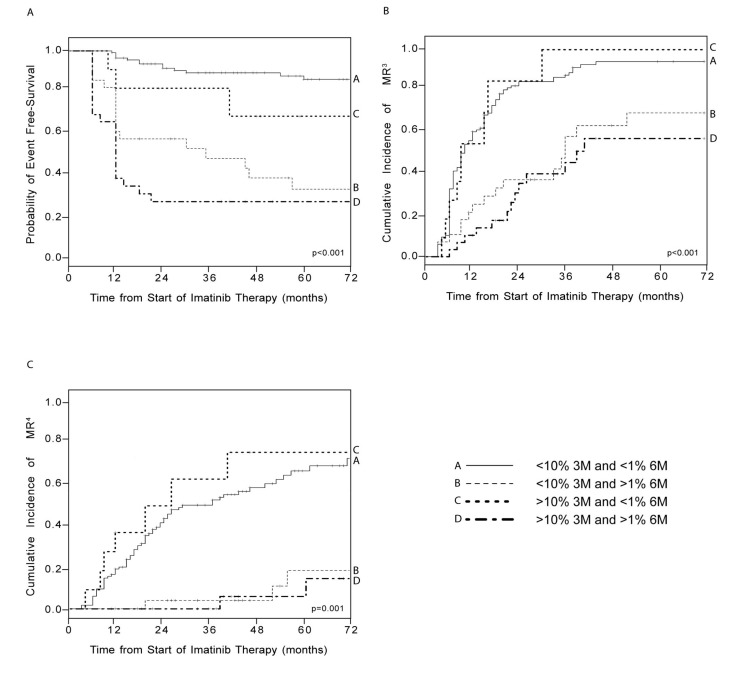
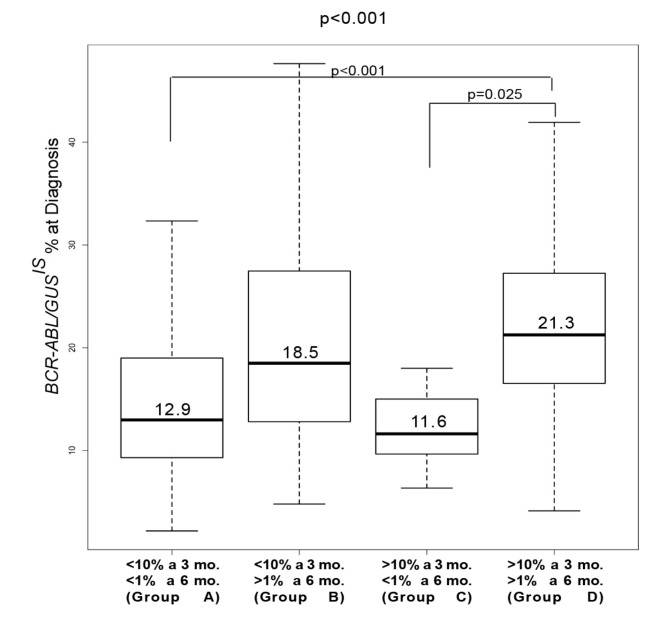
A reduction in transcript levels to <10% after 3 months or <1% after 6 months of tyrosine kinase inhibitor therapy are associated with superior clinical outcomes in chronic myeloid leukemia (CML) patients. In this study, we investigated the reliability of multiple thresholds in predicting treatment outcomes for 184 subjects diagnosed with CML and treated with standard-dose imatinib mesylate (IM). With a median follow-up of 61 months, patients with concordant transcripts below the defined thresholds (10% at 3 months and 1% at 6 months) displayed significantly superior rates of event-free survival (86.1% vs. 26.6%) and deep molecular response (≥ MR; 71.5% vs. 16.1%) compared to individuals with levels above these defined thresholds. We then analyzed the outcomes of subjects displaying discordant molecular transcripts at 3- and 6-month time points. Among these patients, those with values >10% at 3 months but <1% at 6 months fared significantly better than individuals with <10% at 3 months but >1% at 6 months (event-free survival 68.2% vs. 32.7%; < 0.001). Likewise, subjects with at 3 months >10% but <1% at 6 months showed a higher cumulative incidence of MR compared to patients with <10% at 3 months but >1% at 6 months (75% vs. 18.2%; < 0.001). Finally, lower transcripts at diagnosis were associated with values <1% at 6 months ( < 0.001). Our data suggest that when assessing early molecular responses to therapy, the 6-month level displays a superior prognostic value compared to the 3-month measurement in patients with discordant oncogenic transcripts at these two pivotal time points.
在慢性髓性白血病(CML)患者中,酪氨酸激酶抑制剂治疗 3 个月后转录水平降低至<10%或 6 个月后降低至<1%与更好的临床结局相关。在这项研究中,我们研究了多个阈值在预测 184 例接受标准剂量甲磺酸伊马替尼(IM)治疗的 CML 患者治疗结果的可靠性。中位随访 61 个月后,转录水平低于定义阈值(3 个月时<10%,6 个月时<1%)的患者无事件生存(EFS;86.1%对 26.6%)和深度分子反应(MR;71.5%对 16.1%)显著更高,与这些定义阈值以上的患者相比。然后,我们分析了在 3 个月和 6 个月时间点显示出不一致的分子转录物的患者的结果。在这些患者中,那些在 3 个月时>10%但在 6 个月时<1%的患者明显比那些在 3 个月时<10%但在 6 个月时>1%的患者更好(EFS:68.2%对 32.7%;<0.001)。同样,在 3 个月时转录水平>10%但在 6 个月时<1%的患者与在 3 个月时<10%但在 6 个月时>1%的患者相比,MR 的累积发生率更高(75%对 18.2%;<0.001)。最后,诊断时较低的转录水平与 6 个月时<1%的水平相关(<0.001)。我们的数据表明,在评估治疗的早期分子反应时,与在这两个关键时间点转录水平不一致的患者在 3 个月时的测量相比,6 个月时的水平显示出更好的预后价值。