Department of Gastroenterology, Zealand University Hospital, Lykkebækvej 1, DK-4600, Køge, Denmark.
Department of Clinical Medicine, University of Copenhagen, København, Denmark.
Clin Transl Gastroenterol. 2018 Jun 19;9(6):161. doi: 10.1038/s41424-018-0027-2.
A low prevalence of intestinal parasites has been identified in individuals with irritable bowel syndrome (IBS), but potential associations with alterations in the bacterial microbiome remain largely unexplored. We aimed to investigate the relationship between parasites and bacteria in individuals with IBS in order to identify potential trans-kingdom microbial characteristics.
Stool samples were collected from the Danish background population classified into IBS (n = 119), unspecific gastrointestinal (GI) symptoms (n = 114), and asymptomatic controls (n = 186) based on the Rome III criteria for IBS. Bacterial (16S) and eukaryotic (18S) ribosomal DNA was sequenced, and 18S data were merged with data from conventional parasite laboratory tests. The bacterial microbiome was analyzed according to symptom group and parasite colonization status.
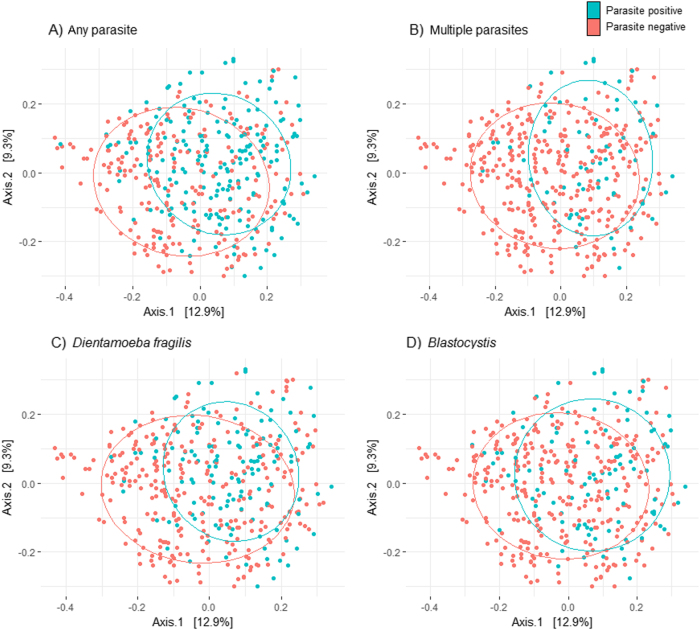
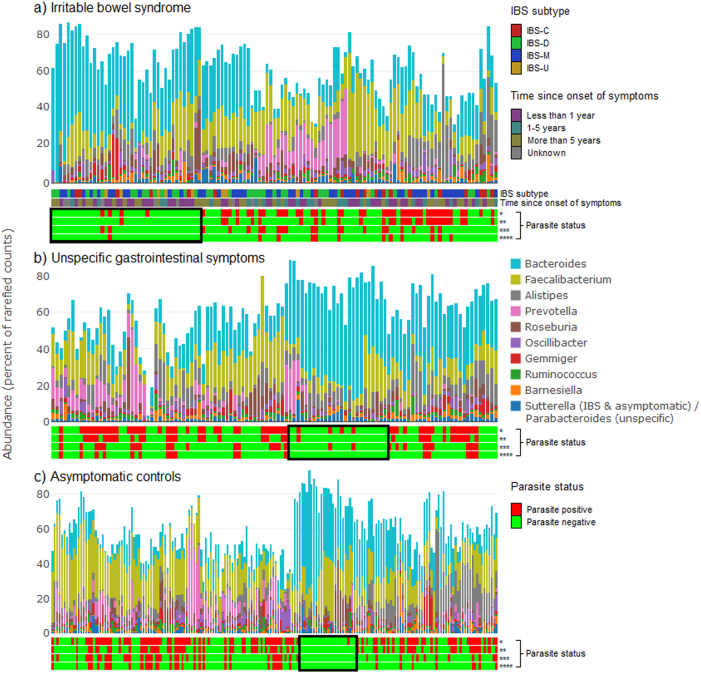
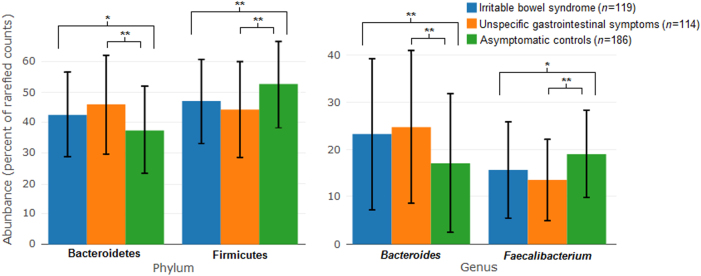
Bacterial richness and diversity were similar for IBS and controls but higher in those with unspecific GI symptoms. A higher abundance of Bacteroides and a lower abundance of Faecalibacterium were detected in individuals with IBS and unspecific GI symptoms compared with controls. Principal component analyses indicated differences in bacterial composition related to parasite colonization rather than symptom group. Parasites were detected at the lowest frequency in the IBS group (39%) and in samples dominated by Bacteroides. Higher bacterial richness and diversity were found in parasite-positive samples from controls and those with unspecific GI symptoms but not in individuals with IBS.
Parasite colonization, rather than bacterial composition, differed between individuals with IBS and healthy controls. Parasite colonization was associated to a rich and diverse bacterial microbiome; however, this association was altered in IBS.
在肠易激综合征(IBS)患者中发现肠道寄生虫的患病率较低,但与细菌微生物组改变的潜在关联在很大程度上仍未得到探索。我们旨在研究 IBS 患者中寄生虫和细菌之间的关系,以确定潜在的跨微生物特征。
根据罗马 III 标准将丹麦背景人群分为 IBS(n=119)、非特异性胃肠道(GI)症状(n=114)和无症状对照(n=186),收集粪便样本。对细菌(16S)和真核生物(18S)核糖体 DNA 进行测序,并将 18S 数据与常规寄生虫实验室检测数据合并。根据症状组和寄生虫定植状态分析细菌微生物组。
IBS 和对照组的细菌丰富度和多样性相似,但非特异性 GI 症状患者的细菌丰富度和多样性更高。与对照组相比,IBS 和非特异性 GI 症状患者的拟杆菌属丰度较高,而粪杆菌属丰度较低。主成分分析表明,与寄生虫定植相关的细菌组成差异大于症状组。寄生虫在 IBS 组(39%)和以拟杆菌属为主的样本中检测到的频率最低。在对照组和非特异性 GI 症状患者的寄生虫阳性样本中发现了更高的细菌丰富度和多样性,但在 IBS 患者中则没有。
与健康对照相比,IBS 患者的寄生虫定植而不是细菌组成存在差异。寄生虫定植与丰富多样的细菌微生物组相关;然而,这种关联在 IBS 中发生了改变。