Shintai Kazunori, Matsubara Noriaki, Izumi Takashi
Department of Neurosurgery, Nagoya University Graduate School of Medicine, Nagoya, Japan.
Department of Neurosurgery, Nagoya Daini Red Cross Hospital, Nagoya, Japan.
Nagoya J Med Sci. 2018 May;80(2):279-284. doi: 10.18999/nagjms.80.2.279.
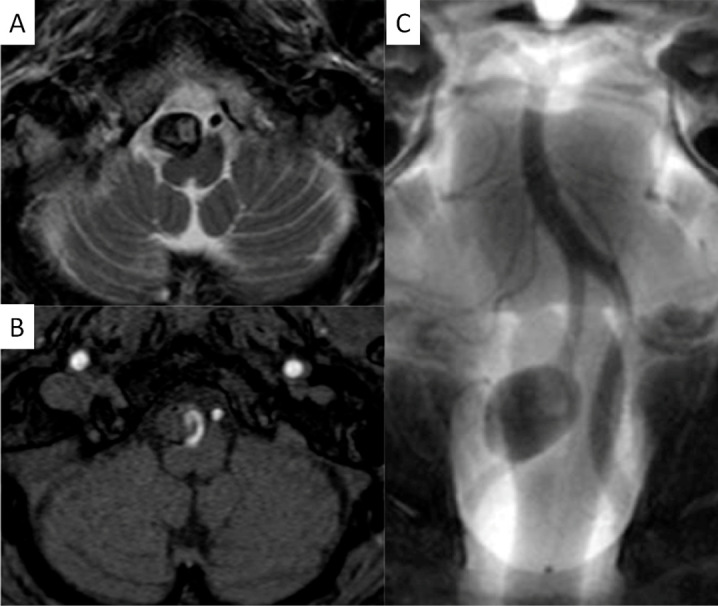
The authors present a 60-year-old man with a partially thrombosed, intracranial vertebral artery aneurysm. A vascular channel in intra-aneurysmal thrombus was effectively identified with high-resolution cone beam CT (DynaCT Micro: Siemens Medical Solutions, Erlangen, Germany). Pre-procedural vertebral angiogram implied a perforating artery arising from near neck of the aneurysm and DynaCT Micro performed before approaching to the lesion demonstrated a vascular channel running in intra-aneurysmal thrombus which could not be distinguished from perforators with other imaging modalities. It was confirmed that perforators around the aneurysm were not identified and safely treated the aneurysm with stent-assisted coil embolization. High-resolution cone beam CT is enable to sharply visualize vessel lumens, thrombus, and intra-thrombus structures, and is useful to identify a vascular channel in intracranial partially thrombosed aneurysm.
作者报告了一名60岁男性,患有部分血栓形成的颅内椎动脉动脉瘤。通过高分辨率锥形束CT(DynaCT Micro:西门子医疗解决方案公司,德国埃尔朗根)有效地识别了动脉瘤内血栓中的血管通道。术前椎动脉血管造影显示有一条穿支动脉起源于动脉瘤颈部附近,在接近病变前进行的DynaCT Micro显示在动脉瘤内血栓中有一条血管通道,这是其他成像方式无法与穿支动脉区分开来的。证实未识别出动脉瘤周围的穿支动脉,并采用支架辅助弹簧圈栓塞术安全地治疗了该动脉瘤。高分辨率锥形束CT能够清晰地显示血管腔、血栓和血栓内结构,有助于识别颅内部分血栓形成的动脉瘤中的血管通道。