Lanoue Jason, Leonardos Evangelos D, Grodzinski Bernard
Department of Plant Agriculture, University of Guelph, Guelph, ON, Canada.
Harrow Research and Development Centre, Agriculture and Agri-Food Canada, Harrow, ON, Canada.
Front Plant Sci. 2018 Jun 4;9:756. doi: 10.3389/fpls.2018.00756. eCollection 2018.
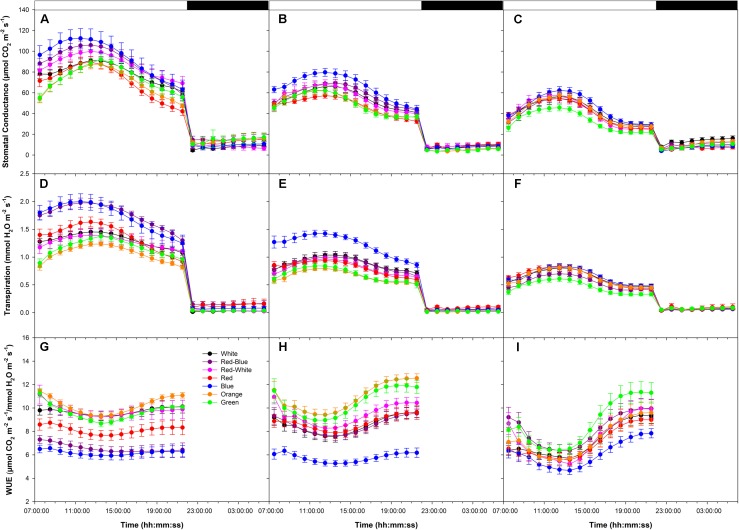
Translocation of assimilates is a fundamental process involving carbon and water balance affecting source/sink relationships. Diurnal patterns of CO exchange, translocation (carbon export), and transpiration of an intact tomato source leaf were determined during CO steady-state labeling under different wavelengths at three pre-set photosynthetic rates. Daily patterns showed that photosynthesis and export were supported by all wavelengths of light tested including orange and green. Export in the light, under all wavelengths was always higher than that at night. Export in the light varied from 65-83% of the total daily carbon fixed, depending on light intensity. Photosynthesis and export were highly correlated under all wavelengths ( = 0.90-0.96). Export as a percentage of photosynthesis (relative export) decreased as photosynthesis increased by increasing light intensity under all wavelengths. These data indicate an upper limit for export under all spectral conditions. Interestingly, only at the medium photosynthetic rate, relative export under the blue and the orange light-emitting diodes (LEDs) were higher than under white and red-white LEDs. Stomatal conductance, transpiration rates, and water-use-efficiency showed similar daily patterns under all wavelengths. Illuminating tomato leaves with different spectral quality resulted in similar carbon export rates, but stomatal conductance and transpiration rates varied due to wavelength specific control of stomatal function. Thus, we caution that the link between transpiration and C-export may be more complex than previously thought. In summary, these data indicate that orange and green LEDs, not simply the traditionally used red and blue LEDs, should be considered and tested when designing lighting systems for optimizing source leaf strength during plant production in controlled environment systems. In addition, knowledge related to the interplay between water and C-movement within a plant and how they are affected by environmental stimuli, is needed to develop a better understanding of source/sink relationships.
同化物的转运是一个涉及碳和水平衡、影响源/库关系的基本过程。在三种预设光合速率下,于不同波长的CO₂稳态标记期间,测定了完整番茄源叶的CO₂交换、转运(碳输出)和蒸腾作用的日变化模式。日变化模式表明,包括橙色和绿色在内的所有测试光波长都能支持光合作用和碳输出。在所有波长下,白天的碳输出总是高于夜间。根据光照强度,白天的碳输出量占每日固定碳总量的65%-83%。在所有波长下,光合作用和碳输出都高度相关(r = 0.90-0.96)。在所有波长下,随着光照强度增加导致光合作用增强,碳输出占光合作用的百分比(相对输出)下降。这些数据表明在所有光谱条件下碳输出都存在上限。有趣的是,仅在中等光合速率下,蓝色和橙色发光二极管(LED)下的相对输出高于白色和红白色LED下的相对输出。在所有波长下,气孔导度、蒸腾速率和水分利用效率呈现相似的日变化模式。用不同光谱质量的光照射番茄叶片会导致相似的碳输出速率,但由于气孔功能的波长特异性控制,气孔导度和蒸腾速率会有所不同。因此,我们提醒,蒸腾作用与碳输出之间的联系可能比之前认为的更为复杂。总之,这些数据表明,在为可控环境系统中的植物生产设计照明系统以优化源叶强度时,应考虑并测试橙色和绿色LED,而不仅仅是传统使用的红色和蓝色LED。此外,需要了解植物体内水和碳移动之间的相互作用以及它们如何受到环境刺激的影响,以便更好地理解源/库关系。