Kasalak Ömer, Adams Hugo J A, Jutte Paul C, Overbosch Jelle, Dierckx Rudi A J O, Wouthuyzen-Bakker Marjan, Kwee Thomas C
Department of Radiology, Nuclear Medicine and Molecular Imaging, University Medical Center Groningen, University of Groningen, Groningen, The Netherlands.
Department of Radiology and Nuclear Imaging, Deventer Hospital, Deventer, The Netherlands.
Skeletal Radiol. 2018 Oct;47(10):1327-1335. doi: 10.1007/s00256-018-3006-5. Epub 2018 Jun 18.
To systematically review the published data on the culture yield of a repeat (second) percutaneous image-guided biopsy after negative initial biopsy in suspected spondylodiscitis.
A systematic search was performed of the PubMed/Medline and Embase databases. The methodological quality of the studies included was assessed. The proportions of positive cultures among all initial biopsies and second biopsies (after a negative initial biopsy) were calculated for each study and assessed for heterogeneity (defined as I > 50%).
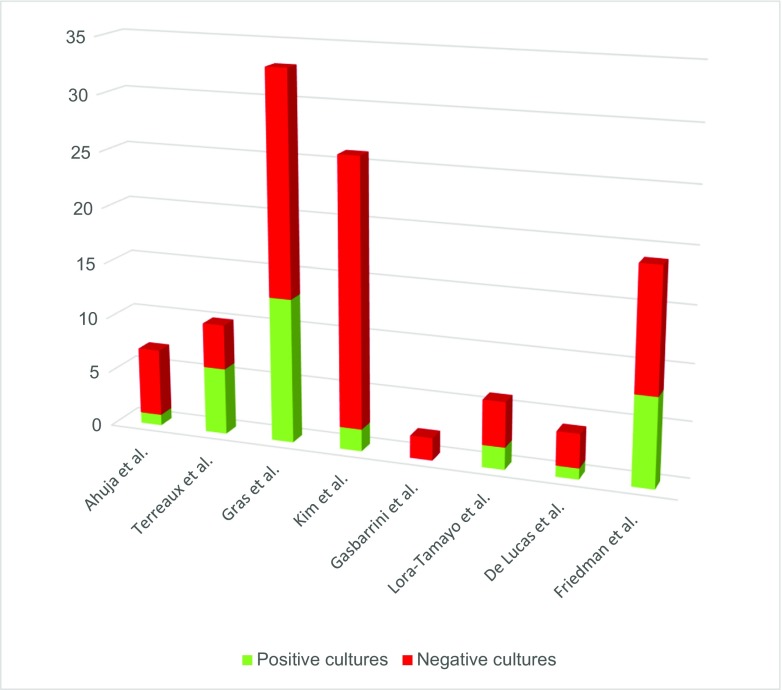
Eight studies, comprising a total of 107 patients who underwent a second percutaneous image-guided biopsy after a culture-negative initial biopsy in suspected spondylodiscitis, were included. All eight studies were at risk of bias and were concerning with regard to applicability, particularly patient selection, flow of patients through the study, and timing of the biopsy. The proportions of positive cultures among all initial biopsies ranged from 10.3 to 52.5%, and were subject to heterogeneity (I = 73.7%). The proportions of positive cultures among all second biopsies after negative initial biopsy ranged from 0 to 60.0%, and were not subject to heterogeneity (I = 38.7%).
Although a second percutaneous image-guided biopsy may have some value in patients with suspected spondylodiscitis, its exact value remains unclear, given the available poor-quality evidence. Future well-designed studies are needed to determine the role of a second percutaneous image-guided biopsy in this setting. Such studies should clearly describe the spectrum of patients that was selected for a second percutaneous image-guided biopsy, the method of biopsy, and differences compared with the first biopsy, if any.
系统回顾疑似脊椎骨髓炎初次活检结果为阴性后,重复(第二次)经皮影像引导活检的培养结果的已发表数据。
对PubMed/Medline和Embase数据库进行系统检索。评估纳入研究的方法学质量。计算每项研究中所有初次活检和第二次活检(初次活检为阴性后)的阳性培养比例,并评估异质性(定义为I>50%)。
纳入八项研究,共107例疑似脊椎骨髓炎患者在初次活检培养结果为阴性后接受了第二次经皮影像引导活检。所有八项研究均存在偏倚风险,在适用性方面存在问题,尤其是患者选择、患者在研究中的流程以及活检时间。所有初次活检的阳性培养比例在10.3%至52.5%之间,存在异质性(I=73.7%)。初次活检为阴性后所有第二次活检的阳性培养比例在0至60.0%之间,不存在异质性(I=38.7%)。
尽管第二次经皮影像引导活检对疑似脊椎骨髓炎患者可能有一定价值,但鉴于现有证据质量较差,其确切价值仍不明确。未来需要设计良好的研究来确定第二次经皮影像引导活检在此情况下的作用。此类研究应明确描述选择进行第二次经皮影像引导活检的患者范围、活检方法以及与第一次活检相比的差异(如有)。