Department of Psychiatry and Behavioral Neuroscience (AV, AK, RL, HdW), University of Chicago, Chicago, Illinois.
Alcohol Clin Exp Res. 2018 Sep;42(9):1725-1734. doi: 10.1111/acer.13814. Epub 2018 Jul 5.
Preclinical and clinical evidence suggest that the neuropeptide oxytocin may be of value in treating alcohol use disorder, by either reducing the rewarding effects of alcohol or reducing negative affect induced by alcohol withdrawal. However, the effect of a single dose of oxytocin on subjective and psychomotor responses to alcohol in social drinkers is not known.
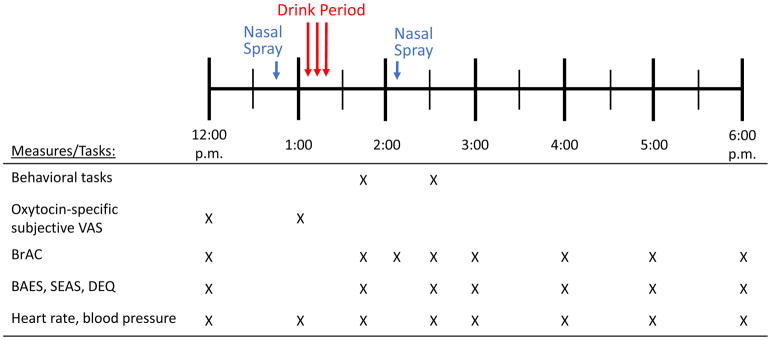
This study examined the effect of intranasal oxytocin on subjective, behavioral, and physiological responses to a moderate dose of alcohol (0.8 g/kg) in young adult social drinkers. Participants (N = 35) completed 2 study sessions at which they consumed beverages containing alcohol (ALC; N = 20) or placebo (NoALC; N = 15) in combination with intranasal oxytocin (40 IU with a 20 IU booster) or placebo. They received oxytocin at one session and placebo at the other session (order counterbalanced) 20 minutes before consuming beverages. Subjective mood and drug effects ratings, heart rate and blood pressure, and 4 behavioral tasks (flanker task, digit span, go/no-go, and pursuit rotor) were the primary outcome measures.
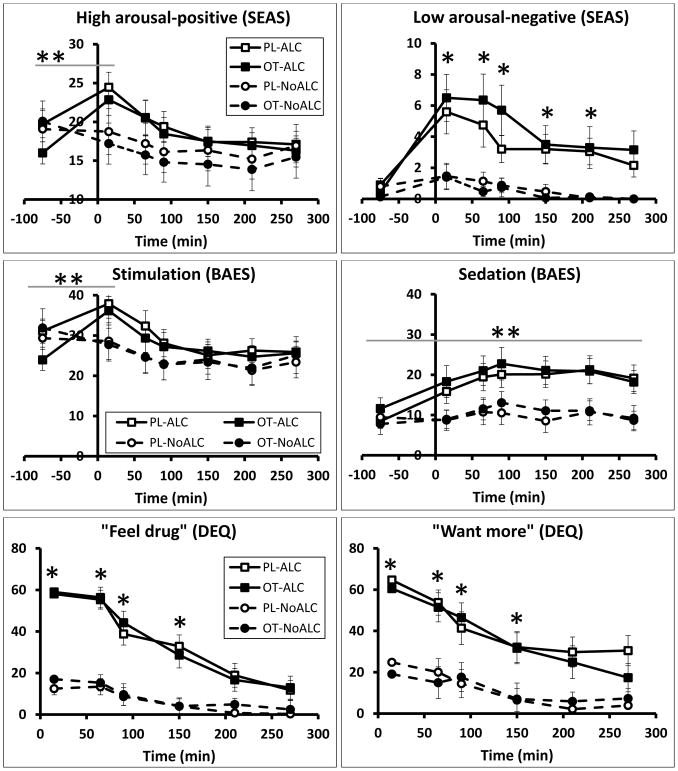
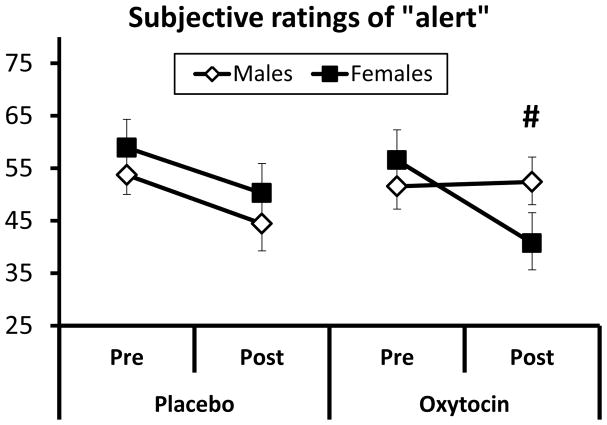
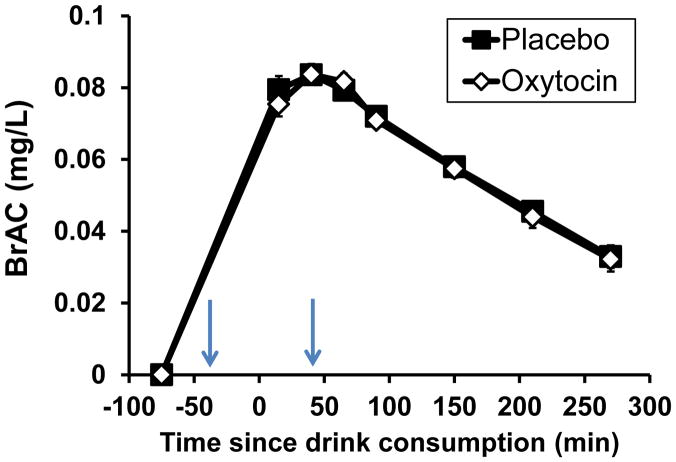
ALC produced its expected subjective and behavioral effects; including feeling intoxicated and impaired performance on the digit span and go/no-go tasks. Oxytocin alone had no significant subjective or physiological effects, and it did not affect responses to alcohol on any measure.
We can conclude that, under these conditions, a single dose of intranasal oxytocin does not alter the effects of acute alcohol in healthy young adult social drinkers. Further research is needed to determine whether oxytocin alters responses to alcohol under different conditions, and to determine its potential as an aid in treatment for substance use disorders.
临床前和临床证据表明,神经肽催产素可能通过减少酒精的奖赏作用或减少酒精戒断引起的负性情绪,从而对治疗酒精使用障碍有价值。然而,单次给予催产素对社交饮酒者对酒精的主观和精神运动反应的影响尚不清楚。
本研究在年轻成年社交饮酒者中检验了鼻内催产素对中剂量酒精(0.8 g/kg)的主观、行为和生理反应的影响。参与者(N=35)在 2 次研究会议中完成了测试,他们在这些会议中饮用含有酒精(ALC;N=20)或安慰剂(NoALC;N=15)的饮料,并同时接受鼻内催产素(40 IU,20 IU 增强剂)或安慰剂。在饮用饮料前 20 分钟,他们接受了催产素(oxytocin)或安慰剂的治疗,治疗顺序(counterbalanced)。主要的测量指标是主观情绪和药物效应评分、心率和血压,以及 4 项行为任务(侧抑制任务、数字跨度、go/no-go 任务和追踪旋转器任务)。
ALC 产生了预期的主观和行为效果;包括醉酒感和数字跨度和 go/no-go 任务的表现受损。单独使用催产素没有显著的主观或生理效应,也没有影响任何测量指标对酒精的反应。
我们可以得出结论,在这些条件下,单次鼻内给予催产素不会改变健康年轻成年社交饮酒者急性酒精的作用。需要进一步研究以确定催产素是否在不同条件下改变对酒精的反应,以及确定其作为物质使用障碍治疗辅助手段的潜力。