Wang Shengjie, Zeng Junjie, Xiao Rui, Xu Guoxing, Liu Gang, Xiong Disheng, Ye Yongzhi, Chen Borong, Wang Haibin, Luo Qi, Huang Zhengjie
Department of Gastrointestinal Surgery, Xiamen Cancer Hospital, The First Affiliated Hospital of Xiamen University, Xiamen, People's Republic of China.
Department of Gastrointestinal Surgery, First Clinical Medical College of Fujian Medical University, Fuzhou, People's Republic of China.
Cancer Manag Res. 2018 Jun 8;10:1471-1478. doi: 10.2147/CMAR.S165497. eCollection 2018.
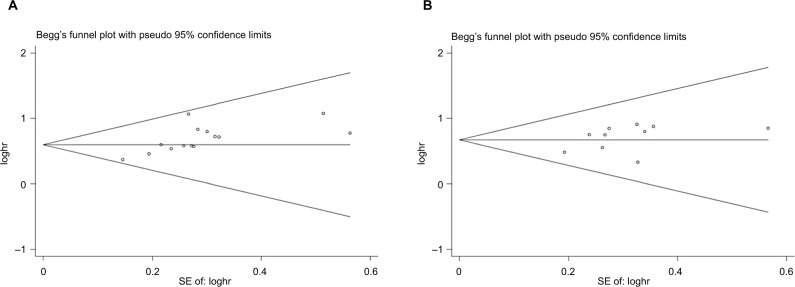
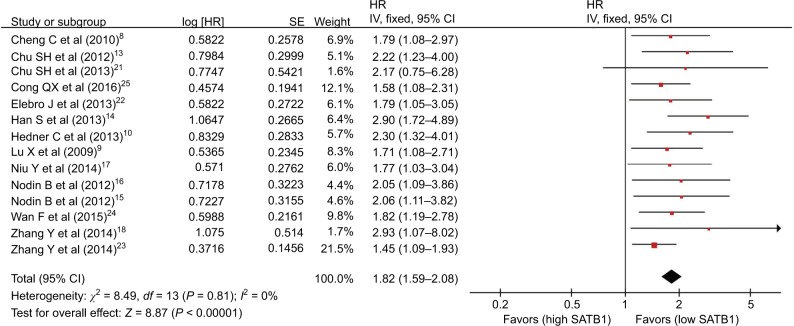
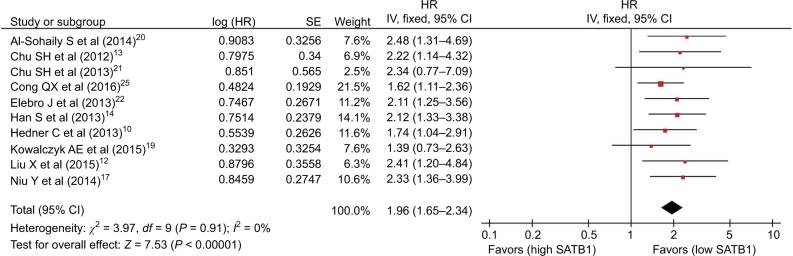
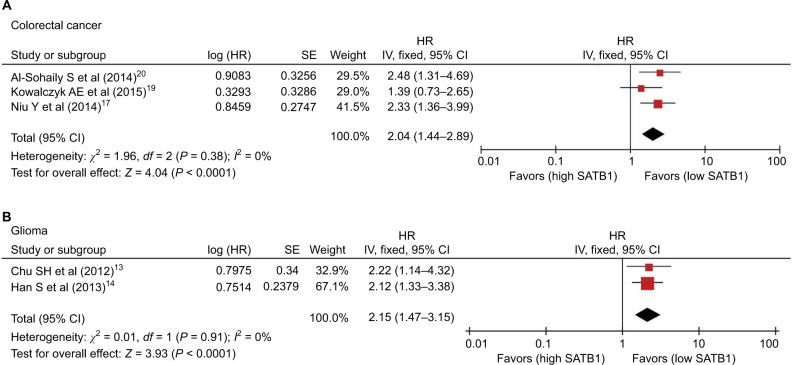
Several previous studies have reported the prognostic value of special -rich sequence-binding protein 1 (SATB1) in solid tumors. However, these studies produced inconsistent results because of their various limitations, including small sample sizes. Here, we describe a meta-analysis based on 17 studies including 3144 patients to search for connections between SATB1 overexpression and overall survival (OS) of patients with solid tumors. Seventeen studies (n = 3144) were assessed in the meta-analysis. Both univariate and multivariate analysis for survival indicated that high SATB1 reactivity significantly predicted poor prognosis. In the multivariate analysis, the combined hazard ratio (HR) for OS was 1.82 (95% confidence interval [CI]: 1.59-2.08, < 0.0001). The pooled HR of the univariate analysis for OS was 1.96 (95% CI: 1.65-2.34, < 0.0001).
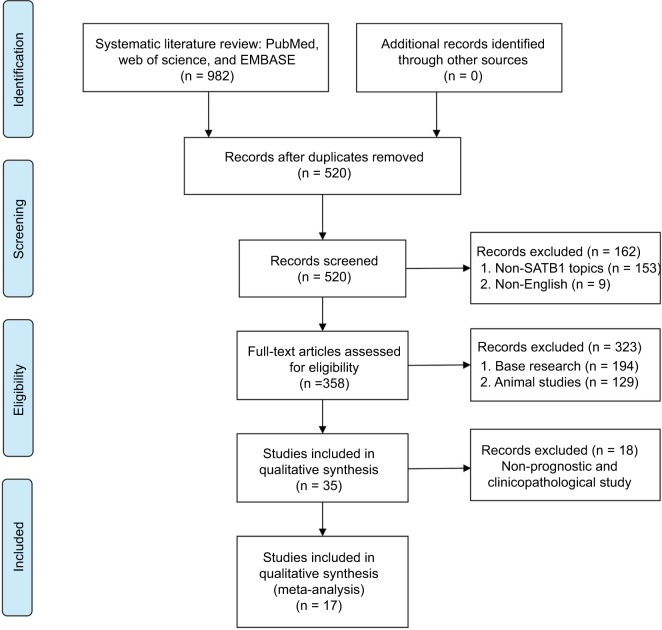
Studies were identified by an electronic search of PubMed, EMBASE, and Web of Science, including publications prior to April 2017. Pooled HR values for OS were aggregated and quantitatively analyzed in the meta-analysis.
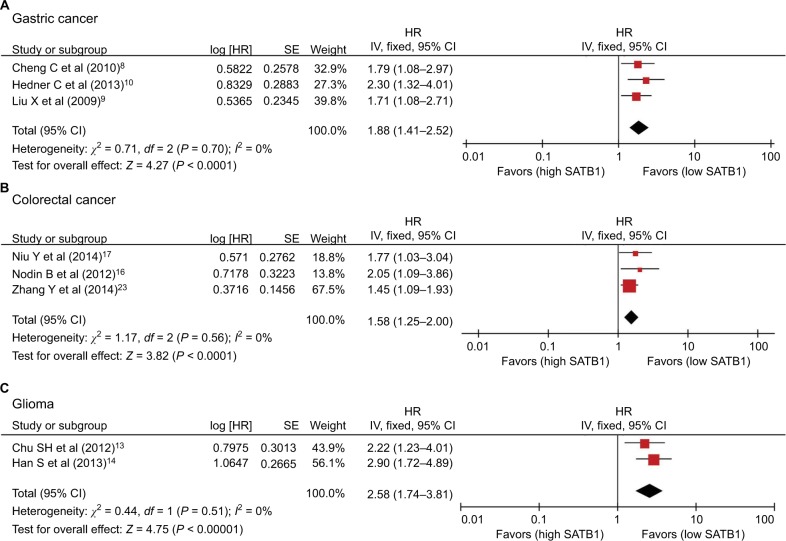
The meta-analysis indicated that high SATB1 reactivity is significantly correlated with decreased survival in most cases of solid tumors. In addition, SATB1 shows promise as a prognostic biomarker and novel therapeutic target on the basis of its expression level in solid tumors.
此前已有多项研究报道了富含特殊序列结合蛋白1(SATB1)在实体瘤中的预后价值。然而,由于样本量小等各种局限性,这些研究结果并不一致。在此,我们基于17项研究(共3144例患者)进行荟萃分析,以探寻SATB1过表达与实体瘤患者总生存期(OS)之间的关联。在这项荟萃分析中评估了17项研究(n = 3144)。生存的单因素和多因素分析均表明,高SATB1反应性显著预示着预后不良。在多因素分析中,OS的合并风险比(HR)为1.82(95%置信区间[CI]:1.59 - 2.08,P < 0.0001)。OS单因素分析的合并HR为1.96(95%CI:1.65 - 2.34,P < 0.0001)。
通过对PubMed、EMBASE和Web of Science进行电子检索来识别研究,包括2017年4月之前发表的文献。在荟萃分析中汇总并定量分析OS的合并HR值。
荟萃分析表明,在大多数实体瘤病例中,高SATB1反应性与生存率降低显著相关。此外,基于SATB1在实体瘤中的表达水平,它有望成为一种预后生物标志物和新型治疗靶点。