Hinton Pamela S, Ortinau Laura C, Dirkes Rebecca K, Shaw Emily L, Richard Matthew W, Zidon Terese Z, Britton Steven L, Koch Lauren G, Vieira-Potter Victoria J
Department of Nutrition and Exercise Physiology, University of Missouri, Columbia, MO, USA.
Department of Anesthesiology, University of Michigan Medical School, Ann Arbor, MI, USA.
Bone Rep. 2018 May 18;8:244-254. doi: 10.1016/j.bonr.2018.05.002. eCollection 2018 Jun.
Osteoporosis and related fractures, decreased physical activity, and metabolic dysfunction are serious health concerns for postmenopausal women. Soy protein might counter the negative effects of menopause on bone and metabolic health due to the additive or synergistic effects of its bioactive components.
To evaluate the effects of ovariectomy (OVX) and a soy-protein diet (SOY) on bone outcomes in female, low-capacity running (LCR) rats selectively bred for low aerobic fitness as a model of menopause.
At 27 weeks of age, LCR rats (N = 40) underwent OVX or sham (SHAM) surgery and were randomized to one of two isocaloric and isonitrogenous plant-protein-based dietary treatments: 1) soy-protein (SOY; soybean meal); or, 2) control (CON, corn-gluten meal), resulting in four treatment groups. During the 30-week dietary intervention, animals were provided ad libitum access to food and water; body weight and food intake were measured weekly. At completion of the 30-week intervention, body composition was measured using EchoMRI; animals were fasted overnight, euthanized, and blood and hindlimbs collected. Plasma markers of bone formation (osteocalcin, OC; N-terminal propeptide of type I procollagen, P1NP) and resorption (tartrate-resistant acid phosphatase, TRAP5b; C-terminal telopeptide of type I collagen, CTx) were measured using ELISA. Tibial trabecular microarchitecture and cortical geometry were evaluated using μCT; and torsional loading to failure was used to assess cortical biomechanical properties. Advanced glycation end-product (AGE) content of the femur was measured using a fluorimetric assay, and was expressed relative to collagen content measured by a colorimetric OH-proline assay. Two-factor ANOVA or ANOVCA was used to test for significant main and interactive effects of ovarian status (OV STAT: OVX vs. SHAM) and DIET (SOY vs. CON); final body weight was included as a covariate for body-weight-dependent cortical geometry and biomechanical properties.
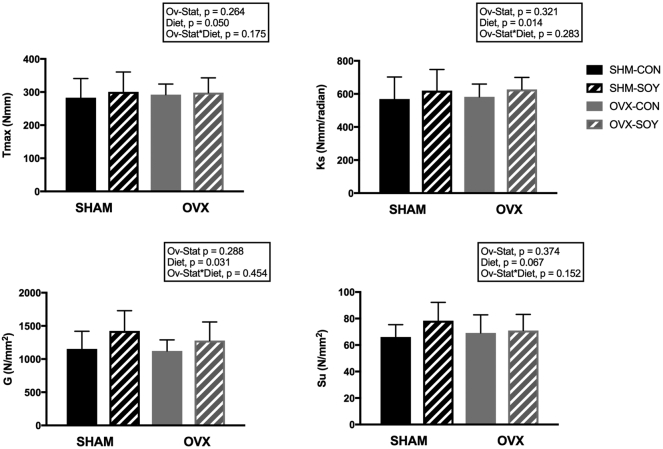
OVX had significantly greater CTx than SHAM; SOY did not affect bone turnover markers. OVX adversely affected trabecular microarchitecture as evidenced by reduced BV/TV, trabecular thickness (Tb.Th), trabecular number (Tb.N), and connectivity density (Conn.D), and by increased trabecular separation (Tb.Sp) and structural model index (SMI). SOY increased BV/TV only in ovary-intact animals. There was no effect of OVX or SOY on tibial cortical geometry. In SHAM and OVX rats, SOY significantly improved whole-bone strength and stiffness; SOY also increased tissue-level stiffness and tended to increase tissue-level strength (p = 0.067). There was no effect of OVX or SOY on AGE content.
Soy protein improved cortical bone biomechanical properties in female low-fit rats, regardless of ovarian hormone status.
骨质疏松症及相关骨折、身体活动减少和代谢功能障碍是绝经后女性严重的健康问题。大豆蛋白因其生物活性成分的相加或协同作用,可能会对抗绝经对骨骼和代谢健康的负面影响。
以低有氧适能的选择性繁殖雌性低容量跑步(LCR)大鼠作为绝经模型,评估卵巢切除术(OVX)和大豆蛋白饮食(SOY)对骨骼结局的影响。
27周龄时,LCR大鼠(N = 40)接受OVX或假手术(SHAM),并随机分为两种等热量、等氮的植物蛋白饮食处理之一:1)大豆蛋白(SOY;豆粕);或2)对照(CON,玉米蛋白粉),从而形成四个处理组。在30周的饮食干预期间,动物可自由获取食物和水;每周测量体重和食物摄入量。在30周干预结束时,使用EchoMRI测量身体组成;动物禁食过夜,安乐死,并采集血液和后肢。使用酶联免疫吸附测定法(ELISA)测量骨形成(骨钙素,OC;I型前胶原N端前肽,P1NP)和吸收(抗酒石酸酸性磷酸酶,TRAP5b;I型胶原C端末肽,CTx)的血浆标志物。使用显微计算机断层扫描(μCT)评估胫骨小梁微结构和皮质几何形态;并使用扭转加载至破坏来评估皮质生物力学性能。使用荧光测定法测量股骨晚期糖基化终产物(AGE)含量,并相对于通过比色法羟脯氨酸测定法测量的胶原含量表示。使用双因素方差分析或协方差分析(ANOVCA)来检验卵巢状态(OV STAT:OVX与SHAM)和饮食(SOY与CON)的显著主要和交互作用;最终体重作为体重依赖性皮质几何形态和生物力学性能的协变量纳入分析。
OVX组的CTx显著高于SHAM组;SOY对骨转换标志物无影响。OVX对小梁微结构产生不利影响,表现为骨体积分数(BV/TV)、小梁厚度(Tb.Th)、小梁数量(Tb.N)和连接密度(Conn.D)降低,小梁间距(Tb.Sp)和结构模型指数(SMI)增加。SOY仅在卵巢完整的动物中增加了BV/TV。OVX或SOY对胫骨皮质几何形态无影响。在SHAM和OVX大鼠中,SOY显著改善了全骨强度和刚度;SOY还增加了组织水平的刚度,并倾向于增加组织水平的强度(p = 0.067)。OVX或SOY对AGE含量无影响。
无论卵巢激素状态如何,大豆蛋白均可改善低适能雌性大鼠的皮质骨生物力学性能。