Department of Chemistry, Massachusetts Institute of Technology, Cambridge, Massachusetts 02139, USA; email:
Annu Rev Biochem. 2018 Jun 20;87:621-643. doi: 10.1146/annurev-biochem-062917-012312.
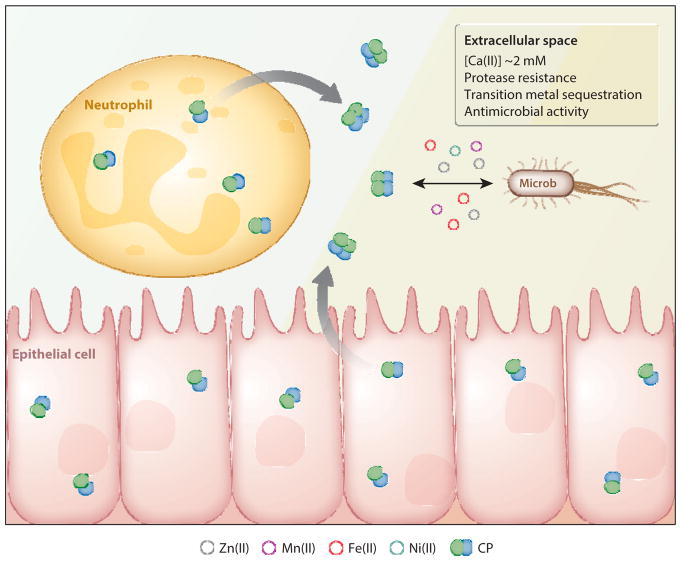
In response to microbial infection, the human host deploys metal-sequestering host-defense proteins, which reduce nutrient availability and thereby inhibit microbial growth and virulence. Calprotectin (CP) is an abundant antimicrobial protein released from neutrophils and epithelial cells at sites of infection. CP sequesters divalent first-row transition metal ions to limit the availability of essential metal nutrients in the extracellular space. While functional and clinical studies of CP have been pursued for decades, advances in our understanding of its biological coordination chemistry, which is central to its role in the host-microbe interaction, have been made in more recent years. In this review, we focus on the coordination chemistry of CP and highlight studies of its metal-binding properties and contributions to the metal-withholding innate immune response. Taken together, these recent studies inform our current model of how CP participates in metal homeostasis and immunity, and they provide a foundation for further investigations of a remarkable metal-chelating protein at the host-microbe interface and beyond.
针对微生物感染,人体宿主会部署金属螯合宿主防御蛋白,这些蛋白会降低营养物质的可用性,从而抑制微生物的生长和毒力。钙卫蛋白(CP)是一种丰富的抗菌蛋白,从感染部位的中性粒细胞和上皮细胞中释放出来。CP 螯合二价第一过渡金属离子,以限制细胞外空间中必需金属营养物质的可用性。尽管数十年来一直在对 CP 的功能和临床研究进行研究,但近年来对其生物学协调化学的理解取得了进展,而这对其在宿主-微生物相互作用中的作用至关重要。在这篇综述中,我们重点介绍 CP 的配位化学,并强调其金属结合特性及其对保留金属先天免疫反应的贡献的研究。总的来说,这些最近的研究为我们目前的 CP 参与金属动态平衡和免疫的模型提供了信息,并为进一步研究宿主-微生物界面以及其他方面的这种出色的金属螯合蛋白提供了基础。