Institute for Biomedical Materials & Devices (IBMD), Faculty of Science, University of Technology Sydney, Sydney, NSW, 2007, Australia.
Department of Chemistry, National University of Singapore, 3 Science Drive 3, Singapore, 117543, Singapore.
Nat Commun. 2018 Jun 20;9(1):2415. doi: 10.1038/s41467-018-04813-5.
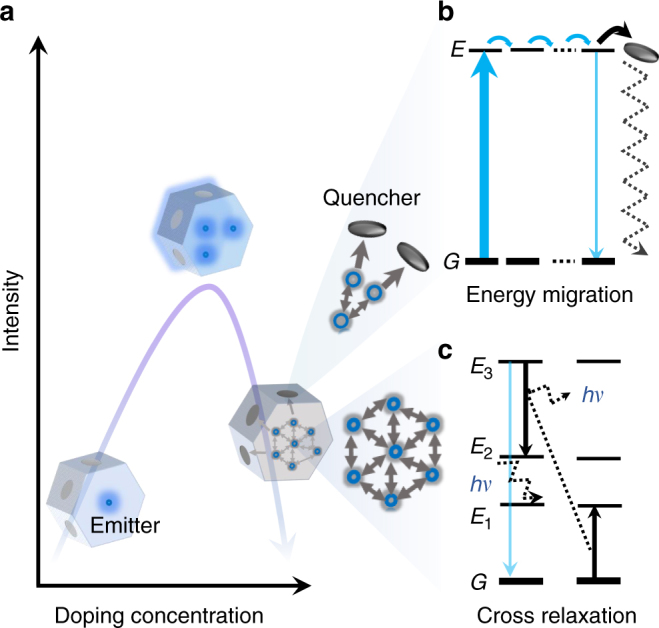
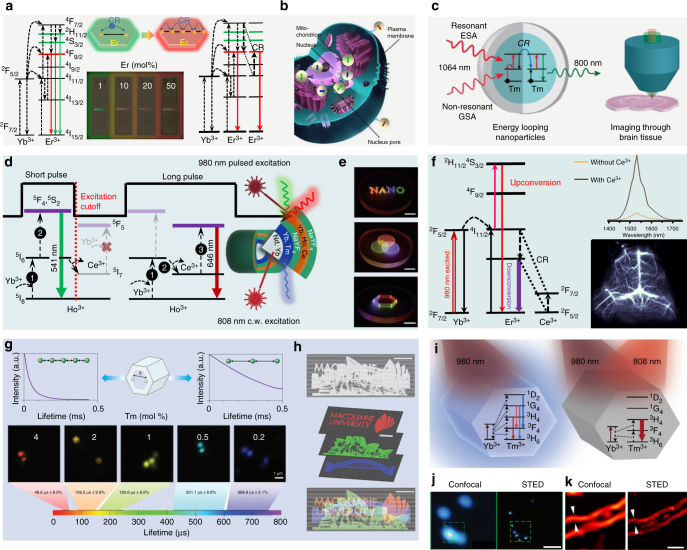
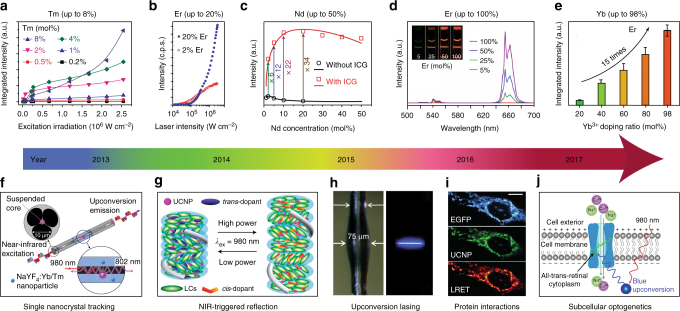
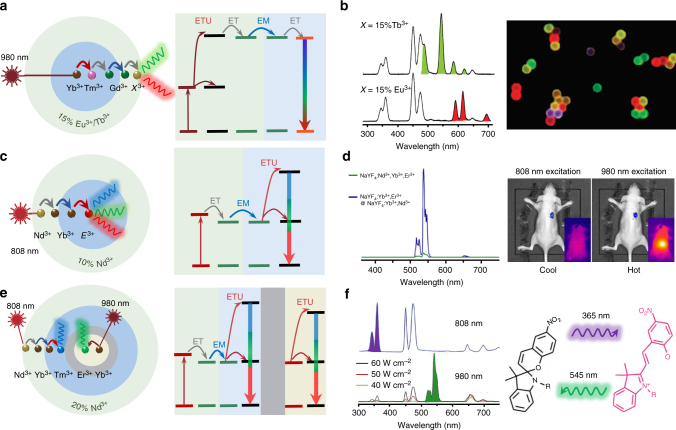
Lanthanide-doped upconversion nanoparticles (UCNPs) are capable of converting near-infra-red excitation into visible and ultraviolet emission. Their unique optical properties have advanced a broad range of applications, such as fluorescent microscopy, deep-tissue bioimaging, nanomedicine, optogenetics, security labelling and volumetric display. However, the constraint of concentration quenching on upconversion luminescence has hampered the nanoscience community to develop bright UCNPs with a large number of dopants. This review surveys recent advances in developing highly doped UCNPs, highlights the strategies that bypass the concentration quenching effect, and discusses new optical properties as well as emerging applications enabled by these nanoparticles.
镧系掺杂上转换纳米粒子(UCNPs)能够将近红外激发转化为可见光和紫外发射。它们独特的光学性质促进了一系列应用的发展,如荧光显微镜、深层组织生物成像、纳米医学、光遗传学、安全标记和体显示。然而,浓度猝灭对上转换发光的限制阻碍了纳米科学领域开发具有大量掺杂剂的高亮度 UCNPs。本综述调查了开发高掺杂 UCNPs 的最新进展,强调了绕过浓度猝灭效应的策略,并讨论了这些纳米粒子带来的新光学性质和新兴应用。