Department of Functional Pathology, Shimane University Faculty of Medicine, Izumo, Japan.
Department of Gene Diagnostics and Therapeutics, Research Institute, National Center for Global Health and Medicine, Tokyo, Japan.
Sci Rep. 2018 Jun 20;8(1):9403. doi: 10.1038/s41598-018-27539-2.
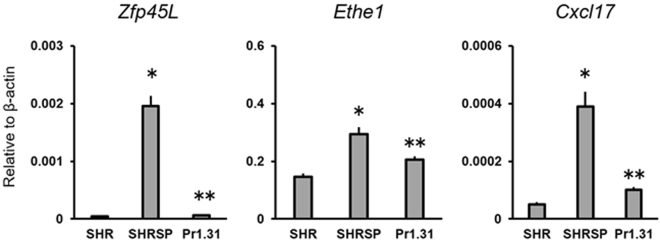
We previously revealed that two major quantitative trait loci (QTLs) for stroke latency of the stroke-prone spontaneously hypertensive rat (SHRSP) under salt-loading were located on chromosome (Chr) 1 and 18. Here, we attempted further dissection of the stroke-QTLs using multiple congenic strains between SHRSP and a stroke-resistant hypertensive rat (SHR). Cox hazard model among subcongenic strains harboring a chromosomal fragment of Chr-1 QTL region showed that the most promising region was a 2.1 Mbp fragment between D1Rat177 and D1Rat97. The QTL region on Chr 18 could not be narrowed down by the analysis, which may be due to multiple QTLs in this region. Nonsynonymous sequence variations were found in four genes (Cblc, Cxcl17, Cic, and Ceacam 19) on the 2.1 Mbp fragment of Chr-1 QTL by whole-genome sequence analysis of SHRSP/Izm and SHR/Izm. Significant changes in protein structure were predicted in CBL-C and CXCL17 using I-TASSER. Comprehensive gene expression analysis in the kidney with a cDNA microarray identified three candidate genes (LOC102548695 (Zinc finger protein 45-like, Zfp45L), Ethe1, and Cxcl17). In conclusion, we successfully narrowed down the QTL region on Chr 1, and identified six candidate genes in this region.
我们之前曾揭示,盐负荷下易发性高血压脑卒中大鼠(SHRSP)脑卒中潜伏期的两个主要数量性状基因座(QTL)位于染色体(Chr)1 和 18 上。在这里,我们尝试使用 SHRSP 和一种抗高血压脑卒中大鼠(SHR)之间的多个同源性嵌合体进一步剖析脑卒中-QTL。在携带 Chr-1 QTL 区域染色体片段的亚同源性嵌合体中,Cox 危险模型分析表明,最有希望的区域是 D1Rat177 和 D1Rat97 之间的 2.1 Mbp 片段。对 Chr18 上的 QTL 区域的分析未能缩小范围,这可能是由于该区域存在多个 QTL。通过对 SHRSP/Izm 和 SHR/Izm 的全基因组序列分析,在 Chr-1 QTL 的 2.1 Mbp 片段上发现了四个基因(Cblc、Cxcl17、Cic 和 Ceacam19)的非同义序列变异。使用 I-TASSER 预测 CBL-C 和 CXCL17 的蛋白质结构发生了显著变化。通过 cDNA 微阵列对肾脏进行全面的基因表达分析,鉴定出三个候选基因(LOC102548695(锌指蛋白 45 样,Zfp45L)、Ethe1 和 Cxcl17)。总之,我们成功地缩小了 Chr1 上的 QTL 区域,并在该区域鉴定出了六个候选基因。