Tran Tam T, Janssens Lizanne, Dinh Khuong V, Stoks Robby
Evolutionary Stress Ecology and Ecotoxicology University of Leuven Leuven Belgium.
Institute of Aquaculture Nha Trang University Nha Trang Vietnam.
Evol Appl. 2018 Mar 5;11(6):906-917. doi: 10.1111/eva.12605. eCollection 2018 Jul.
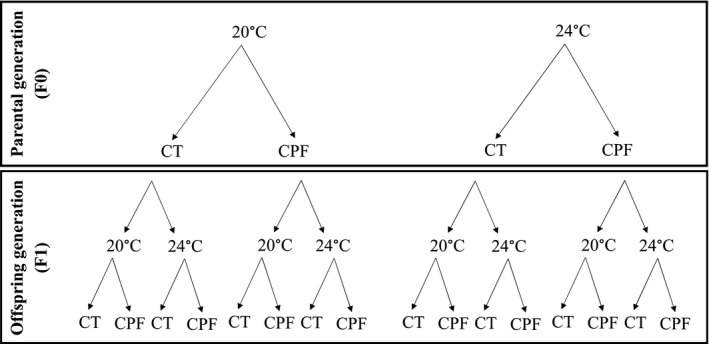
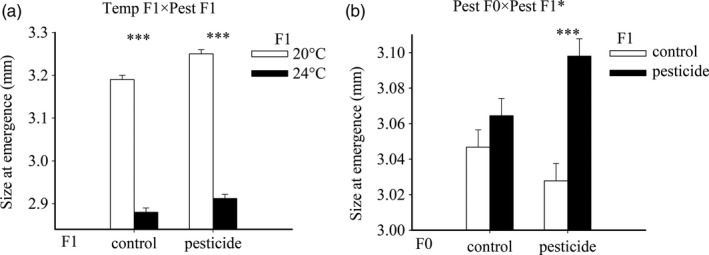
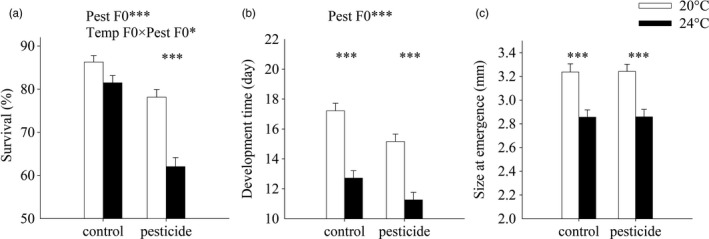
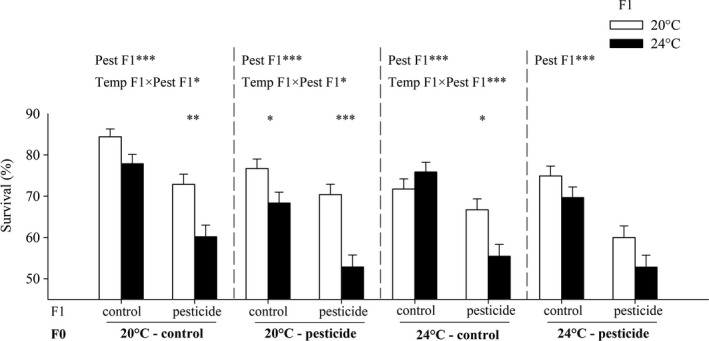
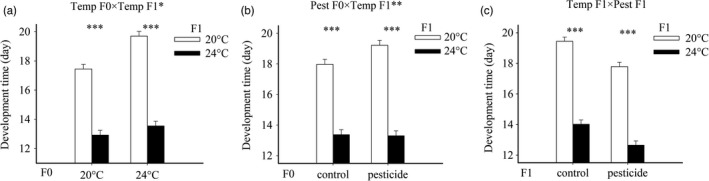
While transgenerational plasticity may buffer ectotherms to warming and pesticides separately, it remains unknown how combined exposure to warming and pesticides in the parental generation shapes the vulnerability to these stressors in the offspring. We studied the transgenerational effects of single and combined exposure to warming (4°C increase) and the pesticide chlorpyrifos on life-history traits of the vector mosquito . Parental exposure to a single stressor, either warming or the pesticide, had negative effects on the offspring: parental exposure to both warming and the pesticide resulted in an overall lower offspring survival, and a delayed offspring metamorphosis. Parental exposure to a single stressor did, however, not alter the vulnerability of the offspring to the same stressor in terms of survival. Parental pesticide exposure resulted in larger offspring when the offspring experienced the same stressor as the parents. Within both the parental and offspring generations, warming made the pesticide more toxic in terms of survival. Yet, this synergism disappeared in the offspring of parents exposed to both stressors simultaneously because in this condition, the pesticide was already more lethal at the lower temperature. Our results indicate that transgenerational effects will not increase the ability of this vector species to deal with pesticides in a warming world. Bifactorial transgenerational experiments are crucial to understand the combined impact of warming and pesticides across generations, hence to assess the efficacy of vector control in a warming world.
虽然跨代可塑性可能会分别缓冲变温动物应对变暖和农药的影响,但亲代同时暴露于变暖和农药下如何影响子代对这些压力源的脆弱性仍不清楚。我们研究了单一和联合暴露于变暖(温度升高4°C)和农药毒死蜱对病媒蚊子生活史特征的跨代影响。亲代暴露于单一压力源,无论是变暖还是农药,都会对后代产生负面影响:亲代同时暴露于变暖和农药会导致子代总体存活率降低,变态延迟。然而,亲代暴露于单一压力源并不会改变子代在生存方面对相同压力源的脆弱性。当子代经历与亲代相同的压力源时,亲代接触农药会导致子代体型更大。在亲代和子代两代中,变暖都会使农药在生存方面更具毒性。然而,这种协同作用在同时暴露于两种压力源的亲代的子代中消失了,因为在这种情况下,农药在较低温度下已经更具致死性。我们的结果表明,跨代效应不会增加这种病媒物种在变暖世界中应对农药的能力。双因素跨代实验对于理解变暖和农药跨代的综合影响至关重要,从而评估变暖世界中病媒控制的效果。