Zhang Lin, Zuo Mingyan, Ma Xinxin, Dong Youhong
Department of Pharmacy, Xiangyang No. 1 People's Hospital, Hubei University of Medicine, Xiangyang, Hubei 441000, P.R. China.
Department of Pulmonary Disease, Xiangyang No. 1 People's Hospital, Hubei University of Medicine, Xiangyang, Hubei 441000, P.R. China.
Oncol Lett. 2018 Jul;16(1):388-394. doi: 10.3892/ol.2018.8621. Epub 2018 May 2.
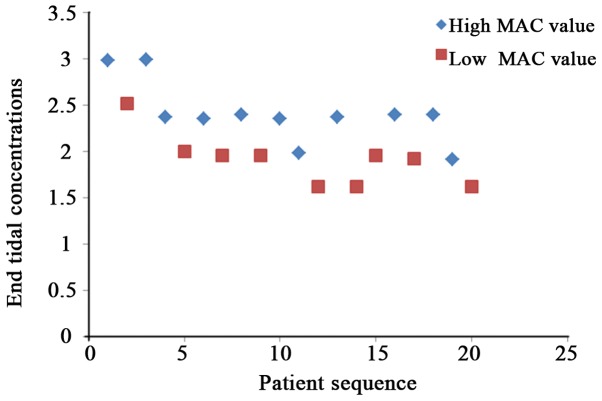
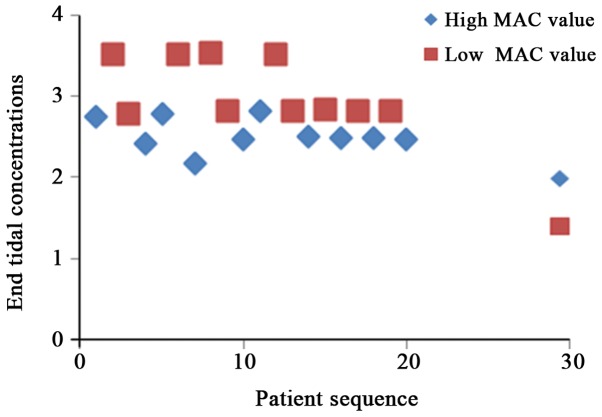
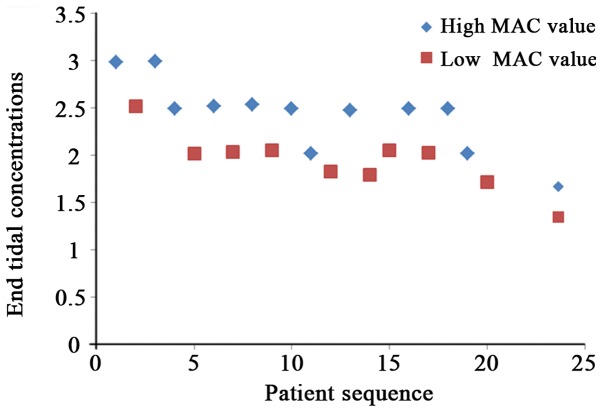
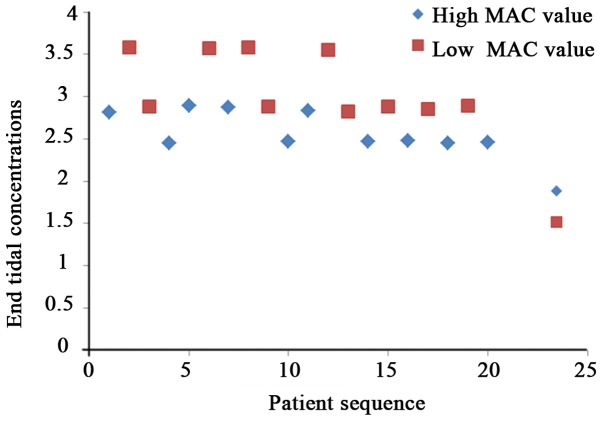
The effects of neoadjuvant chemotherapy on the minimum alveolar concentration (MAC) values of sevoflurane and desflurane in patients with hepatocellular carcinoma (HCC) complicated with jaundice were investigated. Eighty patients with HCC complicated with jaundice were selected. Forty patients underwent the neoadjuvant chemotherapy and were grouped into the desflurane group (Group D) and the sevoflurane group (Group S). Patients in all chemotherapy groups received 2 cycles of chemotherapy prior to surgery and underwent surgical treatment 3 weeks after chemotherapy. The remaining 40 patients in the control group were divided into the desflurane group (Group C1) and the sevoflurane group (Group C2). Changes in MAP, HR and BIS at different time points before and after anesthesia induction and skin incision were compared among the groups. Results showed that there were no significant differences in MAP, HR and BIS before anesthesia induction (T0) (P>0.05); at each time point from T1 to T6, MAP, HR and BIS of Group D were significantly lower than those of Group C1 (P>0.05). Furthermore, MAP, HR and BIS of Group S were significantly lower than those of Group C2 (P>0.05). The MAC of sevoflurane and desflurane were compared among all patient groups using the mean method. MAC values of Group D were significantly lower than those of Group C1 (P<0.05). Notably, MAC values of sevoflurane and desflurane were compared among all patient groups using the Dixon method and the differences were statistically significant (P<0.05). Logistic regression analyses were conducted, respectively, which revealed that the MAC of sevoflurane and desflurane were associated with whether patients received the neoadjuvant chemotherapy. MAC of sevoflurane and desflurane were decreased in patients receiving the neoadjuvant chemotherapy. The results suggested that neoadjuvant chemotherapy can reduce MAC values of sevoflurane and desflurane in HCC patients complicated with jaundice and may improve these patients' sensitivity to sevoflurane and desflurane.
研究了新辅助化疗对合并黄疸的肝细胞癌(HCC)患者七氟烷和地氟烷最低肺泡浓度(MAC)值的影响。选取80例合并黄疸的HCC患者。40例患者接受新辅助化疗,并分为地氟烷组(D组)和七氟烷组(S组)。所有化疗组患者在手术前接受2个周期的化疗,并在化疗后3周接受手术治疗。其余40例对照组患者分为地氟烷组(C1组)和七氟烷组(C2组)。比较各组麻醉诱导前、皮肤切开前后不同时间点的平均动脉压(MAP)、心率(HR)和脑电双频指数(BIS)变化。结果显示,麻醉诱导前(T0)MAP、HR和BIS无显著差异(P>0.05);从T1到T6的每个时间点,D组的MAP、HR和BIS均显著低于C1组(P>0.05)。此外,S组的MAP、HR和BIS显著低于C2组(P>0.05)。采用均值法比较所有患者组七氟烷和地氟烷的MAC。D组的MAC值显著低于C1组(P<0.05)。值得注意的是,采用Dixon法比较所有患者组七氟烷和地氟烷的MAC值,差异有统计学意义(P<0.05)。分别进行Logistic回归分析,结果显示七氟烷和地氟烷的MAC与患者是否接受新辅助化疗有关。接受新辅助化疗的患者七氟烷和地氟烷的MAC降低。结果表明,新辅助化疗可降低合并黄疸的HCC患者七氟烷和地氟烷的MAC值,并可能提高这些患者对七氟烷和地氟烷的敏感性。