Zhou Weifu, Li Hui, Shang Shuo, Liu Feng
Department of Anesthesiology, Zhangqiu District People's Hospital, Jinan, Shandong, China.
Department of Anesthesiology, Zhangqiu Maternal and Child Health Hospital, Jinan, Shandong, China.
Braz J Med Biol Res. 2021 May 17;54(7):e10213. doi: 10.1590/1414-431X2020e10213. eCollection 2021.
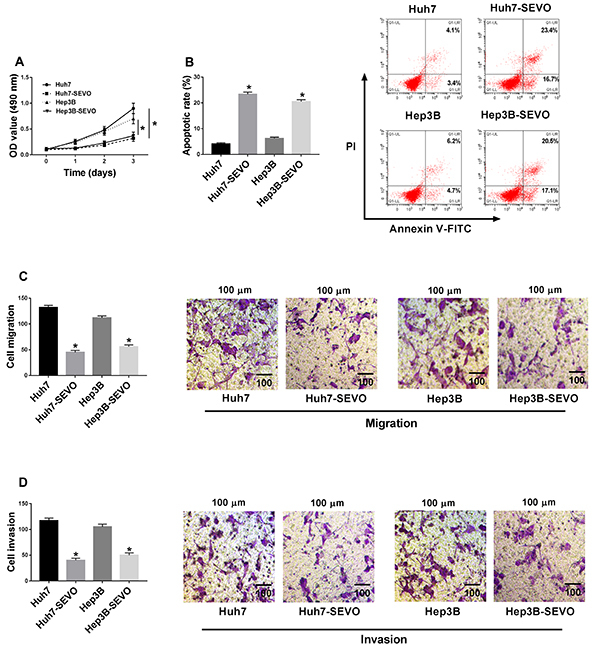
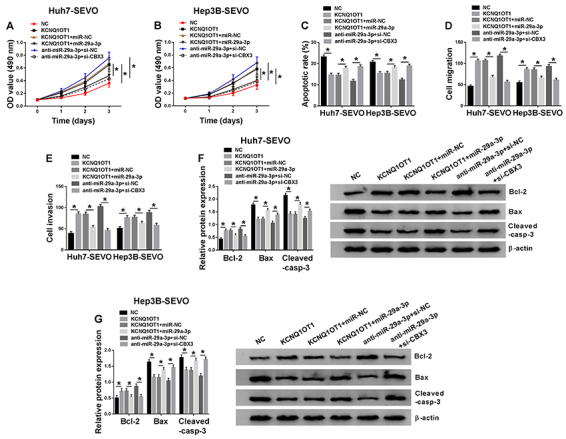
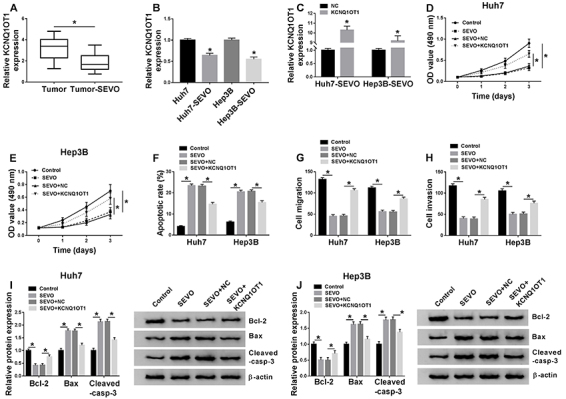
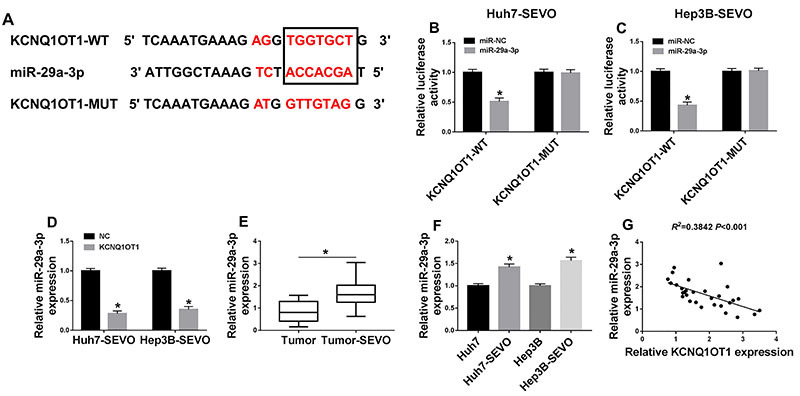
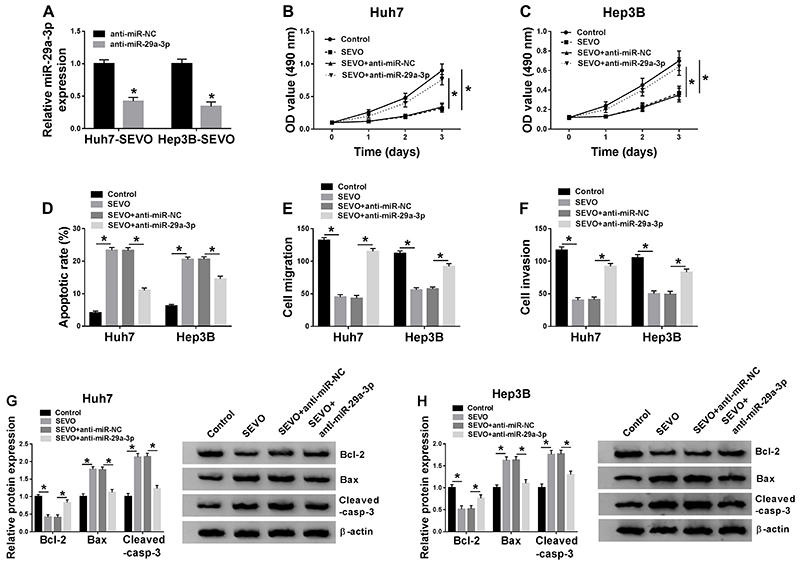
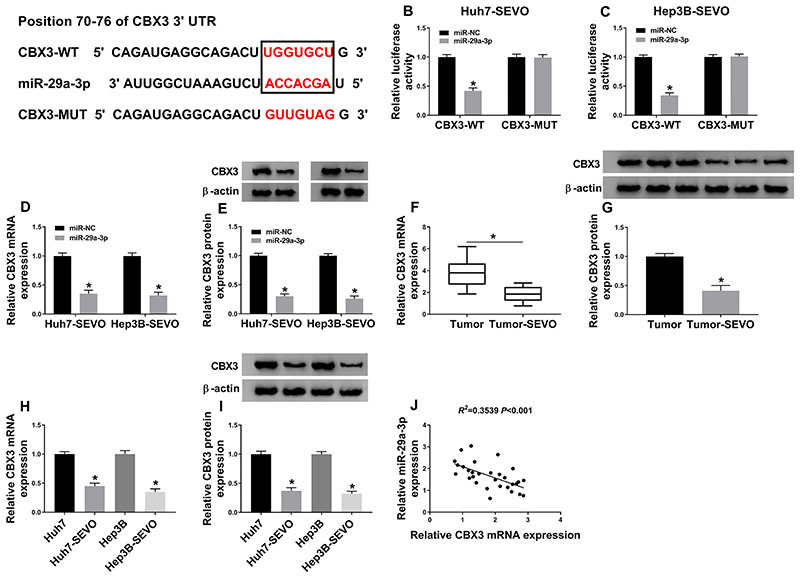
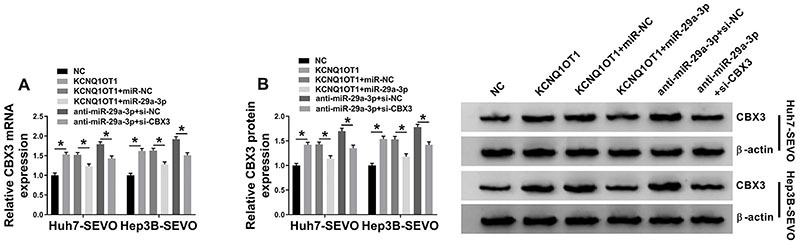
Sevoflurane (SEVO) is widely applied as an anesthetic, which exerts antitumor capacity in various cancers, including hepatocellular carcinoma (HCC). Previous studies indicated that long non-coding RNA KCNQ1 opposite strand/antisense transcript 1 (KCNQ1OT1) was upregulated, while microRNA-29a-3p (miR-29a-3p) was downregulated in HCC. Thus, we aimed to explore the roles of KCNQ1OT1 and miR-29a-3p in HCC cells exposed to SEVO. Cell proliferation, apoptosis, migration, and invasion were assessed by the 3-(4,5-dimethylthiazol-2-yl)-2,5-diphenyltetrazolium bromide (MTT) assay, flow cytometry, and transwell assays, respectively. The levels of genes were determined by quantitative real-time polymerase chain reaction (qRT-PCR) or western blot. Furthermore, the interaction between miR-29a-3p and KCNQ1OT1 or chromebox protein homolog 3 (CBX3) was predicted by Starbase or Targetscan, and then confirmed by dual-luciferase reporter assay. We found that the levels of KCNQ1OT1 and CBX3 were decreased, while miR-29a-3p was increased in SEVO-treated HCC cells. KCNQ1OT1 overexpression weakened the inhibitory effects of SEVO on HCC cell proliferation, apoptosis, migration, and invasion. Interestingly, KCNQ1OT1 bound to miR-29a-3p, and miR-29a-3p targeted CBX3. KCNQ1OT1 upregulated CBX3 level by repressing miR-29a-3p expression. Furthermore, KCNQ1OT1 exerted tumor promotion in HCC cells via suppressing miR-29a-3p to regulate CBX3 expression. Collectively, our findings demonstrated that KCNQ1OT1 regulated the antitumor effects of SEVO on HCC cells through modulating the miR-29a-3p/CBX3 axis, providing a theoretical basis for the treatment of HCC.
七氟醚(SEVO)作为一种麻醉剂被广泛应用,它在包括肝细胞癌(HCC)在内的多种癌症中发挥抗肿瘤作用。先前的研究表明,长链非编码RNA KCNQ1反义链/反义转录本1(KCNQ1OT1)在肝癌中上调,而微小RNA-29a-3p(miR-29a-3p)在肝癌中下调。因此,我们旨在探讨KCNQ1OT1和miR-29a-3p在暴露于SEVO的肝癌细胞中的作用。分别通过3-(4,5-二甲基噻唑-2-基)-2,5-二苯基四氮唑溴盐(MTT)法、流式细胞术和Transwell实验评估细胞增殖、凋亡、迁移和侵袭。通过定量实时聚合酶链反应(qRT-PCR)或蛋白质免疫印迹法测定基因水平。此外,通过Starbase或Targetscan预测miR-29a-3p与KCNQ1OT1或染色质盒蛋白同源物3(CBX3)之间的相互作用,然后通过双荧光素酶报告基因实验进行验证。我们发现,在SEVO处理的肝癌细胞中,KCNQ1OT1和CBX3的水平降低,而miR-29a-3p的水平升高。KCNQ1OT1过表达减弱了SEVO对肝癌细胞增殖、凋亡、迁移和侵袭的抑制作用。有趣的是,KCNQ1OT1与miR-29a-3p结合,且miR-29a-3p靶向CBX3。KCNQ1OT1通过抑制miR-29a-3p的表达上调CBX3水平。此外,KCNQ1OT1通过抑制miR-29a-3p来调节CBX3表达,从而在肝癌细胞中发挥促肿瘤作用。总的来说,我们的研究结果表明,KCNQ1OT1通过调节miR-29a-3p/CBX3轴来调控SEVO对肝癌细胞的抗肿瘤作用,为肝癌的治疗提供了理论依据。