Bido-Medina Richard, Wirsich Jonathan, Rodríguez Minelly, Oviedo Jairo, Miches Isidro, Bido Pamela, Tusen Luis, Stoeter Peter, Sadaghiani Sepideh
Beckman Institute for Advanced Science and Technology University of Illinois at Urbana-Champaign Urbana Illinois 61801.
Neuroscience Program University of Illinois at Urbana-Champaign Urbana Illinois 61801.
Ann Clin Transl Neurol. 2018 May 16;5(6):752-762. doi: 10.1002/acn3.575. eCollection 2018 Jun.
To determine the impact of Zika virus (ZIKV) infection on brain structure and functional organization of severely affected adult patients with neurological complications that extend beyond Guillain-Barré Syndrome (GBS)-like manifestations and include symptoms of the central nervous system (CNS).
In this first case-control neuroimaging study, we obtained structural and functional magnetic resonance images in nine rare adult patients in the subacute phase, and healthy age- and sex-matched controls. ZIKV patients showed atypical descending and rapidly progressing peripheral nervous system (PNS) manifestations, and importantly, additional CNS presentations such as perceptual deficits. Voxel-based morphometry was utilized to evaluate gray matter volume, and resting state functional connectivity and Network Based Statistics were applied to assess the functional organization of the brain.
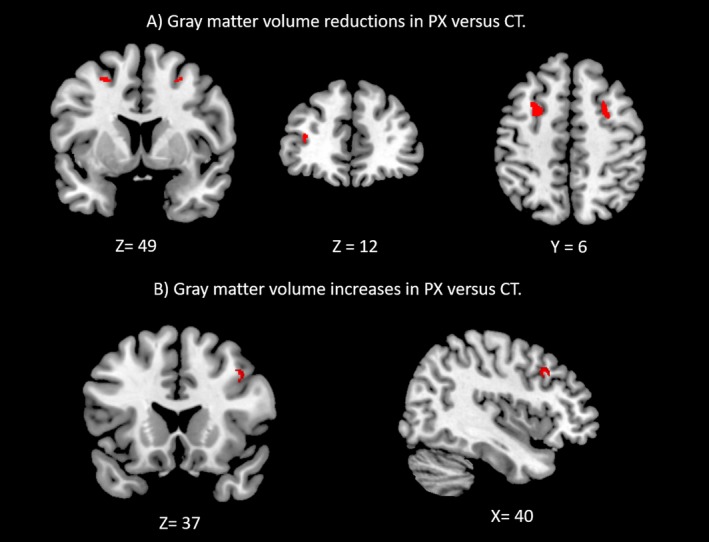
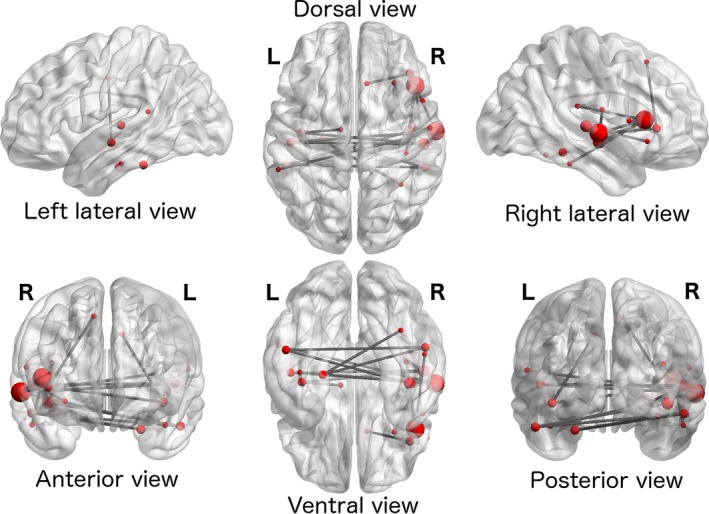
Gray matter volume was decreased bilaterally in motor areas (supplementary motor cortex, specifically Frontal Eye Fields) and beyond (left inferior frontal sulcus). Additionally, gray matter volume increased in right middle frontal gyrus. Functional connectivity increased in a widespread network within and across temporal lobes.
We provide preliminary evidence for a link between ZIKV neurological complications and changes in adult human brain structure and functional organization, comprising both motor-related regions potentially secondary to prolonged PNS weakness, and nonsomatomotor regions indicative of PNS-independent alternations. The latter included the temporal lobes, particularly vulnerable in a range of neurological conditions. While future studies into the ZIKV-related neuroinflammatory mechanisms in adults are urgently needed, this study indicates that ZIKV infection can lead to an impact on the brain.
确定寨卡病毒(ZIKV)感染对患有神经系统并发症的成年重症患者脑结构和功能组织的影响,这些并发症超出了吉兰 - 巴雷综合征(GBS)样表现,还包括中枢神经系统(CNS)症状。
在这项首例病例对照神经影像学研究中,我们获取了9例处于亚急性期的罕见成年患者以及年龄和性别匹配的健康对照者的结构和功能磁共振图像。寨卡病毒感染患者表现出非典型的下行性且进展迅速的周围神经系统(PNS)表现,重要的是,还存在额外的中枢神经系统表现,如感知缺陷。基于体素的形态学测量用于评估灰质体积,静息态功能连接和基于网络的统计分析用于评估大脑的功能组织。
双侧运动区域(辅助运动皮层,特别是额眼区)及其他区域(左侧额下沟)的灰质体积减少。此外,右侧额中回的灰质体积增加。颞叶内和颞叶间广泛网络的功能连接增强。
我们提供了初步证据,证明寨卡病毒神经系统并发症与成人大脑结构和功能组织变化之间存在联系,这些变化既包括可能继发于长期周围神经系统无力的运动相关区域,也包括表明与周围神经系统无关的改变的非躯体运动区域。后者包括颞叶,在一系列神经系统疾病中特别脆弱。虽然迫切需要对成人中寨卡病毒相关神经炎症机制进行进一步研究,但本研究表明寨卡病毒感染可对大脑产生影响。