Department of Population Science and Human Resource Development, University of Rajshahi, Rajshahi, 6205, Bangladesh.
Reprod Health. 2018 Jun 22;15(1):112. doi: 10.1186/s12978-018-0558-8.
The purpose of the study was to explore the association between couples' joint participation in household decision making and modern contraceptive use (MCU) among fecund (physically able to bear child) young women in Bangladesh.
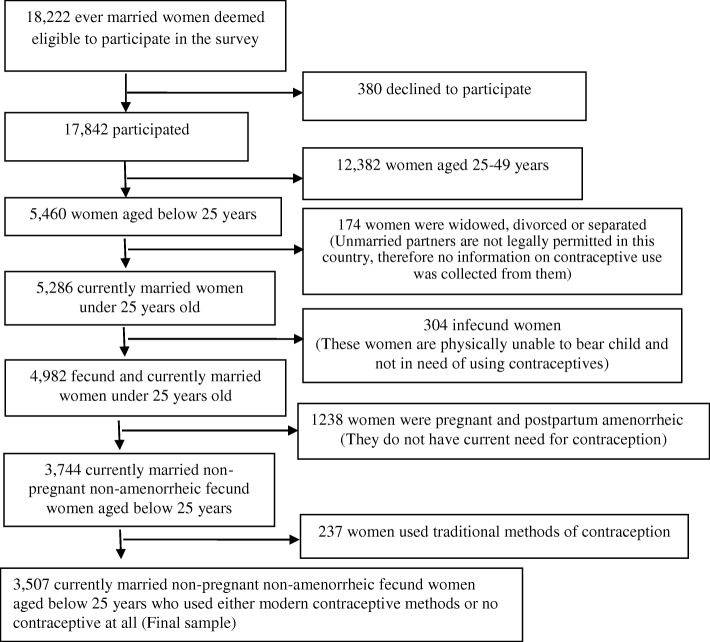
This study utilized a cross-sectional data (n = 3507) extracted from the Bangladesh Demographic and Health Survey (BDHS) 2011. Differences in the utilization of modern contraceptives (MC) by socio-demographic characteristics were assessed by χ analyses. Binary logistic regression was used to identify the associated factors of usingMC, and the odds ratio with a 95% CI was computed to assess the strength of association. Multicollinearity was also checked by examining the standard errors in the fitted model.
Desire for a child after two years go by and no child at all contributed the most to increasing MCU followed by receiving family planning (FP) methods from FP workers. Couples' joint decision making power on women's health care, child's health care and visiting family members or relatives emerged as the third most influential factor that might be associated with MCU.
Since spousal joint decision making increases the likelihood of using MC, government should include strategic interventions in FP programs to elevate women's status through creating educational and employment opportunities and encouraging more visible involvement in household decision making.
本研究旨在探讨孟加拉国生育期(有生育能力)年轻女性中夫妻共同参与家庭决策与现代避孕方法(MCU)使用之间的关联。
本研究利用了 2011 年孟加拉国人口与健康调查(BDHS)中的横断面数据(n=3507)。采用 χ 分析评估了社会人口特征对现代避孕药具(MC)使用的差异。采用二元逻辑回归确定使用 MC 的相关因素,并计算比值比(OR)及其 95%置信区间(CI)以评估关联强度。通过检查拟合模型中的标准误差,还检查了多重共线性。
两年后想要孩子和没有孩子是增加 MCU 的最重要因素,其次是接受计划生育工作者提供的计划生育方法。夫妻双方共同决策妇女保健、儿童保健以及探望家庭成员或亲戚的权力是与 MCU 相关的第三大影响因素。
由于配偶共同决策增加了使用 MC 的可能性,政府应通过创造教育和就业机会并鼓励更明显地参与家庭决策,将战略干预纳入计划生育方案,以提高妇女地位。