Dulka Brooke N, Koul-Tiwari Richa, Grizzell J Alex, Harvey Marquinta L, Datta Subimal, Cooper Matthew A
a Department of Psychology , University of Tennessee , Knoxville , TN , USA.
b NeuroNET Research Center , University of Tennessee , Knoxville , TN , USA.
Stress. 2018 Jun 22:1-6. doi: 10.1080/10253890.2018.1485646.
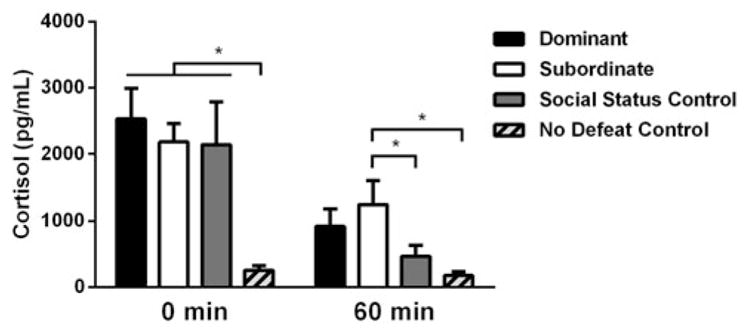
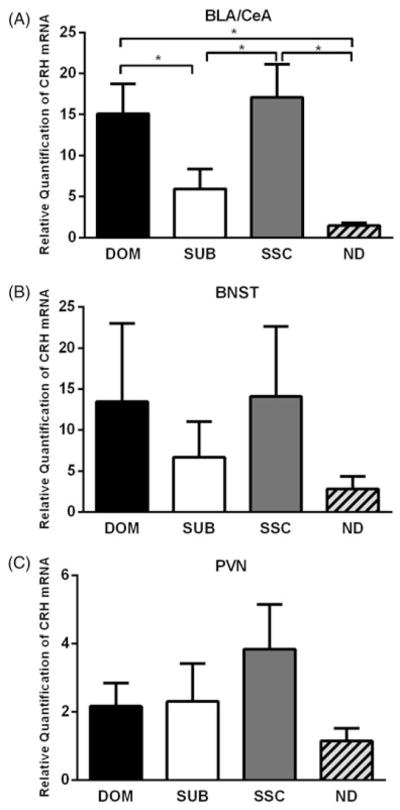
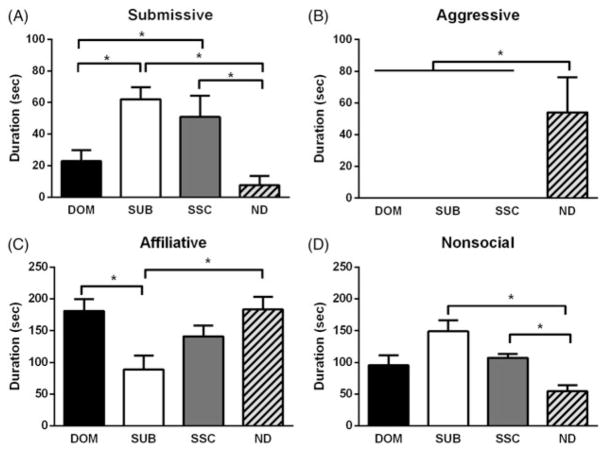
Stress is a well-known risk factor for psychopathology and rodent models of social defeat have strong face, etiological, construct and predictive validity for these conditions. Syrian hamsters are highly aggressive and territorial, but after an acute social defeat experience they become submissive and no longer defend their home territory, even from a smaller, non-aggressive intruder. This defeat-induced change in social behavior is called conditioned defeat (CD). We have shown that dominant hamsters show increased neural activity in the ventromedial prefrontal cortex (vmPFC) following social defeat stress and exhibit a reduced CD response at social interaction testing compared to subordinates. Although the vmPFC can inhibit the neuroendocrine stress response, it is unknown whether dominants and subordinates differ in stress-induced activity of the extended hypothalamic-pituitary-adrenal (HPA) axis. Here, we show that, following acute social defeat, dominants exhibit decreased submissive and defensive behavior compared to subordinates but do not differ from subordinates or social status controls (SSCs) in defeat-induced cortisol concentrations. Furthermore, both dominants and SSCs show greater corticotropin-releasing hormone (CRH) mRNA expression in the basolateral/central amygdala compared to subordinates, while there was no effect of social status on CRH mRNA expression in the paraventricular nucleus of the hypothalamus or bed nucleus of the stria terminalis. Overall, status-dependent differences in the CD response do not appear linked to changes in stress-induced cortisol concentrations or CRH gene expression, which is consistent with the view that stress resilience is not a lack of a physiological stress response but the addition of stress coping mechanisms. Lay summary Dominant hamsters show resistance to the behavioral effects of acute social defeat compared to subordinates, but it is unclear whether social status modulates the neuroendocrine stress response in Syrian hamsters. This study indicates that dominant social status does not alter stress-induced activity of the extended hypothalamic-pituitary-adrenal (HPA) axis, which suggests that the ability of dominants to cope with social defeat stress is not associated with changes in their neuroendocrine stress response.
压力是心理病理学中一个众所周知的风险因素,社会挫败的啮齿动物模型在这些情况的表面效度、病因效度、结构效度和预测效度方面表现很强。叙利亚仓鼠极具攻击性且具有领地意识,但在经历急性社会挫败后,它们会变得顺从,不再保卫自己的领地,即使面对较小的、无攻击性的入侵者也如此。这种由挫败引起的社会行为变化被称为条件性挫败(CD)。我们已经表明,与从属仓鼠相比,优势仓鼠在经历社会挫败压力后腹内侧前额叶皮层(vmPFC)的神经活动增加,并且在社交互动测试中表现出降低的CD反应。虽然vmPFC可以抑制神经内分泌应激反应,但尚不清楚优势仓鼠和从属仓鼠在应激诱导的下丘脑 - 垂体 - 肾上腺(HPA)轴活动方面是否存在差异。在这里,我们表明,急性社会挫败后,与从属仓鼠相比,优势仓鼠表现出的顺从和防御行为减少,但在挫败诱导的皮质醇浓度方面与从属仓鼠或社会地位对照(SSC)没有差异。此外,与从属仓鼠相比,优势仓鼠和SSC在基底外侧/中央杏仁核中促肾上腺皮质激素释放激素(CRH)mRNA表达均更高,而社会地位对下丘脑室旁核或终纹床核中CRH mRNA表达没有影响。总体而言,CD反应中依赖地位的差异似乎与应激诱导的皮质醇浓度或CRH基因表达的变化无关,这与应激恢复力不是缺乏生理应激反应而是增加了应激应对机制的观点一致。外行总结与从属仓鼠相比,优势仓鼠对急性社会挫败的行为影响具有抵抗力,但尚不清楚社会地位是否会调节叙利亚仓鼠的神经内分泌应激反应。这项研究表明,优势社会地位不会改变下丘脑 - 垂体 - 肾上腺(HPA)轴的应激诱导活动,这表明优势仓鼠应对社会挫败压力的能力与其神经内分泌应激反应的变化无关。