Gyhagen Maria, Al-Mukhtar Othman Jwan, Åkervall Sigvard, Nilsson Ida, Milsom Ian
Gothenburg Continence Research Centre, Institute of Clinical Sciences, Sahlgrenska Academy at Gothenburg University, Gothenburg, Sweden.
Department of Obstetrics and Gynecology, Södra Älvsborgs Hospital, 501 82, Borås, Sweden.
Int Urogynecol J. 2019 Apr;30(4):639-647. doi: 10.1007/s00192-018-3684-5. Epub 2018 Jun 23.
Vaginal bulging is considered the key symptom for genital organ prolapse. The aim was to investigate the age-related prevalence and frequency of symptomatic pelvic organ prolapse (sPOP) and other pelvic floor symptoms in nonpregnant nullipara aged 25-64 years.
This national postal and web-based questionnaire survey was conducted in 2014 and included four independent random samples of women aged 25-34, 35-44, 45-54, and 55-64 years. The association of sPOP with demographics and with other pelvic floor conditions and with clustering to other pelvic floor conditions, was presented in women with and without sPOP. Logistic regression was used to identify and rank variables associated with symptomatic prolapse.
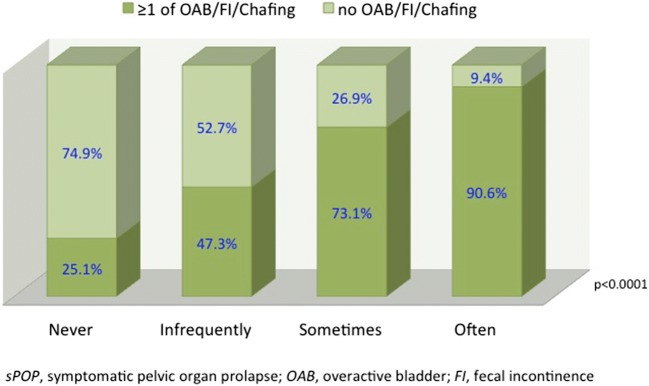
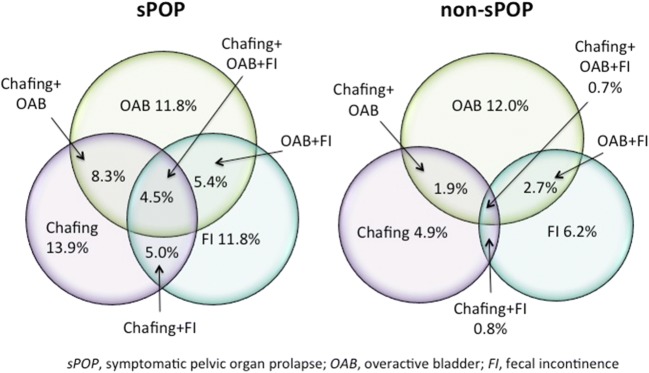
The response rate was 52% (n = 10,187) and 726 nullipara confirmed sPOP. Women with sPOP were younger (p < 0.001), shorter (p < 0.001), and more often overweight and obese (p < 0.01) compared with asymptomatic women. Previous surgery for prolapse was reported by 15 women only (0.16%). Symptomatic POP decreased from 9.8% in the youngest age group (25-34 years) to 6.1% in the oldest (55-64 years) (p < 0.0001). Symptomatic POP was more often experienced as bothersome (p = 0.012), and aggravated by straining and heavy lifting (p = 0.003), in older women. Vaginal/vulval chafing/rubbing feeling was most prevalent among the youngest 14.2%, decreasing to 7.8% among the oldest (<0.0001). This symptom occurred three to five times more often in those with sPOP (p < 0.0001). Clustering of pelvic floor symptoms was four times more prevalent in women with sPOP (23.2% versus 6.1%) (p < 0.0001).
The high prevalence of sPOP in this study was contradictory to most earlier reports, which have shown that genital prolapse is rare in nullipara. The explanation of our results may be the low probability of the clinical condition, the dominance of weak and infrequent symptoms, and not least clustering of alternative conditions mimicking sPOP.
阴道膨出被认为是生殖器官脱垂的关键症状。本研究旨在调查25 - 64岁未孕未育女性中症状性盆腔器官脱垂(sPOP)及其他盆底症状的年龄相关患病率和发生频率。
2014年开展了这项全国性的邮寄及网络问卷调查,包括25 - 34岁、35 - 44岁、45 - 54岁和55 - 64岁四个独立随机样本的女性。分别在有和没有sPOP的女性中呈现sPOP与人口统计学特征、其他盆底状况以及与其他盆底状况聚集性之间的关联。采用逻辑回归来识别与症状性脱垂相关的变量并进行排序。
回复率为52%(n = 10187),726名未孕未育女性确诊为sPOP。与无症状女性相比,有sPOP的女性更年轻(p < 0.001)、更矮(p < 0.001),超重和肥胖的比例更高(p < 0.01)。仅15名女性(0.16%)报告曾因脱垂接受手术。症状性POP从最年轻年龄组(25 - 34岁)的9.8%降至最年长年龄组(55 - 64岁)的6.1%(p < 0.0001)。在老年女性中,症状性POP更常被认为困扰(p = 0.012),且因用力和提重物而加重(p = 0.003)。阴道/外阴摩擦感在最年轻组中最为普遍,为14.2%,在最年长组中降至7.8%(<0.0001)。该症状在有sPOP的女性中出现频率高出三至五倍(p < 0.0001)。盆底症状的聚集性在有sPOP的女性中更为普遍,是无sPOP女性的四倍(23.2%对6.1%)(p < 0.0001)。
本研究中sPOP的高患病率与大多数早期报告相悖,早期报告显示未孕未育女性中生殖器脱垂罕见。对我们研究结果的解释可能是临床状况的低概率、微弱和不频繁症状的主导作用,以及尤其是模仿sPOP的其他状况的聚集性。