Maddali Aditya, Razack Farook Abdul, Cattamanchi Srihari, Ramakrishnan Trichur V
Department of Emergency Medicine, Sri Ramachandra Medical College Hospital and Research Institute, Chennai, Tamil Nadu, India.
J Emerg Trauma Shock. 2018 Apr-Jun;11(2):111-114. doi: 10.4103/JETS.JETS_8_17.
Early recognition of Stroke is one of the key concepts in the "Chain of Survival" as described by the American Heart Association/American Stroke Association Stroke guidelines. The most commonly used tools for prehospital assessment of stroke are "The Cincinnati Prehospital Stroke Scale," (CPSS) the "Face, Arm, Speech Test," and "The Los Angeles Prehospital Stroke Screen." The former two are used to identify stroke using physical findings while the latter is used to rule out other causes of altered consciousness.
The aim of this study is to validate the CPSS in the prehospital setting by correlating with computed tomography scan findings. (1) To determine if these scores can be implemented in the Indian prehospital setting. (2) To determine if it is feasible for new emergency departments (EDs) to use these protocols for early detection of stroke.
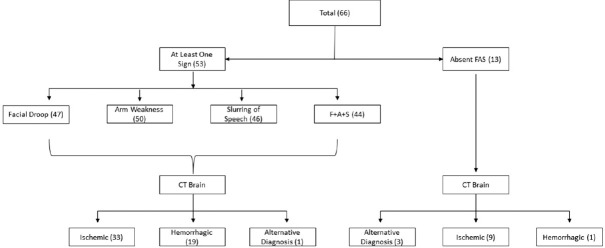
A prospective, observational study from December, 2015 to March, 2016. Patients with suspected stroke were enrolled. Data were collected prehospital in patients that arrived to the ED in an ambulance. Sensitivity, specificity, positive predictive value, and negative predictive value of the score were calculated using standard formulae.
CPSS showed good sensitivity of 81% (confidence interval [CI] - 68.5%-97%) when combined and a positive predictive value (PPV) of 100% (CI: 91.9%-100%). Individually, they showed a sensitivity of 75.8%, 79%, and 74.1%, respectively, with a PPV of 100% and specificity of 95%-100%.
As a prehospital screening tool, CPSS can be extremely useful as any diagnosis is only provisional until confirmed by an appropriate investigation in a hospital.
如美国心脏协会/美国卒中协会卒中指南所述,早期识别卒中是“生存链”中的关键概念之一。用于院前卒中评估的最常用工具是“辛辛那提院前卒中量表”(CPSS)、“面、臂、言语测试”和“洛杉矶院前卒中筛查”。前两者用于通过体格检查结果识别卒中,而后者用于排除意识改变的其他原因。
本研究的目的是通过与计算机断层扫描结果相关联,在院前环境中验证CPSS。(1)确定这些评分是否可在印度院前环境中实施。(2)确定新的急诊科使用这些方案早期检测卒中是否可行。
2015年12月至2016年3月进行的一项前瞻性观察性研究。纳入疑似卒中患者。在乘坐救护车抵达急诊科的患者中进行院前数据收集。使用标准公式计算该评分的敏感性、特异性、阳性预测值和阴性预测值。
CPSS联合使用时显示出良好的敏感性,为81%(置信区间[CI] - 68.5%-97%),阳性预测值(PPV)为100%(CI:91.9%-100%)。单独来看,它们的敏感性分别为75.8%、79%和74.1%,PPV为100%,特异性为95%-100%。
作为一种院前筛查工具,CPSS可能非常有用,因为在医院通过适当检查确诊之前,任何诊断都只是初步的。