Garri Carolina, Howell Shannon, Tiemann Katrin, Tiffany Aleczandria, Jalali-Yazdi Farzad, Alba Mario M, Katz Jonathan E, Takahashi Terry T, Landgraf Ralf, Gross Mitchell E, Roberts Richard W, Kani Kian
Keck School of Medicine, Lawrence J. Ellison Institute for Transformative Medicine, University of Southern California, Los Angeles, CA, USA.
Department of Chemistry, University of Southern California, Los Angeles, CA, USA.
Oncotarget. 2018 Jun 8;9(44):27363-27379. doi: 10.18632/oncotarget.25221.
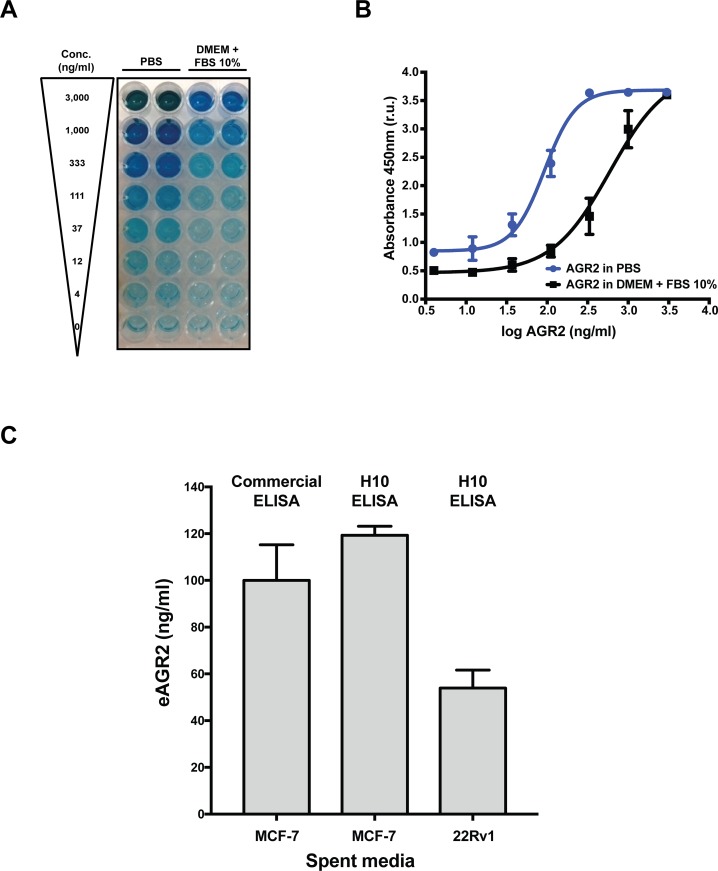
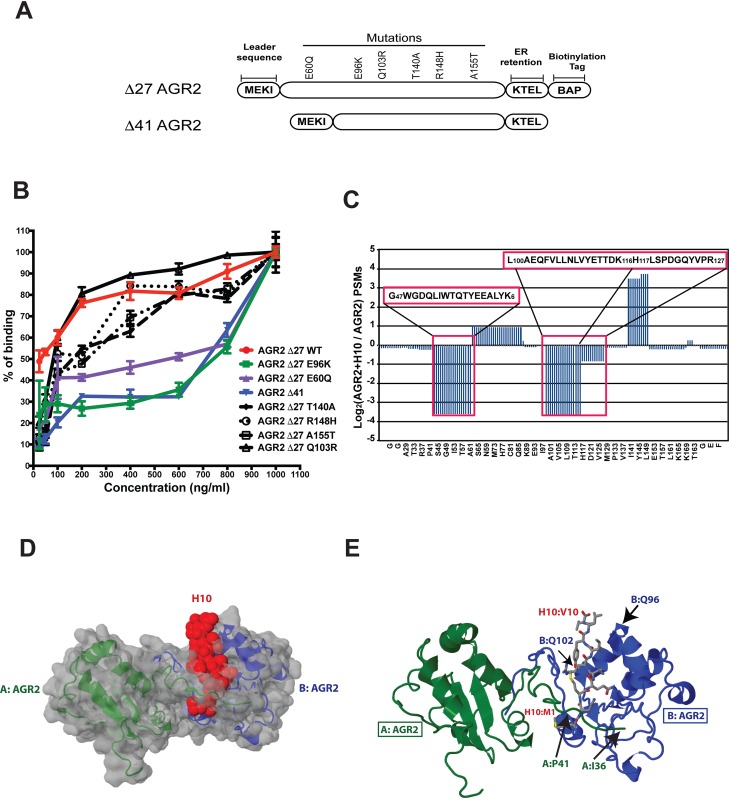
The cancer-associated protein Anterior Gradient 2 (AGR2) has been described, predominantly in adenocarcinomas. Increased levels of extracellular AGR2 (eAGR2) have been correlated with poor prognosis in cancer patients, making it a potential biomarker. Additionally, neutralizing AGR2 antibodies showed preclinical effectiveness in murine cancer models suggesting eAGR2 may be a therapeutic target. We set out to identify a peptide by mRNA display that would serve as a theranostic tool targeting AGR2. This method enables the selection of peptides from a complex (>10) library and incorporates a protease incubation step that filters the selection for serum stable peptides. We performed six successive rounds of enrichment using a 10-amino acid mRNA display library and identified several AGR2 binding peptides. One of these peptides (H10), demonstrated high affinity binding to AGR2 with a binding constant (K) of 6.4 nM. We developed an AGR2 ELISA with the H10 peptide as the capture reagent. Our H10-based ELISA detected eAGR2 from cancer cell spent media with a detection limit of (20-50 ng/ml). Furthermore, we investigated the therapeutic utility of H10 and discovered that it inhibited cell viability at IC (9-12 μmoles/L) in cancer cell lines. We also determined that 10 μg/ml of H10 was sufficient to inhibit cancer cell migration in breast and prostate cancer cell lines. A control peptide did not show any appreciable activity in these cells. The H10 peptide showed promise as both a novel diagnostic and a potential therapeutic peptide.
癌症相关蛋白前梯度2(AGR2)已被描述,主要存在于腺癌中。细胞外AGR2(eAGR2)水平升高与癌症患者的不良预后相关,使其成为一种潜在的生物标志物。此外,中和AGR2抗体在小鼠癌症模型中显示出临床前有效性,表明eAGR2可能是一个治疗靶点。我们着手通过mRNA展示鉴定一种肽,该肽将作为靶向AGR2的治疗诊断工具。这种方法能够从复杂(>10)文库中选择肽,并包含一个蛋白酶孵育步骤,该步骤可筛选出血清稳定肽。我们使用一个10氨基酸的mRNA展示文库进行了六轮连续富集,并鉴定出几种AGR2结合肽。其中一种肽(H10)与AGR2表现出高亲和力结合,结合常数(K)为6.4 nM。我们开发了一种以H10肽为捕获试剂的AGR2 ELISA。我们基于H10的ELISA检测癌细胞培养基中的eAGR2,检测限为(20 - 50 ng/ml)。此外,我们研究了H10的治疗效用,发现它在癌细胞系中以IC(9 - 12 μmol/L)抑制细胞活力。我们还确定10 μg/ml的H10足以抑制乳腺癌和前列腺癌细胞系中的癌细胞迁移。对照肽在这些细胞中未显示出任何明显活性。H10肽有望成为一种新型诊断和潜在治疗肽。