Garcia Marc A, Garcia Catherine, Chiu Chi-Tsun, Raji Mukaila, Markides Kyriakos S
Sealy Center on Aging, University of Texas Medical Branch, Galveston.
Leonard Davis School of Gerontology, University of Southern California, Los Angeles.
Innov Aging. 2018 Jun;2(2):igy014. doi: 10.1093/geroni/igy014. Epub 2018 Jun 18.
Although a clear advantage in mortality has been documented among older Hispanic subgroups, particularly the foreign-born, research examining health selectivity in morbidity life expectancies among older Hispanics are scarce. Differences in sociocultural characteristics among Hispanic subgroups may influence racial/ethnic and nativity disparities in morbidity. Research examining the heterogeneity among older Hispanic subgroups may further our understanding of why some Hispanics are able to preserve good health in old age, while others experience a health disadvantage. Thus, the primary goal of this analysis is to examine racial/ethnic, nativity, and country of origin differences in morbidity life expectancies among older adults in the United States.
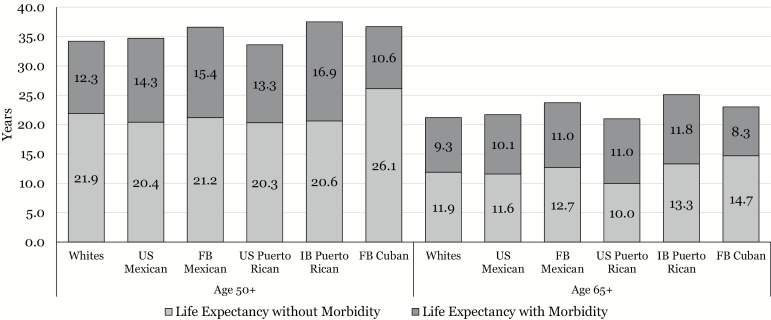
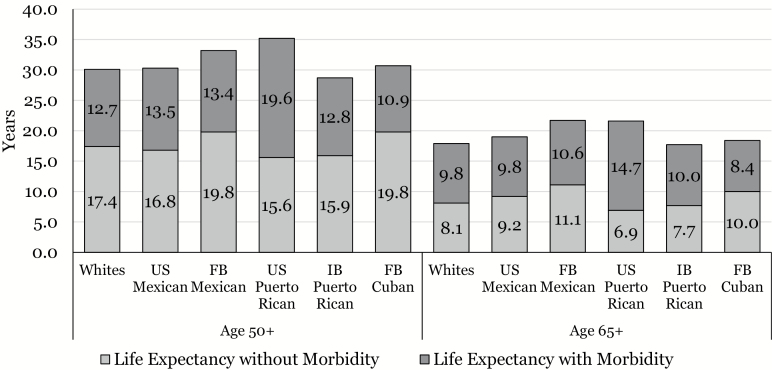
We used individual-level data (1999-2015) from the National Health Interview Survey to estimate Sullivan-based life tables of life expectancies with morbidity and without morbidity by gender for U.S.-born Mexicans, foreign-born Mexicans, U.S.-born Puerto Ricans, island-born Puerto Ricans, foreign-born Cubans, and whites in mid-life (age 50), and late-life (age 65).
Hispanics are heterogeneous in morbidity life expectancies. Among females, U.S.-born Mexicans, foreign-born Mexicans, and island-born Puerto Ricans spent more late-life years with morbidity than whites. For men, U.S.-born Puerto Ricans were the only Hispanic subgroup disadvantaged in the number of years lived with morbidity. Conversely, foreign-born Cubans exhibited the healthiest outcomes of all groups, regardless of gender.
Reducing the risk for late-life morbidity must be informed by a comprehensive understanding of a wide range of factors that shape health among older adults. Research should avoid pan-ethnic groupings that overlook important differences in chronic disease risk profiles among Hispanic subgroups. Recognizing the various sociocultural and environmental processes that underlie Hispanic subpopulations is important for development and implementation of social and public health policies aimed at ameliorating negative health outcomes of late-life morbidity among minority and immigrant groups.
尽管已有文献证明,在年龄较大的西班牙裔亚群体中,尤其是那些出生在国外的群体,在死亡率方面具有明显优势,但针对年龄较大的西班牙裔群体发病预期寿命中的健康选择性进行研究的却很少。西班牙裔亚群体在社会文化特征方面的差异,可能会影响发病率方面的种族/民族及出生地差异。对年龄较大的西班牙裔亚群体之间的异质性进行研究,或许能让我们进一步理解为何一些西班牙裔人在老年时能够保持健康,而另一些人却面临健康劣势。因此,本分析的主要目标是研究美国老年人在发病预期寿命方面的种族/民族、出生地及原籍国差异。
我们使用了来自美国国家健康访谈调查的个体层面数据(1999 - 2015年),以估计基于沙利文方法的寿命表,该表按性别分别列出了美国出生的墨西哥人、外国出生的墨西哥人、美国出生的波多黎各人、岛出生的波多黎各人、外国出生的古巴人和白人在中年(50岁)和老年(65岁)时伴有发病情况和无发病情况的预期寿命。
西班牙裔群体在发病预期寿命方面存在异质性。在女性中,美国出生的墨西哥人、外国出生的墨西哥人和岛出生的波多黎各人在晚年伴有发病情况的年数比白人更多。对于男性,美国出生的波多黎各人是唯一在伴有发病情况的存活年数方面处于劣势的西班牙裔亚群体。相反,无论性别,外国出生的古巴人在所有群体中表现出最健康的结果。
要降低晚年发病风险,必须全面了解影响老年人健康的各种因素。研究应避免泛族裔分类,因为这种分类会忽略西班牙裔亚群体在慢性病风险状况方面的重要差异。认识到构成西班牙裔亚群体基础的各种社会文化和环境因素,对于制定和实施旨在改善少数族裔和移民群体晚年发病负面健康结果的社会和公共卫生政策非常重要。