Department of Research in Education, VUmc School of Medical Sciences, Amsterdam University Medical Centers, Amsterdam, the Netherlands.
LEARN! Research Institute for Education and Learning, VU University, Amsterdam, the Netherlands.
Med Educ. 2018 Aug;52(8):838-850. doi: 10.1111/medu.13617. Epub 2018 Jun 25.
As unprofessional behaviour in physicians can compromise patient safety, all physicians should be willing and able to respond to lapses in professionalism. Although students endorse an obligation to respond to lapses, they experience difficulties in doing so. If medical educators knew how students respond and why they choose certain responses, they could support students in responding appropriately.
The aim of this study was to describe medical students' responses to professionalism lapses in peers and faculty staff, and to understand students' motivation for responding or not responding.
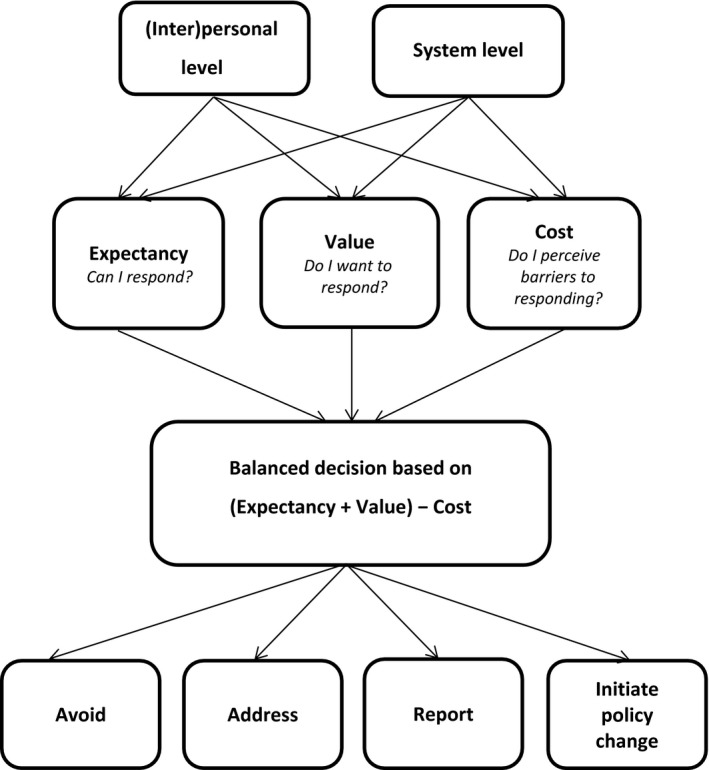
We conducted an explorative, qualitative study using template analysis, in which three researchers independently coded transcripts of semi-structured, face-to-face interviews. We purposefully sampled 18 student representatives convening at a medical education conference. Preliminary open coding of a data subset yielded an initial template, which was applied to further data and modified as necessary. All transcripts were coded using the final template. Finally, three sensitising concepts from the Expectancy-Value-Cost model were used to map participants' responses.
Students mentioned having observed lapses in professionalism in both faculty staff and peers. Students' responses to these lapses were avoiding, addressing, reporting or initiating policy change. Generally, students were not motivated to respond if they did not know how to respond, if they believed responding was futile and if they feared retaliation. Students were motivated to respond if they were personally affected, if they perceived the individual as approachable and if they thought that the whole group of students could benefit from their actions. Expectancy of success, value and costs each appeared to be influenced by (inter)personal and system factors.
The Expectancy-Value-Cost model effectively explains students' motivation for responding to lapses. The (inter)personal and system factors influencing students' motivation to respond are modifiable and can be used by medical educators to enhance students' motivation to respond to lapses in professionalism observed in medical school.
由于医生的不专业行为会危及患者安全,因此所有医生都应该愿意并有能力应对职业素养的缺失。尽管学生们认为自己有责任回应这些行为,但实际上他们在这样做的时候却存在困难。如果医学教育者了解学生们的回应方式以及他们选择回应或不回应的原因,就可以为学生提供适当的支持。
本研究旨在描述医学生对同学和教师职业素养缺失的反应,并理解学生回应或不回应的动机。
我们采用模板分析法进行了一项探索性的定性研究,三位研究人员分别对医学教育会议上召集的 18 名学生代表的半结构化面对面访谈记录进行了独立编码。我们采用目的性抽样,初步对数据子集进行开放式编码,生成初始模板,然后将其应用于进一步的数据,并根据需要进行修改。使用最终模板对所有转录本进行编码。最后,使用期望-价值-成本模型中的三个敏感概念来映射参与者的反应。
学生们提到在教师和同学中都观察到了职业素养缺失的情况。学生对这些缺失的反应包括回避、处理、报告或启动政策变更。通常,如果学生不知道如何回应、认为回应没有用或担心报复,他们就没有动力回应。如果学生个人受到影响、认为个人可以接近或认为整个学生群体可以从他们的行动中受益,他们就会有动力回应。期望、价值和成本似乎都受到(人际)和系统因素的影响。
期望-价值-成本模型有效地解释了学生对职业素养缺失做出回应的动机。影响学生回应动机的(人际)和系统因素是可以改变的,医学教育者可以利用这些因素来提高学生对医学生活中观察到的职业素养缺失做出回应的动机。