Beguerisse-Díaz Mariano, McLennan Amy K, Garduño-Hernández Guillermo, Barahona Mauricio, Ulijaszek Stanley J
Department of Mathematics, Imperial College London, UK.
Mathematical Institute, University of Oxford, UK.
Digit Health. 2017 Jan 1;3:2055207616688841. doi: 10.1177/2055207616688841. eCollection 2017 Jan-Dec.
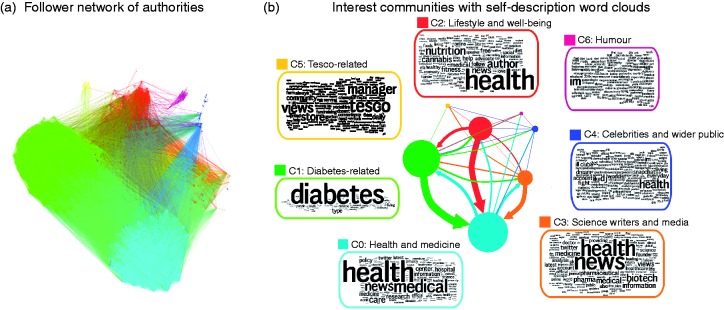
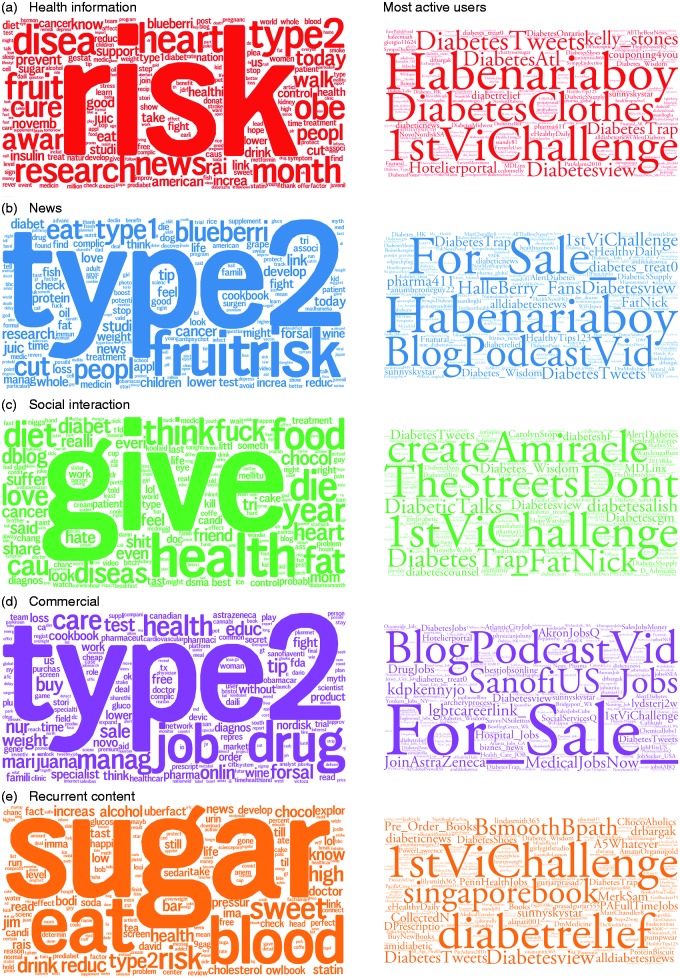
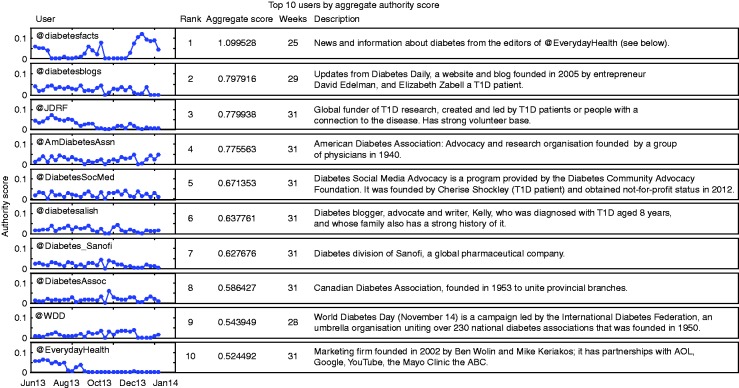
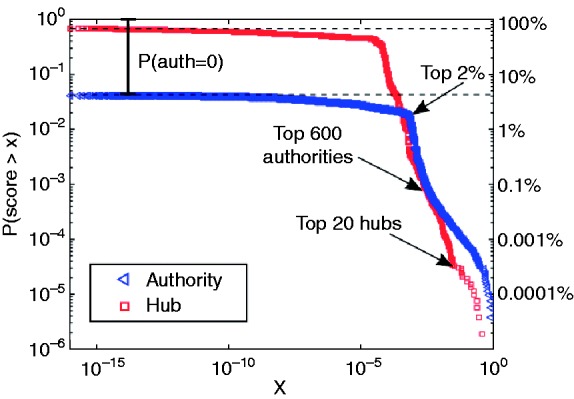
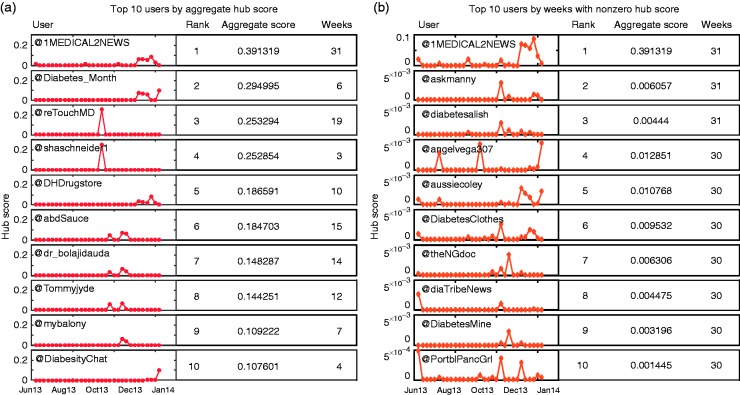
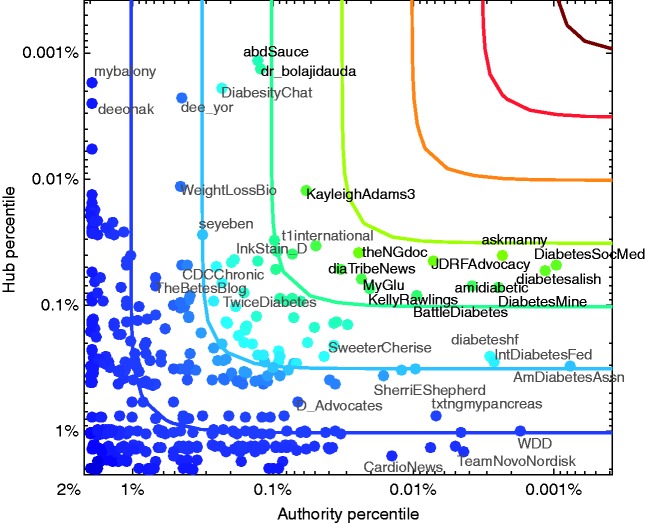
Social media are being increasingly used for health promotion, yet the landscape of users, messages and interactions in such fora is poorly understood. Studies of social media and diabetes have focused mostly on patients, or public agencies addressing it, but have not looked broadly at all of the participants or the diversity of content they contribute. We study Twitter conversations about diabetes through the systematic analysis of 2.5 million tweets collected over 8 months and the interactions between their authors. We address three questions. (1) What themes arise in these tweets? (2) Who are the most influential users? (3) Which type of users contribute to which themes? We answer these questions using a mixed-methods approach, integrating techniques from anthropology, network science and information retrieval such as thematic coding, temporal network analysis and community and topic detection. Diabetes-related tweets fall within broad thematic groups: health information, news, social interaction and commercial. At the same time, humorous messages and references to popular culture appear consistently, more than any other type of tweet. We classify authors according to their temporal 'hub' and 'authority' scores. Whereas the hub landscape is diffuse and fluid over time, top authorities are highly persistent across time and comprise bloggers, advocacy groups and NGOs related to diabetes, as well as for-profit entities without specific diabetes expertise. Top authorities fall into seven interest communities as derived from their Twitter follower network. Our findings have implications for public health professionals and policy makers who seek to use social media as an engagement tool and to inform policy design.
社交媒体正越来越多地被用于健康促进,但人们对这类平台上的用户、信息和互动情况却知之甚少。关于社交媒体与糖尿病的研究大多聚焦于患者或处理糖尿病问题的公共机构,而没有全面考察所有参与者及其所提供内容的多样性。我们通过系统分析在8个月内收集的250万条推文及其作者之间的互动,来研究推特上有关糖尿病的对话。我们探讨三个问题。(1)这些推文中出现了哪些主题?(2)最具影响力的用户是谁?(3)哪种类型的用户贡献了哪些主题?我们采用混合方法来回答这些问题,整合了人类学、网络科学和信息检索等技术,如主题编码、时间网络分析以及社区和主题检测。与糖尿病相关的推文可归为广泛的主题类别:健康信息、新闻、社交互动和商业。与此同时,幽默信息和对流行文化的提及始终存在,比其他任何类型的推文都多。我们根据作者的时间“中心性”和“权威性”得分对其进行分类。虽然中心性情况随着时间推移是分散且不稳定的,但顶级权威在时间上具有高度持久性,包括与糖尿病相关的博主、倡导团体和非政府组织,以及缺乏特定糖尿病专业知识的营利性实体。顶级权威根据其推特关注者网络可分为七个兴趣社区。我们的研究结果对寻求将社交媒体用作参与工具并为政策设计提供信息的公共卫生专业人员和政策制定者具有启示意义。