• 文献检索
  • 文档翻译
  • 深度研究
  • 学术资讯
  • Suppr Zotero 插件Zotero 插件
  • 邀请有礼
  • 套餐&价格
  • 历史记录
应用&插件
Suppr Zotero 插件Zotero 插件浏览器插件Mac 客户端Windows 客户端微信小程序
定价
高级版会员购买积分包购买API积分包
服务
文献检索文档翻译深度研究API 文档MCP 服务
关于我们
关于 Suppr公司介绍联系我们用户协议隐私条款
关注我们

Suppr 超能文献

核心技术专利:CN118964589B侵权必究
粤ICP备2023148730 号-1Suppr @ 2026

文献检索

告别复杂PubMed语法,用中文像聊天一样搜索,搜遍4000万医学文献。AI智能推荐,让科研检索更轻松。

立即免费搜索

文件翻译

保留排版,准确专业,支持PDF/Word/PPT等文件格式,支持 12+语言互译。

免费翻译文档

深度研究

AI帮你快速写综述,25分钟生成高质量综述,智能提取关键信息,辅助科研写作。

立即免费体验

新冠疫情与5G阴谋论:基于推特数据的社交网络分析

COVID-19 and the 5G Conspiracy Theory: Social Network Analysis of Twitter Data.

作者信息

Ahmed Wasim, Vidal-Alaball Josep, Downing Joseph, López Seguí Francesc

机构信息

Newcastle University, Newcastle upon Tyne, United Kingdom.

Health Promotion in Rural Areas Research Group, Gerència Territorial de la Catalunya Central, Institut Català de la Salut, Sant Fruitós de Bages, Spain.

出版信息

J Med Internet Res. 2020 May 6;22(5):e19458. doi: 10.2196/19458.

DOI:10.2196/19458
PMID:32352383
原文链接:https://pmc.ncbi.nlm.nih.gov/articles/PMC7205032/
Abstract

BACKGROUND

Since the beginning of December 2019, the coronavirus disease (COVID-19) has spread rapidly around the world, which has led to increased discussions across online platforms. These conversations have also included various conspiracies shared by social media users. Amongst them, a popular theory has linked 5G to the spread of COVID-19, leading to misinformation and the burning of 5G towers in the United Kingdom. The understanding of the drivers of fake news and quick policies oriented to isolate and rebate misinformation are keys to combating it.

OBJECTIVE

The aim of this study is to develop an understanding of the drivers of the 5G COVID-19 conspiracy theory and strategies to deal with such misinformation.

METHODS

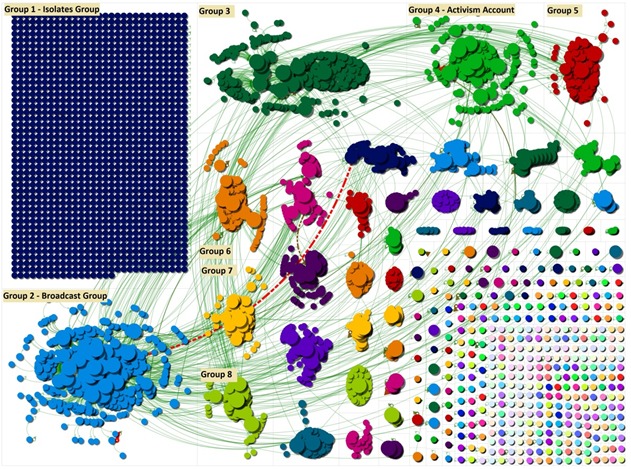
This paper performs a social network analysis and content analysis of Twitter data from a 7-day period (Friday, March 27, 2020, to Saturday, April 4, 2020) in which the #5GCoronavirus hashtag was trending on Twitter in the United Kingdom. Influential users were analyzed through social network graph clusters. The size of the nodes were ranked by their betweenness centrality score, and the graph's vertices were grouped by cluster using the Clauset-Newman-Moore algorithm. The topics and web sources used were also examined.

RESULTS

Social network analysis identified that the two largest network structures consisted of an isolates group and a broadcast group. The analysis also revealed that there was a lack of an authority figure who was actively combating such misinformation. Content analysis revealed that, of 233 sample tweets, 34.8% (n=81) contained views that 5G and COVID-19 were linked, 32.2% (n=75) denounced the conspiracy theory, and 33.0% (n=77) were general tweets not expressing any personal views or opinions. Thus, 65.2% (n=152) of tweets derived from nonconspiracy theory supporters, which suggests that, although the topic attracted high volume, only a handful of users genuinely believed the conspiracy. This paper also shows that fake news websites were the most popular web source shared by users; although, YouTube videos were also shared. The study also identified an account whose sole aim was to spread the conspiracy theory on Twitter.

CONCLUSIONS

The combination of quick and targeted interventions oriented to delegitimize the sources of fake information is key to reducing their impact. Those users voicing their views against the conspiracy theory, link baiting, or sharing humorous tweets inadvertently raised the profile of the topic, suggesting that policymakers should insist in the efforts of isolating opinions that are based on fake news. Many social media platforms provide users with the ability to report inappropriate content, which should be used. This study is the first to analyze the 5G conspiracy theory in the context of COVID-19 on Twitter offering practical guidance to health authorities in how, in the context of a pandemic, rumors may be combated in the future.
https://cdn.ncbi.nlm.nih.gov/pmc/blobs/36ab/7205032/3ce2319322f7/jmir_v22i5e19458_fig1.jpg
摘要

背景

自2019年12月初以来,冠状病毒病(COVID-19)在全球迅速传播,这引发了在线平台上越来越多的讨论。这些对话还包括社交媒体用户分享的各种阴谋论。其中,一个流行的理论将5G与COVID-19的传播联系起来,导致了错误信息的传播以及英国5G基站被烧毁。了解虚假新闻的驱动因素以及针对隔离和反驳错误信息的快速政策是打击虚假新闻的关键。

目的

本研究的目的是了解5G与COVID-19阴谋论的驱动因素以及应对此类错误信息的策略。

方法

本文对2020年3月27日星期五至2020年4月4日星期六这7天期间英国推特上#5G冠状病毒#标签趋势的推特数据进行了社会网络分析和内容分析。通过社会网络图聚类分析有影响力的用户。节点大小根据其介数中心性得分进行排名,图的顶点使用克劳塞特-纽曼-摩尔算法按聚类进行分组。还检查了所使用的主题和网络来源。

结果

社会网络分析发现,两个最大的网络结构由一个孤立群体和一个传播群体组成。分析还表明,缺乏一个积极打击此类错误信息的权威人物。内容分析显示,在233条样本推文中,34.8%(n = 81)包含5G与COVID-19有关联的观点,32.2%(n = 75)谴责了该阴谋论,33.0%(n = 77)是不表达任何个人观点或意见的普通推文。因此,65.2%(n = 152)的推文来自非阴谋论支持者,这表明尽管该话题吸引了大量关注,但只有少数用户真正相信这个阴谋论。本文还表明,虚假新闻网站是用户分享最多的网络来源;不过,YouTube视频也有被分享。该研究还识别出一个在推特上专门传播该阴谋论的账号。

结论

采取快速且有针对性的干预措施以使虚假信息来源失去合法性,是减少其影响的关键。那些表达反对阴谋论观点、链接诱饵或分享幽默推文的用户无意中提高了该话题的关注度,这表明政策制定者应坚持努力隔离基于虚假新闻的观点。许多社交媒体平台为用户提供了举报不当内容的功能,应该加以利用。本研究首次在推特上COVID-19背景下分析5G阴谋论,为卫生当局在大流行背景下未来如何打击谣言提供了实际指导。

相似文献

1
COVID-19 and the 5G Conspiracy Theory: Social Network Analysis of Twitter Data.新冠疫情与5G阴谋论:基于推特数据的社交网络分析
J Med Internet Res. 2020 May 6;22(5):e19458. doi: 10.2196/19458.
2
COVID-19 and the "Film Your Hospital" Conspiracy Theory: Social Network Analysis of Twitter Data.新冠疫情与“拍摄你的医院”阴谋论:基于推特数据的社交网络分析
J Med Internet Res. 2020 Oct 5;22(10):e22374. doi: 10.2196/22374.
3
Conversations and Medical News Frames on Twitter: Infodemiological Study on COVID-19 in South Korea.推特上的对话与医学新闻框架:韩国新冠肺炎信息流行病学研究
J Med Internet Res. 2020 May 5;22(5):e18897. doi: 10.2196/18897.
4
Temporal and Location Variations, and Link Categories for the Dissemination of COVID-19-Related Information on Twitter During the SARS-CoV-2 Outbreak in Europe: Infoveillance Study.欧洲SARS-CoV-2疫情期间推特上新冠疫情相关信息传播的时间和地点变化以及链接类别:信息监测研究
J Med Internet Res. 2020 Aug 28;22(8):e19629. doi: 10.2196/19629.
5
Top Concerns of Tweeters During the COVID-19 Pandemic: Infoveillance Study.新冠疫情期间推特用户的主要担忧:信息监测研究
J Med Internet Res. 2020 Apr 21;22(4):e19016. doi: 10.2196/19016.
6
"Thought I'd Share First" and Other Conspiracy Theory Tweets from the COVID-19 Infodemic: Exploratory Study.“我想率先分享”和其他有关 COVID-19 信息疫情的阴谋论推文:探索性研究。
JMIR Public Health Surveill. 2021 Apr 14;7(4):e26527. doi: 10.2196/26527.
7
Misinformation about spinal manipulation and boosting immunity: an analysis of Twitter activity during the COVID-19 crisis.关于脊柱推拿与增强免疫力的错误信息:对新冠疫情危机期间推特活动的分析
Chiropr Man Therap. 2020 Jun 9;28(1):34. doi: 10.1186/s12998-020-00319-4.
8
Twitter's Role in Combating the Magnetic Vaccine Conspiracy Theory: Social Network Analysis of Tweets.推特在打击磁性疫苗阴谋论中的作用:推特的社交网络分析
J Med Internet Res. 2023 Mar 31;25:e43497. doi: 10.2196/43497.
9
Cross-platform spread: vaccine-related content, sources, and conspiracy theories in YouTube videos shared in early Twitter COVID-19 conversations.跨平台传播:在早期 Twitter COVID-19 对话中分享的 YouTube 视频中的疫苗相关内容、来源和阴谋论。
Hum Vaccin Immunother. 2022 Dec 31;18(1):1-13. doi: 10.1080/21645515.2021.2003647. Epub 2022 Jan 21.
10
COVID-19 Vaccine Hesitancy on Social Media: Building a Public Twitter Data Set of Antivaccine Content, Vaccine Misinformation, and Conspiracies.社交媒体上对 COVID-19 疫苗的犹豫:构建一个关于反疫苗内容、疫苗错误信息和阴谋论的公共 Twitter 数据集。
JMIR Public Health Surveill. 2021 Nov 17;7(11):e30642. doi: 10.2196/30642.

引用本文的文献

1
Mapping Vaccine Sentiment by Analyzing Spanish-Language Social Media Posts and Survey-Based Public Opinion: Dual Methods Study.通过分析西班牙语社交媒体帖子和基于调查的公众舆论来绘制疫苗情绪:双方法研究
JMIR Infodemiology. 2025 Aug 29;5:e63223. doi: 10.2196/63223.
2
Modularity of Online Social Networks and COVID-19 Misinformation Spreading in Russia: Combining Social Network Analysis and National Representative Survey.俄罗斯在线社交网络的模块化与新冠疫情虚假信息传播:结合社交网络分析与全国代表性调查
JMIR Infodemiology. 2025 Jun 26;5:e58302. doi: 10.2196/58302.
3
: Exploring the challenges, concerns, and informational needs of vaccine-hesitant caregivers and pregnant women in the Philippines.

本文引用的文献

1
Data Mining and Content Analysis of the Chinese Social Media Platform Weibo During the Early COVID-19 Outbreak: Retrospective Observational Infoveillance Study.新冠疫情早期的中文社交媒体平台微博数据挖掘和内容分析:回顾性观察性信息监测研究。
JMIR Public Health Surveill. 2020 Apr 21;6(2):e18700. doi: 10.2196/18700.
2
Contextualising the 2019 E-Cigarette Health Scare: Insights from Twitter.从 Twitter 看 2019 年电子烟健康恐慌事件的背景
Int J Environ Res Public Health. 2020 Mar 26;17(7):2236. doi: 10.3390/ijerph17072236.
3
Coronavirus Disease 2019 (COVID-19) in Italy.
探索菲律宾对接种疫苗持犹豫态度的照料者和孕妇所面临的挑战、担忧及信息需求。
Public Health Chall. 2023 Jul 14;2(3):e105. doi: 10.1002/puh2.105. eCollection 2023 Sep.
4
Identification of Online Health Information Using Large Pretrained Language Models: Mixed Methods Study.使用大型预训练语言模型识别在线健康信息:混合方法研究。
J Med Internet Res. 2025 May 14;27:e70733. doi: 10.2196/70733.
5
The quality and reliability of online video resources concerning patient education for migraine treatment in China Mainland: an electronic media-based study.中国大陆偏头痛治疗患者教育在线视频资源的质量与可靠性:一项基于电子媒体的研究
BMC Public Health. 2025 Feb 18;25(1):656. doi: 10.1186/s12889-025-21861-x.
6
Organ Donation Conversations on X and Development of the OrgReach Social Media Marketing Strategy: Social Network Analysis.关于X平台上的器官捐赠对话与OrgReach社交媒体营销策略的制定:社交网络分析
J Med Internet Res. 2025 Feb 6;27:e59872. doi: 10.2196/59872.
7
When Infodemic Meets Epidemic: Systematic Literature Review.当信息疫情遇上疫情:系统文献综述
JMIR Public Health Surveill. 2025 Feb 3;11:e55642. doi: 10.2196/55642.
8
Cross-Cultural Sense-Making of Global Health Crises: A Text Mining Study of Public Opinions on Social Media Related to the COVID-19 Pandemic in Developed and Developing Economies.全球卫生危机的跨文化意义建构:关于发达经济体和发展中经济体社交媒体上与新冠疫情相关公众舆论的文本挖掘研究
J Med Internet Res. 2025 Jan 27;27:e58656. doi: 10.2196/58656.
9
Mapping the Mpox discourse: A network and sentiment analysis.绘制猴痘话语图谱:网络与情感分析
Explor Res Clin Soc Pharm. 2024 Oct 9;16:100521. doi: 10.1016/j.rcsop.2024.100521. eCollection 2024 Dec.
10
Racial Biases Associated With Pulse Oximetry: Longitudinal Social Network Analysis of Social Media Advocacy Impact.种族偏见与脉搏血氧饱和度测定仪相关:社交媒体宣传影响的纵向社会网络分析。
J Med Internet Res. 2024 Oct 8;26:e56034. doi: 10.2196/56034.
意大利的2019冠状病毒病(COVID-19)。
JAMA. 2020 Apr 14;323(14):1335. doi: 10.1001/jama.2020.4344.
4
World Health Organization declares global emergency: A review of the 2019 novel coronavirus (COVID-19).世界卫生组织宣布全球紧急状态:对 2019 年新型冠状病毒(COVID-19)的回顾。
Int J Surg. 2020 Apr;76:71-76. doi: 10.1016/j.ijsu.2020.02.034. Epub 2020 Feb 26.
5
A new coronavirus associated with human respiratory disease in China.一种在中国与人类呼吸道疾病相关的新型冠状病毒。
Nature. 2020 Mar;579(7798):265-269. doi: 10.1038/s41586-020-2008-3. Epub 2020 Feb 3.
6
Public health implications of #ShoutYourAbortion.# 呼吁公开堕胎# 带来的公共健康问题
Public Health. 2018 Oct;163:35-41. doi: 10.1016/j.puhe.2018.06.010. Epub 2018 Jul 27.
7
The Importance of Debiasing Social Media Data to Better Understand E-Cigarette-Related Attitudes and Behaviors.消除社交媒体数据偏差以更好理解电子烟相关态度和行为的重要性。
J Med Internet Res. 2016 Aug 9;18(8):e219. doi: 10.2196/jmir.6185.
8
Pandemics in the age of Twitter: content analysis of Tweets during the 2009 H1N1 outbreak.推特时代的大流行疫情:2009 年 H1N1 爆发期间推文的内容分析。
PLoS One. 2010 Nov 29;5(11):e14118. doi: 10.1371/journal.pone.0014118.
9
Responding to global infectious disease outbreaks: lessons from SARS on the role of risk perception, communication and management.应对全球传染病爆发:非典在风险认知、沟通与管理方面的经验教训
Soc Sci Med. 2006 Dec;63(12):3113-23. doi: 10.1016/j.socscimed.2006.08.004. Epub 2006 Sep 15.