Department of Cardiovascular Medicine, the First Affiliated Hospital of Medical College, Xi'an Jiaotong University, Xi'an, 710061, China.
Department of Gynaecology and Obstetrics, the First Affiliated Hospital of Medical College, Xi'an Jiaotong University, Xi'an, 710061, China.
BMC Pregnancy Childbirth. 2018 Jun 27;18(1):265. doi: 10.1186/s12884-018-1798-x.
To determine the relationship between maternal anxiety and cortisol values and birth weight at various stages of pregnancy.
Two hundred sixteen pregnant Chinese women were assessed for anxiety and depression and had measurement of morning fasting serum cortisol. Women were assessed either in the first (71), second (72) or third (73) trimester. Birth weights of all children were recorded.
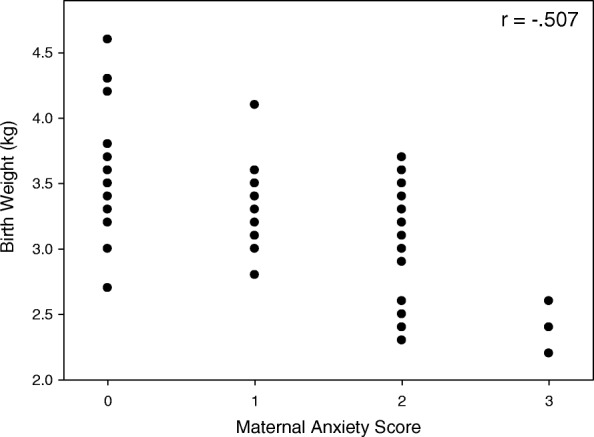
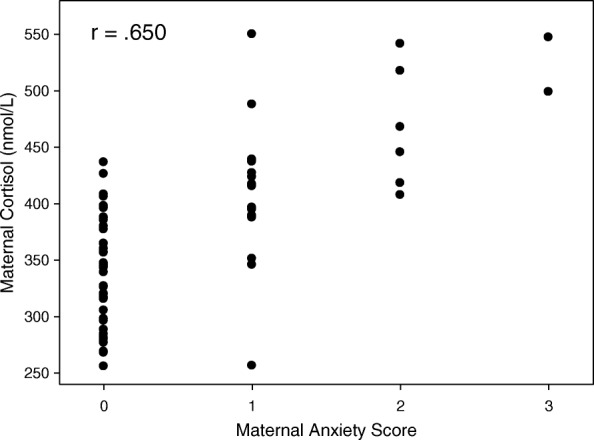
There were significant negative correlations between anxiety level and birth weight of - 0.507 (p < 0.01) and - 0.275 (p < 0.05) in trimesters 1and 2. In trimester 3 the negative relation between anxiety and birth weight of -.209 failed to reach significance (p = 0.070). There was no relation between depression and birth weight in any trimester (p > 0.5 for all). Maternal cortisol was significantly inversely related to birth weight in trimester 1 (r = - 0.322) and with borderline significance in trimester 2 (r = - 0.229). Anxiety score and maternal cortisol were significantly correlated in each trimester (r = 0.551, 0.650, 0.537). When both anxiety score and maternal cortisol were simultaneously included in multiple regression analyses only anxiety score remained significant.
Whilst both maternal anxiety score and maternal cortisol are inversely related to birth weight the associations with anxiety score were more robust perhaps indicating the importance of mechanisms other than, or in addition to, maternal cortisol in mediating the effects of anxiety. The findings indicate the importance of measures to reduce maternal anxiety, particularly of a severe degree, at all stages of pregnancy.
The study was approved by the Ethics Committee of the 1st Affiliated Hospital of Xi'an Jiaotong University.
确定孕妇在妊娠各阶段的焦虑与皮质醇值和出生体重之间的关系。
对 16 名中国孕妇进行焦虑和抑郁评估,并测量早晨空腹血清皮质醇。这些女性在第一(71 名)、第二(72 名)或第三(73 名)孕期进行评估。所有孩子的出生体重均有记录。
在第 1 期和第 2 期,焦虑水平与出生体重呈显著负相关,分别为-0.507(p<0.01)和-0.275(p<0.05)。在第 3 期,焦虑与出生体重的负相关关系为-0.209,未达到显著性(p=0.070)。在任何孕期,抑郁与出生体重均无相关性(p>0.5)。在第 1 期,母体皮质醇与出生体重呈显著负相关(r=-0.322),在第 2 期呈边缘显著相关(r=-0.229)。在每一孕期,焦虑评分与母体皮质醇均显著相关(r=0.551、0.650、0.537)。当同时将焦虑评分和母体皮质醇纳入多元回归分析时,只有焦虑评分仍然具有显著性。
虽然母体焦虑评分和母体皮质醇均与出生体重呈负相关,但与焦虑评分的相关性更为稳健,这表明在介导焦虑的影响方面,除了母体皮质醇之外,可能还有其他机制在起作用。研究结果表明,在妊娠的各个阶段,都需要采取措施来减少母体的焦虑,尤其是严重程度的焦虑。
本研究得到了西安交通大学第一附属医院伦理委员会的批准。