Yan Yi-Dan, Zhang Chi, Shen Long, Su Ying-Jie, Liu Xiao-Yan, Wang Li-Wei, Gu Zhi-Chun
Department of Pharmacy, Renji Hospital, School of Medicine, Shanghai Jiaotong University, Shanghai, China.
Department of Cardiology, Renji Hospital, School of Medicine, Shanghai Jiaotong University, Shanghai, China.
Front Pharmacol. 2018 Jun 12;9:575. doi: 10.3389/fphar.2018.00575. eCollection 2018.
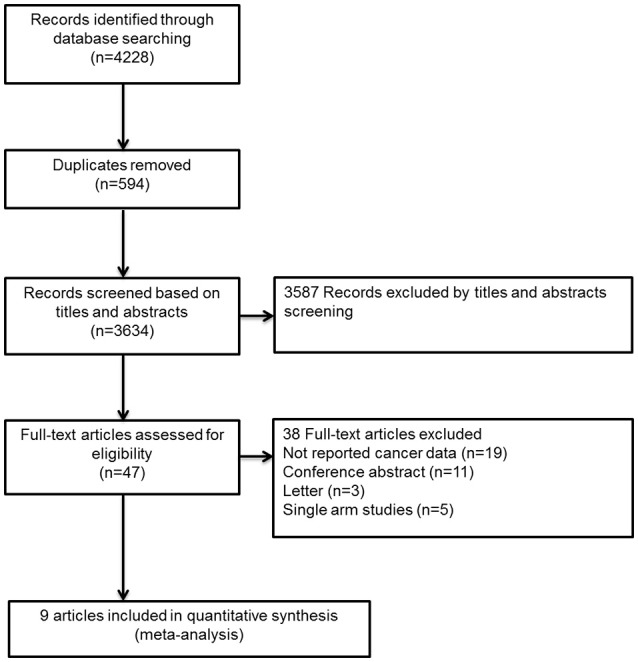
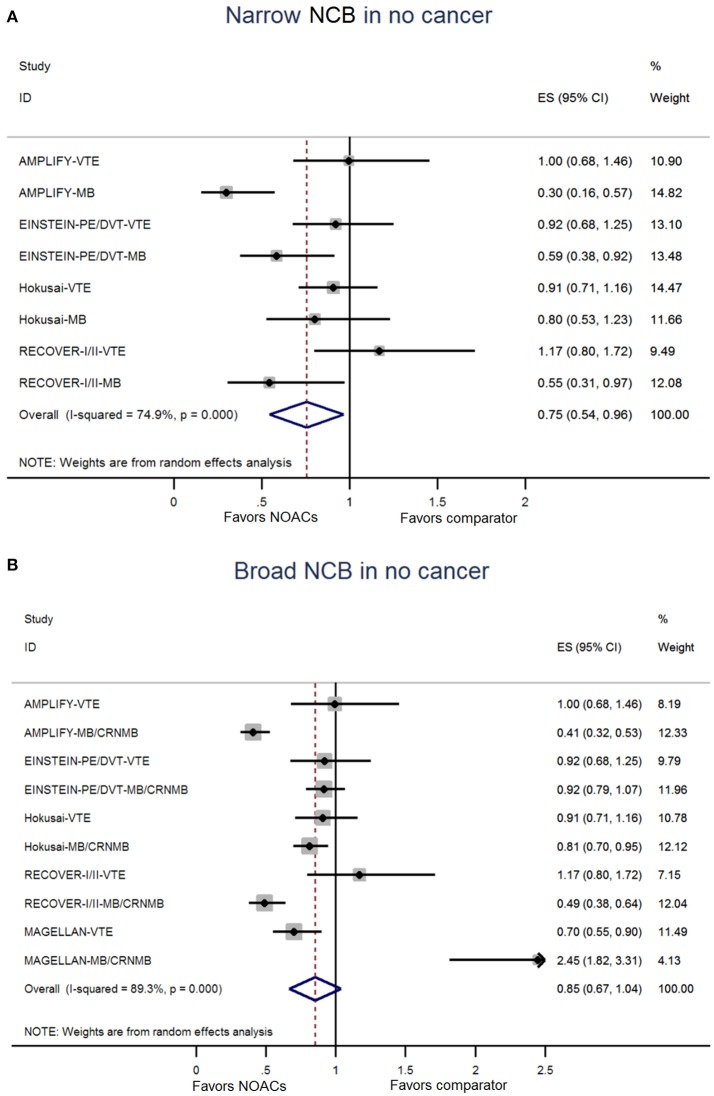
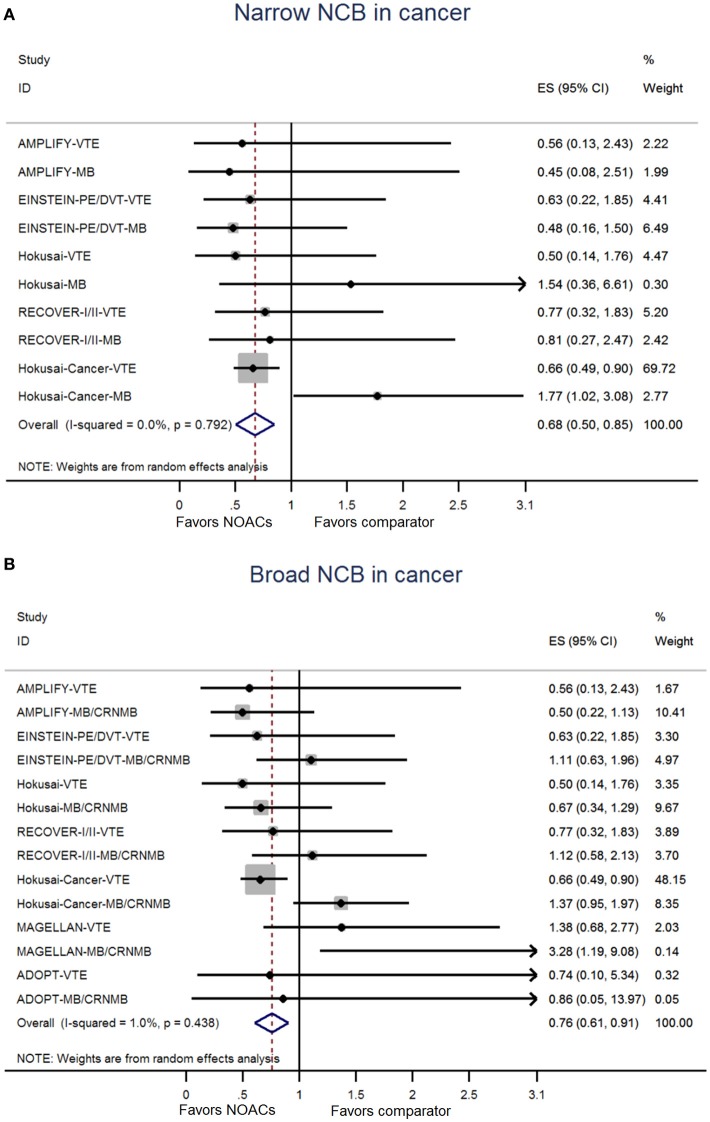
Venous thromboembolism (VTE) is highly prevalent in patients with cancer. Non-vitamin K antagonist oral anticoagulants (NOACs), directly targeting the enzymatic activity of thrombin or factor Xa, have been shown to be as effective as and safer than traditional anticoagulation for VTE prophylaxis in no-cancer patients. However, related studies that focused on the anticoagulation in cancer patients are lacked, and almost no net clinical benefit (NCB) analyses that quantified both VTE events and bleeding events have been addressed in this fragile population. Therefore, we aim to investigate this issue using a systematic review and NCB analysis. A comprehensive search of Medline, Embase, and Cochrane Library were performed for randomized controlled trials (RCTs) that reported the VTE events and major bleeding of NOACs and traditional anticoagulants in patients with or without cancer. Odds ratios (ORs) and 95% confidence intervals (CIs) of VTE and bleeding events were calculated using a random-effects model. The primacy outcome of narrow NCB was calculated by pooling ORs of VTE and major bleeding, with a weighting of 1.0. Similarly, the broad NCB was calculated by pooling ORs of VTE and clinically relevant bleeding. Heterogeneity was assessed through test and Q statistic, and subgroup analyses were performed on the basis of different patients (VTE patients or acutely ill patients), comparators (vitamin-K antagonists or low-molecular-weight heparin), and follow-up duration (≤6 months or >6 months). Overall, 9 RCTs including 41,454 patients were enrolled, of which 2,902 (7%) were cancer patients, and 38,552 (93%) were no-cancer patients; 20,712 (50%) were administrated with NOACs and 20,742 (50%) were administrated with traditional anticoagulants. The use of NOACs had a superior NCB than traditional anticoagulation in both cancer patients (OR: 0.68, 95%CI: 0.50-0.85 for narrow NCB; OR: 0.76, 95%CI: 0.61-0.91 for broad NCB) and no-cancer patients (OR: 0.75, 95%CI: 0.54-0.96 for narrow NCB; OR: 0.85, 95%CI: 0.67-1.04 for broad NCB), with the estimates mainly from VTE patients receiving long-term warfarin treatment. In conclusion, NOACs may represent a better NCB property compared to traditional anticoagulants in cancer patients who need long-term anticoagulation treatment.
静脉血栓栓塞症(VTE)在癌症患者中极为常见。非维生素K拮抗剂口服抗凝剂(NOACs)直接作用于凝血酶或Xa因子的酶活性,已被证明在非癌症患者的VTE预防中与传统抗凝治疗效果相当且更安全。然而,针对癌症患者抗凝治疗的相关研究较少,在这个脆弱群体中,几乎没有对VTE事件和出血事件进行量化的净临床获益(NCB)分析。因此,我们旨在通过系统评价和NCB分析来研究这个问题。我们全面检索了Medline、Embase和Cochrane图书馆,以查找报告了NOACs和传统抗凝剂在有或无癌症患者中的VTE事件和大出血情况的随机对照试验(RCTs)。使用随机效应模型计算VTE和出血事件的比值比(ORs)及95%置信区间(CIs)。通过汇总VTE和大出血的ORs计算狭义NCB的主要结局,权重为1.0。同样,通过汇总VTE和临床相关出血的ORs计算广义NCB。通过检验和Q统计量评估异质性,并根据不同患者(VTE患者或急性病患者)、对照(维生素K拮抗剂或低分子肝素)以及随访持续时间(≤6个月或>6个月)进行亚组分析。总体而言,共纳入9项RCTs,涉及41454例患者,其中2902例(7%)为癌症患者,38552例(93%)为非癌症患者;20712例(50%)接受NOACs治疗,20742例(50%)接受传统抗凝剂治疗。在癌症患者(狭义NCB的OR:0.68,95%CI:0.50 - 0.85;广义NCB的OR:0.76,95%CI:0.61 - 0.91)和非癌症患者(狭义NCB的OR:0.75,95%CI:0.54 - 0.96;广义NCB的OR:0.85,95%CI:0.67 - 1.04)中,使用NOACs的NCB均优于传统抗凝治疗,估计值主要来自接受长期华法林治疗的VTE患者。总之,在需要长期抗凝治疗的癌症患者中,与传统抗凝剂相比,NOACs可能具有更好的NCB特性。