National Institute for Health Research Blood and Transplant Research Unit (NIHR BTRU) in Organ Donation and Transplantation, University of Cambridge, Newcastle University, Newcastle upon Tyne, UK.
NHS Blood and Transplant (NHSBT), NIHR Cambridge Biomedical Research Centre, Cambridge, UK.
Am J Transplant. 2018 Nov;18(11):2739-2751. doi: 10.1111/ajt.14989. Epub 2018 Jul 30.
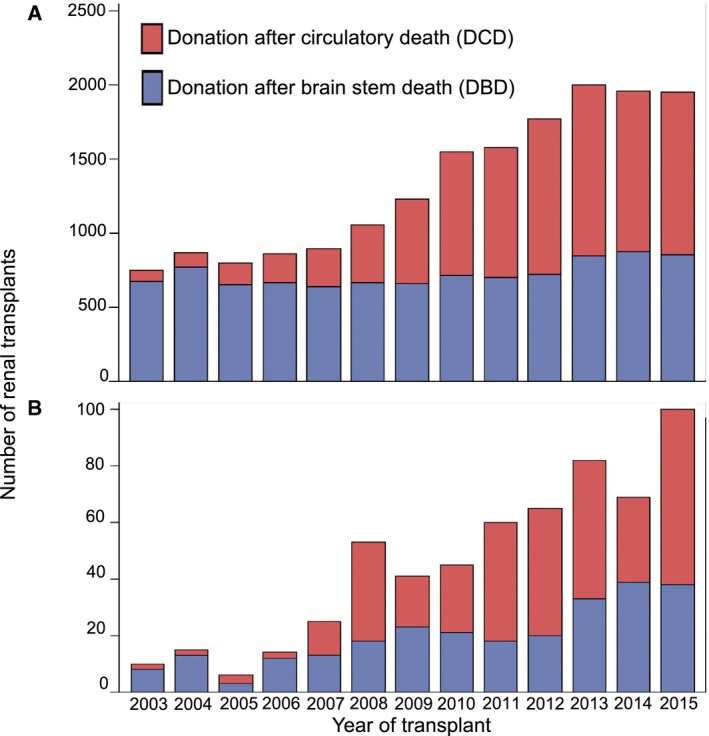
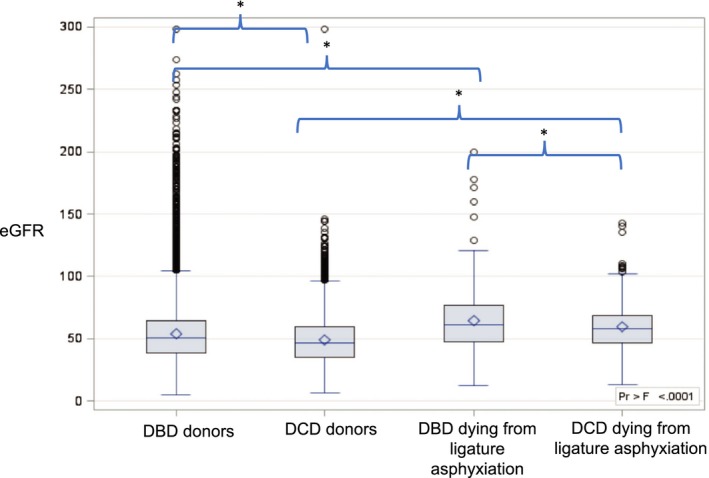
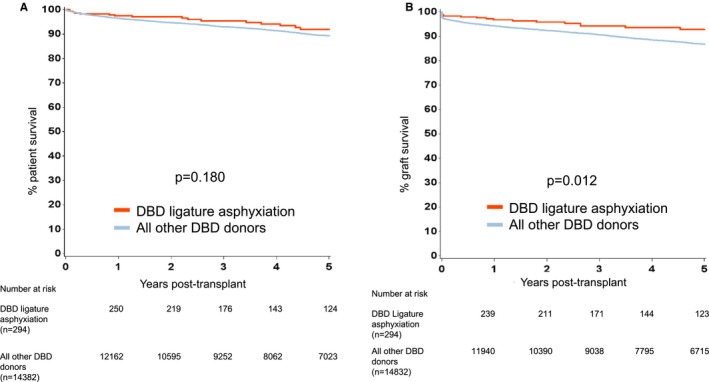
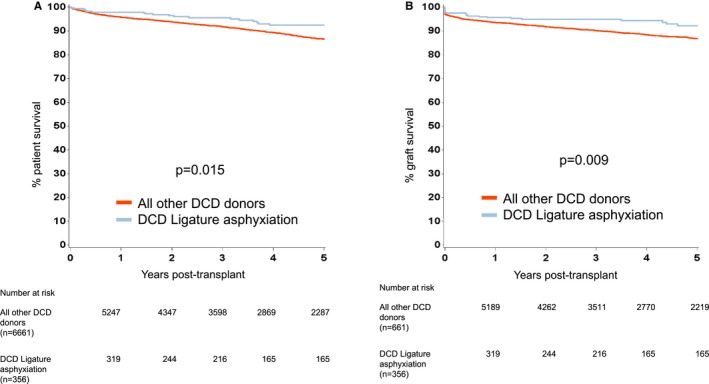
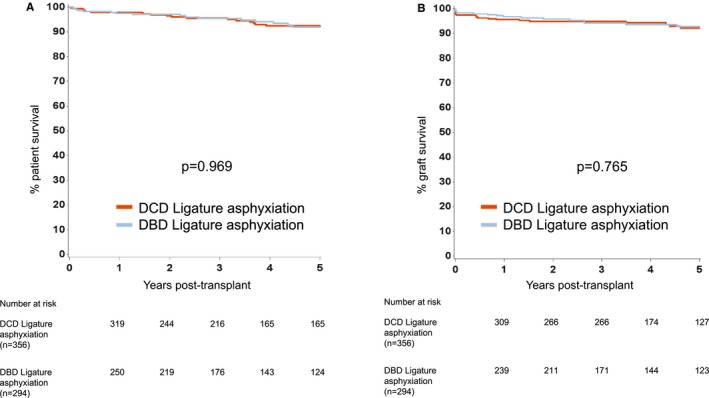
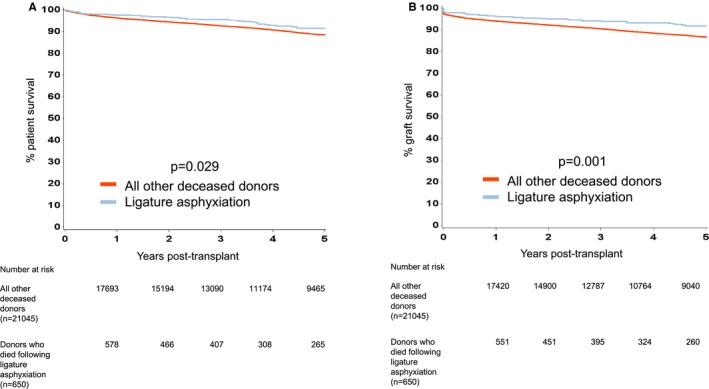
There is uncertainty about whether hypoxic injury accompanying donor death from ligature asphyxiation influences renal transplant outcomes, particularly for recipients of kidneys donated after circulatory death (DCD). The UK Registry analysis was undertaken to determine transplant outcomes in recipients of kidneys from donors who died following ligature asphyxiation. From 2003 to 2016, 2.7% (n = 521) of potential organ donors died following ligature asphyxiation (mostly suicide by hanging). Of these, 409 (78.5%) donated kidneys for transplantation (46.9% donation after brain death [DBD] and 53.1% DCD donors) resulting in 650 kidney transplants. Compared to other deceased donors, those dying from ligature asphyxiation were younger, more often male, and had less hypertension. Unadjusted patient and graft survival were superior for recipients of both DBD and DCD kidneys from donors dying after ligature asphyxiation, although after adjustment for donor/recipient variables, transplant outcomes were similar. A case-control matched analysis confirmed transplant outcomes for those who received kidneys from donors dying after ligature asphyxiation were similar to controls. Although caution is required in interpreting these findings because of potential selection bias, kidneys from donors dying of ligature asphyxiation suffer an additional warm ischemic insult that does not apparently adversely influence transplant outcomes, even for kidneys from DCD donors.
关于伴随勒颈窒息导致供体死亡的缺氧损伤是否会影响肾移植结局,特别是对于接受循环死亡后捐献的肾脏(DCD)的受者,目前仍存在不确定性。英国注册处的分析旨在确定接受勒颈窒息后死亡的供者捐献的肾脏的移植结局。2003 年至 2016 年,2.7%(n=521)的潜在器官供者在勒颈窒息后死亡(主要是上吊自杀)。其中,409 例(78.5%)捐献肾脏进行移植(46.9%为脑死亡后捐献[DBD],53.1%为 DCD 供者),共进行了 650 例肾移植。与其他已故供者相比,勒颈窒息后死亡的供者更年轻,男性更多,高血压更少。未调整的患者和移植物存活率在 DBD 和 DCD 供者中均优于接受勒颈窒息后死亡供者的肾脏移植,尽管在调整了供者/受者变量后,移植结局相似。病例对照匹配分析证实,接受勒颈窒息后死亡供者的肾脏的移植结局与对照组相似。尽管由于潜在的选择偏倚,对这些发现的解释需要谨慎,但勒颈窒息导致供体死亡的肾脏会遭受额外的热缺血损伤,这似乎不会对移植结局产生不利影响,即使是来自 DCD 供者的肾脏也是如此。