Prado Paulo Sousa, Almeida Júnior José Teófilo Duarte, Abreu Lanna Takada de, Silva Cristina Gabriel, Souza Larissa da Costa, Gomes Marizoneide Cavalcante, Mendes Lucinda Malheiros Teixeira, Santos Eliane Maria Dos, Romero Gustavo Adolfo Sierra
Universidade de Brasília, Núcleo de Medicina Tropical, Brasília, DF, Brasil.
Laboratório Central de Saúde Pública, Brasília, DF, Brasil.
Mem Inst Oswaldo Cruz. 2018 Jun 25;113(8):e170433. doi: 10.1590/0074-02760170433.
The diagnosis of dengue is complex. Until recently, only specialised laboratories were able to confirm dengue infection. However, this has changed with the newly available immunochromatographic rapid tests. Early diagnosis is of great interest, and point-of-care rapid tests have been increasingly used in Brazil. Most of those tests have not undergone validation in the Brazilian population. In this context, we decided to evaluate a rapid test introduced in the Federal District (FD).
To estimate the accuracy and reliability of the SD Bioeasy Dengue Duo rapid test and its components to detect dengue infections in a consecutive sample of symptomatic residents in the FD, Brazil.
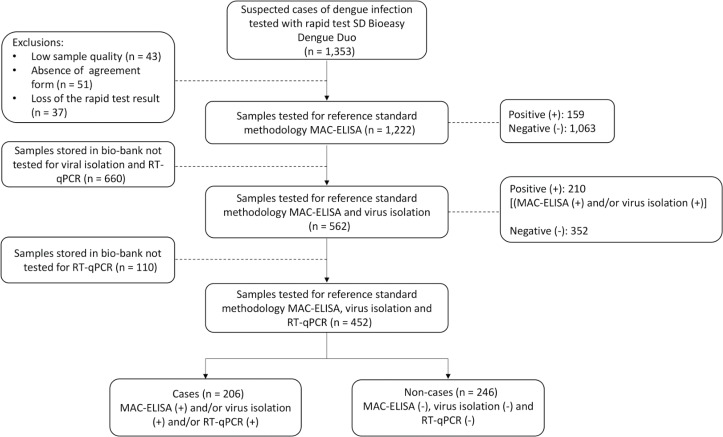
In total, 1353 venous blood samples were collected between 2013 and 2014. Two hundred and six positive samples (cases) and 246 negative samples (non cases) were required for sensitivity and specificity estimation, respectively; for agreement evaluation, we used 401 samples. The reference standard used was a composite of MAC-ELISA, virus isolation and real-time polymerase chain reaction (RT-qPCR). The evaluation was conducted prospectively under field conditions in the public health units of the FD.
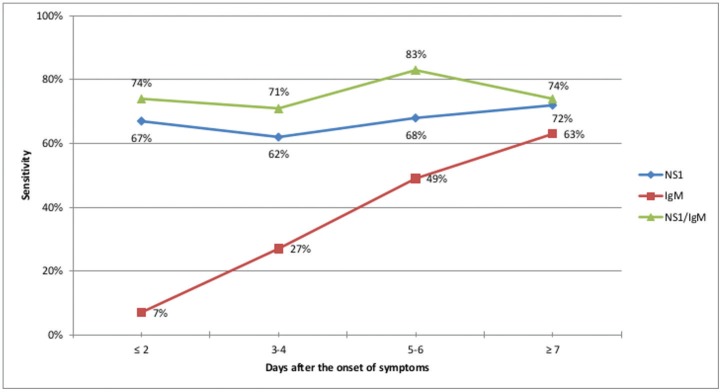
The results for the overall accuracy of the rapid test (NS1/IgM combined) showed 76% sensitivity and 98% specificity. The sensitivity for the NS1 component (67%) was better than that for the IgM component (35%). The positive likelihood ratio was 46, and the negative likelihood ratio was 0.24. The reliability of the test (NS1/IgM combined) demonstrated crude agreement of 98% (Kappa index 0.94).
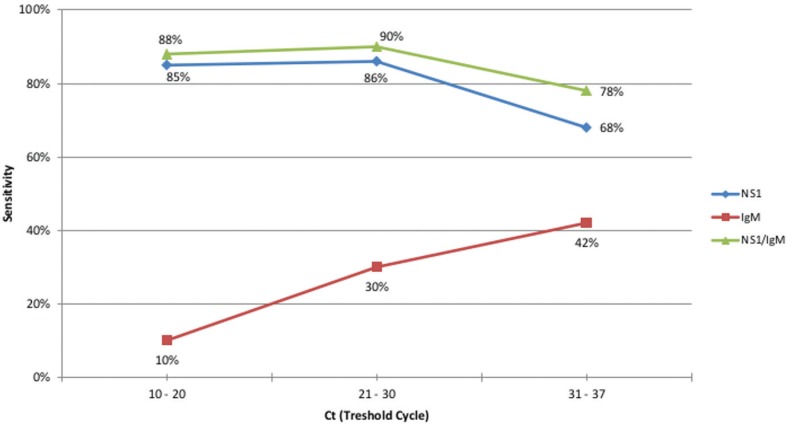
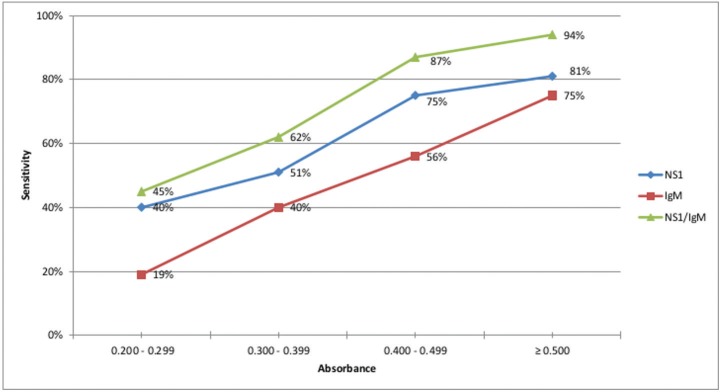
The present phase III, large-scale validation study demonstrates that the rapid test SD Bioeasy Dengue Duo has moderate sensitivity (NS1/IgM combined) and high specificity. Therefore, the test is useful in confirming the diagnosis of dengue, but not enough to rule out the diagnosis. Our results also suggest that Dengue virus (DENV) viral load estimated through the RT-qPCR and antibody level measured through the MAC-ELISA could have had a direct influence on the accuracy of the rapid test.
登革热的诊断较为复杂。直到最近,只有专业实验室才能确诊登革热感染。然而,随着新出现的免疫层析快速检测方法,这种情况已有所改变。早期诊断备受关注,即时检测快速检测方法在巴西的使用越来越广泛。这些检测方法大多尚未在巴西人群中进行验证。在此背景下,我们决定对在联邦区(FD)引入的一种快速检测方法进行评估。
评估SD Bioeasy Dengue Duo快速检测方法及其各组分在巴西联邦区有症状居民连续样本中检测登革热感染的准确性和可靠性。
2013年至2014年期间共采集了1353份静脉血样本。分别需要206份阳性样本(病例)和246份阴性样本(非病例)来估计灵敏度和特异性;为进行一致性评估,我们使用了401份样本。所使用的参考标准是MAC-ELISA、病毒分离和实时聚合酶链反应(RT-qPCR)的组合。评估是在联邦区公共卫生单位的现场条件下前瞻性进行的。
快速检测方法(NS1/IgM联合检测)的总体准确性结果显示灵敏度为76%,特异性为98%。NS1组分的灵敏度(67%)高于IgM组分(35%)。阳性似然比为46,阴性似然比为0.24。检测方法(NS1/IgM联合检测)的可靠性显示粗一致性为98%(kappa指数为0.94)。
目前的III期大规模验证研究表明,SD Bioeasy Dengue Duo快速检测方法具有中等灵敏度(NS1/IgM联合检测)和高特异性。因此,该检测方法有助于确诊登革热,但不足以排除诊断。我们的结果还表明,通过RT-qPCR估计的登革热病毒(DENV)病毒载量和通过MAC-ELISA测量的抗体水平可能直接影响快速检测方法的准确性。