Department of Gene Therapy & Regenerative Medicine, Vrije Universiteit Brussel, Brussels 1090, Belgium.
Department of Human Genetics, University of Leuven, Leuven 3000, Belgium.
Nucleic Acids Res. 2018 Sep 19;46(16):8275-8298. doi: 10.1093/nar/gky548.
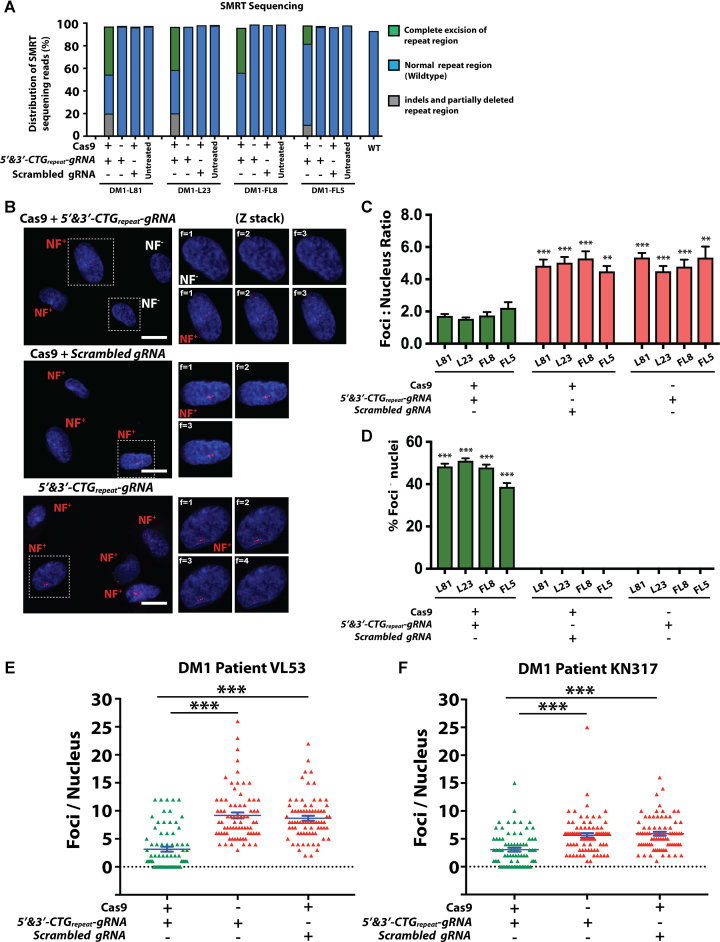
CRISPR/Cas9 is an attractive platform to potentially correct dominant genetic diseases by gene editing with unprecedented precision. In the current proof-of-principle study, we explored the use of CRISPR/Cas9 for gene-editing in myotonic dystrophy type-1 (DM1), an autosomal-dominant muscle disorder, by excising the CTG-repeat expansion in the 3'-untranslated-region (UTR) of the human myotonic dystrophy protein kinase (DMPK) gene in DM1 patient-specific induced pluripotent stem cells (DM1-iPSC), DM1-iPSC-derived myogenic cells and DM1 patient-specific myoblasts. To eliminate the pathogenic gain-of-function mutant DMPK transcript, we designed a dual guide RNA based strategy that excises the CTG-repeat expansion with high efficiency, as confirmed by Southern blot and single molecule real-time (SMRT) sequencing. Correction efficiencies up to 90% could be attained in DM1-iPSC as confirmed at the clonal level, following ribonucleoprotein (RNP) transfection of CRISPR/Cas9 components without the need for selective enrichment. Expanded CTG repeat excision resulted in the disappearance of ribonuclear foci, a quintessential cellular phenotype of DM1, in the corrected DM1-iPSC, DM1-iPSC-derived myogenic cells and DM1 myoblasts. Consequently, the normal intracellular localization of the muscleblind-like splicing regulator 1 (MBNL1) was restored, resulting in the normalization of splicing pattern of SERCA1. This study validates the use of CRISPR/Cas9 for gene editing of repeat expansions.
CRISPR/Cas9 是一种极具吸引力的平台,可通过基因编辑实现精准治疗,从而有潜力纠正显性遗传疾病。在目前的原理验证研究中,我们通过在 DM1 患者特异性诱导多能干细胞(DM1-iPSC)、DM1-iPSC 衍生的肌细胞和 DM1 患者特异性成肌细胞中编辑肌强直性营养不良蛋白激酶(DMPK)基因 3'-非翻译区(UTR)中的 CTG 重复扩增,探索了 CRISPR/Cas9 在肌强直性营养不良 1 型(DM1)中的基因编辑作用。DM1 是一种常染色体显性肌肉疾病,为消除致病性功能获得型突变 DMPK 转录本,我们设计了一种基于双向导 RNA 的策略,该策略能高效切除 CTG 重复扩增,Southern 印迹和单分子实时(SMRT)测序均证实了这一点。通过在无选择性富集的情况下转染 CRISPR/Cas9 组件的核糖核蛋白(RNP),在克隆水平上确认 DM1-iPSC 中的校正效率高达 90%。扩展的 CTG 重复切除导致纠正的 DM1-iPSC、DM1-iPSC 衍生的肌细胞和 DM1 成肌细胞中核仁核糖核蛋白焦点消失,这是 DM1 的典型细胞表型。因此,肌肉盲样剪接调节剂 1(MBNL1)的正常细胞内定位得到恢复,导致 SERCA1 的剪接模式正常化。这项研究验证了 CRISPR/Cas9 用于重复扩展的基因编辑。