Department of Psychiatry, Erasmus University Medical Center, 's-Gravendijkwal 230, 3015 CE, Rotterdam, The Netherlands.
Department of Child and Adolescent Psychiatry, Erasmus University Medical Center, Rotterdam, The Netherlands.
Eur Child Adolesc Psychiatry. 2018 Sep;27(9):1209-1230. doi: 10.1007/s00787-018-1177-1. Epub 2018 Jun 11.
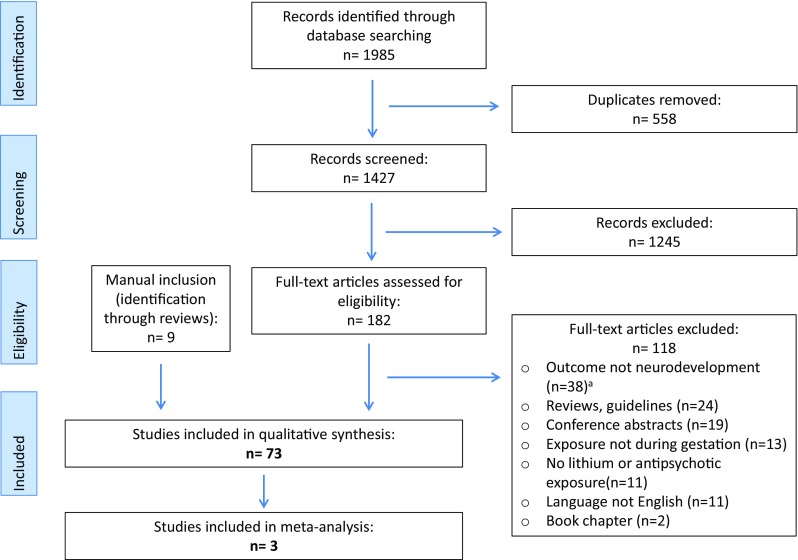
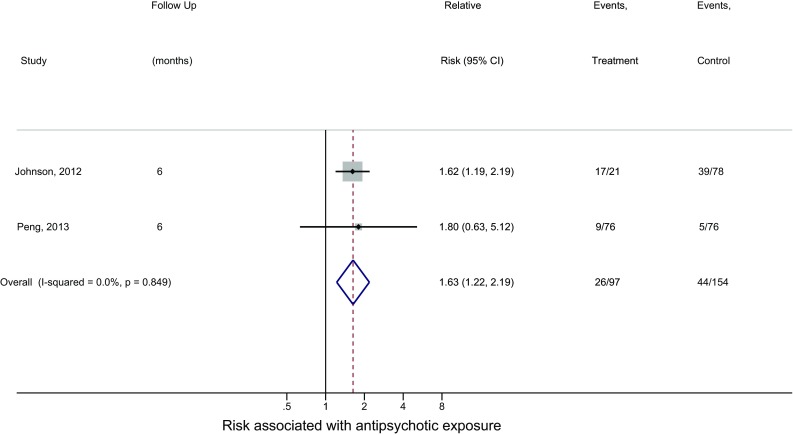
Lithium and antipsychotics are often prescribed to treat bipolar disorder or psychotic disorders in women of childbearing age. Little is known about the consequences of these medications during pregnancy for the developing child. The objective of this article is to systematically review findings from preclinical and clinical studies that have examined the neurodevelopmental consequences of intrauterine exposure to lithium and antipsychotics. A systematic search was performed in Embase, Medline, Web of Science, PsychINFO, Cochrane, and Google Scholar. Clinical and experimental studies were selected if they investigated neurodevelopment of offspring exposed to lithium or antipsychotics during gestation. Quality of clinical and preclinical studies was assessed by the Newcastle-Ottawa Scale and the SYRCLE's risk of Bias tool, respectively. In total, 73 studies were selected for qualitative synthesis and three studies were selected for quantitative synthesis. Of preclinical studies, 93% found one or more adverse effects of prenatal exposure to antipsychotics or lithium on neurodevelopment or behaviour. Only three clinical cohort studies have investigated the consequences of lithium exposure, all of which reported normal development. In 66% of clinical studies regarding antipsychotic exposure, a transient delay in neurodevelopment was observed. The relative risk for neuromotor deficits after in utero exposure to antipsychotics was estimated to be 1.63 (95% CI 1.22-2.19; I = 0%). Preclinical studies suggest long-term adverse neurodevelopmental consequences of intrauterine exposure to either lithium or antipsychotics. However, there is a lack of high-quality clinical studies. Interpretation is difficult, since most studies have compared exposed children with their peers from the unaffected population, which did not allow correction for potential influences regarding genetic predisposition or parental psychiatric illness.
锂盐和抗精神病药常用于治疗育龄期女性的双相情感障碍或精神病性障碍。然而,人们对于这些药物在妊娠期间对发育中胎儿的影响知之甚少。本文的目的是系统综述检查子宫内暴露于锂盐和抗精神病药对神经发育影响的临床前和临床研究结果。我们在 Embase、Medline、Web of Science、PsychINFO、Cochrane 和 Google Scholar 中进行了系统性检索。如果研究调查了暴露于锂盐或抗精神病药的胎儿在妊娠期间的神经发育情况,则选择临床和实验研究。分别使用纽卡斯尔-渥太华量表和 SYRCLE 的偏倚风险工具评估临床和临床前研究的质量。总共选择了 73 项研究进行定性综合分析,选择了 3 项研究进行定量综合分析。在临床前研究中,93%的研究发现产前暴露于抗精神病药或锂盐对神经发育或行为有一个或多个不良影响。仅有 3 项关于锂暴露的临床队列研究调查了锂暴露的后果,所有研究均报告了正常的发育情况。在 66%的关于抗精神病药暴露的临床研究中,观察到神经发育的短暂延迟。在子宫内暴露于抗精神病药后出现神经运动缺陷的相对风险估计为 1.63(95%CI 1.22-2.19;I=0%)。临床前研究表明,子宫内暴露于锂盐或抗精神病药都与长期不良的神经发育后果有关。然而,目前缺乏高质量的临床研究。由于大多数研究将暴露儿童与未受影响人群的同龄人进行比较,无法纠正潜在的遗传易感性或父母精神疾病的影响,因此解释较为困难。