Medical Oncology, CHA Bundang Medical Center, CHA University, Seongnam, South Korea.
Yonsei Graduate School, Yonsei University College of Medicine, Seoul, South Korea.
Gastric Cancer. 2019 Jan;22(1):113-122. doi: 10.1007/s10120-018-0847-5. Epub 2018 Jun 9.
The prognostic impact of preoperative F-FDG PET/CT in advanced gastric cancer (AGC) remains a matter of debate. This study aims to evaluate the prognostic impact of SUV in preoperative F-FDG PET/CT of AGC according to histologic subtype, with a focus on the differences between tubular adenocarcinoma and signet ring cell (SRC) carcinoma.
As a discovery set, a total of 727 AGC patients from prospective database were analyzed according to histologic subtype with Cox proportional hazard model and p-spline curves. In addition, another 173 patients from an independent institution was assessed as an external validation set.
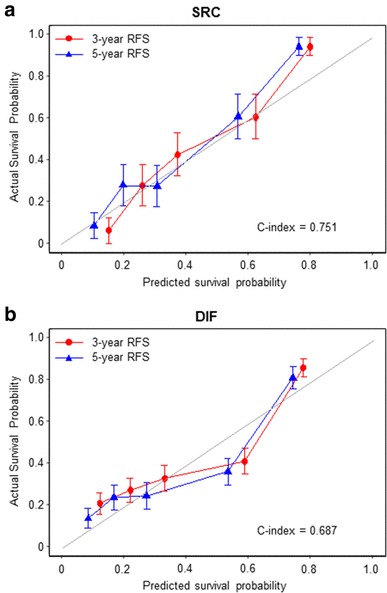
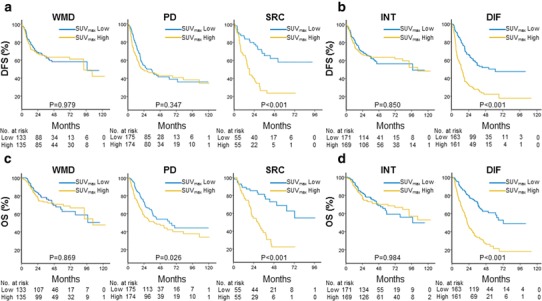
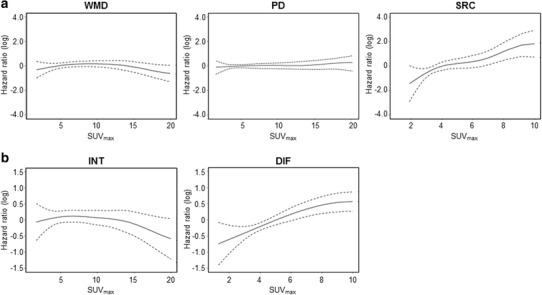
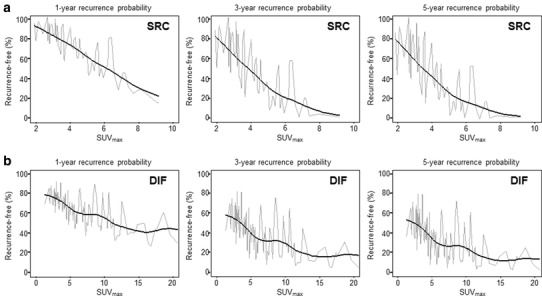
In multivariate analysis, high SUV in preoperative F-FDG PET/CT of AGC was negatively correlated with disease-free survival (DFS) and overall survival (OS) in patients with diffuse type (DFS: HR 2.17, P < 0.001; OS: HR 2.47, P < 0.001) or SRC histology (DFS: HR 2.26, P = 0.005; OS: HR 2.61, P = 0.003). This negative prognostic impact was not observed in patients with intestinal type or well or moderately differentiated histology. These findings have been consistently confirmed in a validation set. The p-spline curves also showed a gradual increase in log HR as SUV rises only for SRC histology and for diffuse-type AGC. Finally, a novel predictive model for recurrence of AGC with diffuse type or SRC histology was generated and validated based on the preoperative SUV.
Preoperative high SUV of AGC is a poor prognostic factor in those with diffuse type or SRC histology. This study is the first to demonstrate the differential prognostic impact of preoperative PET/CT SUV in AGC according to histologic subtype and provide a clue to explain previous discrepancies in the prognostic impact of preoperative PET/CT in AGC. Prospective studies are required to validate the role of preoperative SUV in AGC.
术前 F-FDG PET/CT 对晚期胃癌(AGC)的预后影响仍存在争议。本研究旨在根据组织学亚型评估术前 F-FDG PET/CT 中 SUV 对 AGC 的预后影响,重点关注管状腺癌和印戒细胞癌(SRC)之间的差异。
作为发现集,根据组织学亚型,对来自前瞻性数据库的总共 727 例 AGC 患者进行 Cox 比例风险模型和 p-样条曲线分析。此外,来自另一个独立机构的 173 例患者被评估为外部验证集。
在多变量分析中,弥漫型(DFS:HR 2.17,P<0.001;OS:HR 2.47,P<0.001)或 SRC 组织学(DFS:HR 2.26,P=0.005;OS:HR 2.61,P=0.003)的 AGC 患者中,术前 F-FDG PET/CT 中 SUV 高与无病生存(DFS)和总生存(OS)呈负相关。这些发现在肠型或高分化或中分化组织学患者中并未观察到。这些发现在验证集中得到了一致的证实。p-样条曲线也显示仅对于 SRC 组织学和弥漫型 AGC,随着 SUV 的升高,对数 HR 逐渐增加。最后,基于术前 SUV 生成并验证了用于预测弥漫型或 SRC 组织学 AGC 复发的新型预测模型。
术前 AGC 的高 SUV 是弥漫型或 SRC 组织学患者的不良预后因素。本研究首次证明了根据组织学亚型,术前 PET/CT SUV 对 AGC 的预后影响存在差异,并为解释之前在 AGC 术前 PET/CT 预后影响方面的差异提供了线索。需要前瞻性研究来验证术前 SUV 在 AGC 中的作用。