• 文献检索
  • 文档翻译
  • 深度研究
  • 学术资讯
  • Suppr Zotero 插件Zotero 插件
  • 邀请有礼
  • 套餐&价格
  • 历史记录
应用&插件
Suppr Zotero 插件Zotero 插件浏览器插件Mac 客户端Windows 客户端微信小程序
定价
高级版会员购买积分包购买API积分包
服务
文献检索文档翻译深度研究API 文档MCP 服务
关于我们
关于 Suppr公司介绍联系我们用户协议隐私条款
关注我们

Suppr 超能文献

核心技术专利:CN118964589B侵权必究
粤ICP备2023148730 号-1Suppr @ 2026

文献检索

告别复杂PubMed语法,用中文像聊天一样搜索,搜遍4000万医学文献。AI智能推荐,让科研检索更轻松。

立即免费搜索

文件翻译

保留排版,准确专业,支持PDF/Word/PPT等文件格式,支持 12+语言互译。

免费翻译文档

深度研究

AI帮你快速写综述,25分钟生成高质量综述,智能提取关键信息,辅助科研写作。

立即免费体验

鸟类与细菌的关联模式。

Patterns of Bird-Bacteria Associations.

作者信息

Chung Deanna M, Ferree Elise, Simon Dawn M, Yeh Pamela J

机构信息

Department of Ecology and Evolutionary Biology, UCLA, 621 Charles E. Young Drive South, Los Angeles, CA, 90095, USA.

Keck Science Department, Claremont McKenna, Scripps and Pitzer Colleges, Claremont, CA, USA.

出版信息

Ecohealth. 2018 Sep;15(3):627-641. doi: 10.1007/s10393-018-1342-5. Epub 2018 Jun 12.

DOI:10.1007/s10393-018-1342-5
PMID:29948415
原文链接:https://pmc.ncbi.nlm.nih.gov/articles/PMC6521974/
Abstract

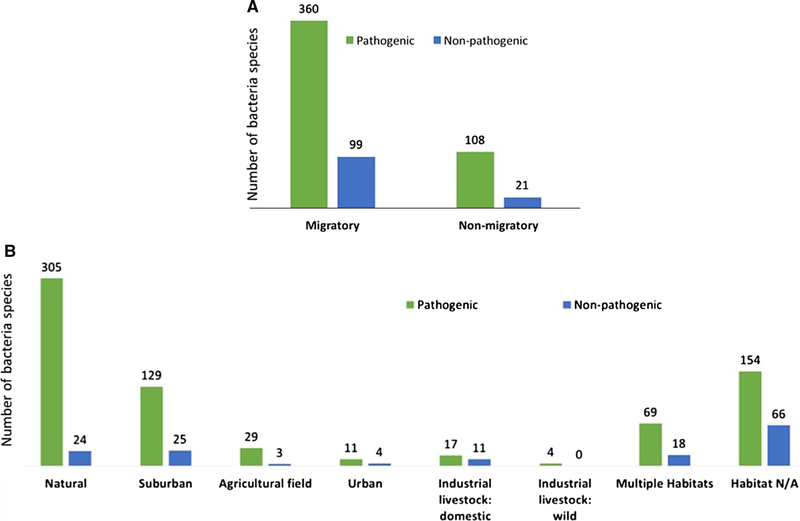
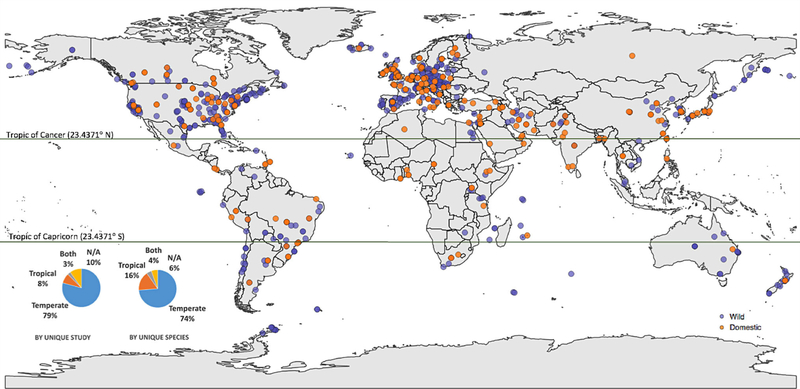
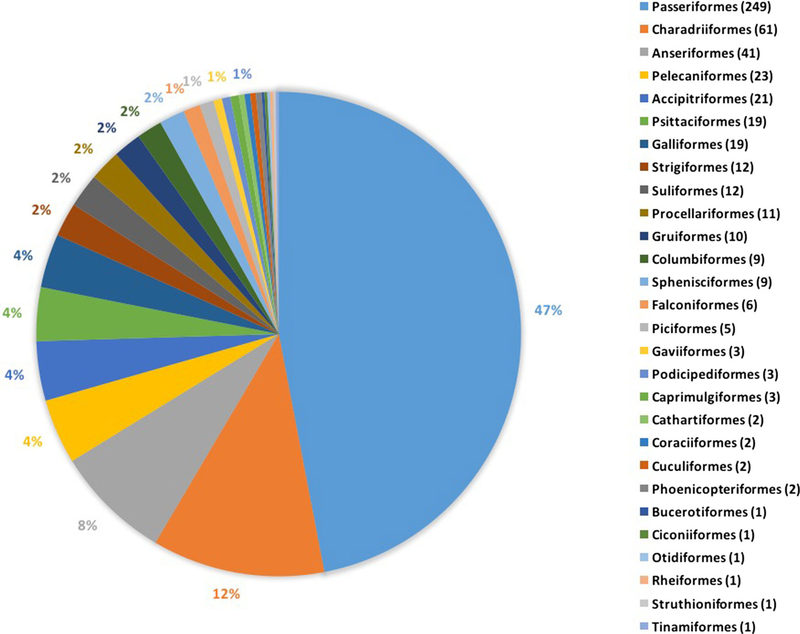
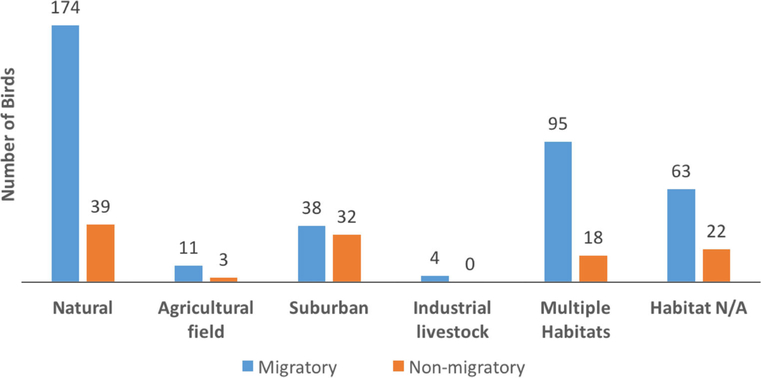
Birds, with their broad geographic ranges and close association with humans, have historically played an important role as carriers of human disease and as reservoirs for drug-resistant bacteria. Here, we examine scientific literature over a 15-year timespan to identify reported avian-bacterial associations and factors that may impact zoonotic disease emergence by classifying traits of bird species and their bacteria. We find that the majority of wild birds studied were migratory, in temperate habitats, and in the order Passeriformes. The highest diversity of bacteria was found on birds in natural habitats. The most frequently reported bacteria were Escherichia coli, Salmonella enterica, and Campylobacter jejuni. Of the bacteria species reported, 54% have shown pathogenicity toward humans. Percentage-wise, more pathogens were found in tropical (vs. temperate) habitats and natural (vs. suburban, urban, or agricultural) habitats. Yet, only 22% were tested for antibiotic resistance, and of those tested, 75% of bacteria species were resistant to at least one antibiotic. There were no significant patterns of antibiotic resistance in migratory versus non-migratory birds, temperate versus tropical areas, or different habitats. We discuss biases in detection and representation, and suggest a need for increased sampling in non-temperate zones and in a wider range of avian species.

摘要

鸟类分布范围广泛,且与人类关系密切,在历史上一直作为人类疾病的传播载体以及耐药菌的宿主发挥着重要作用。在此,我们研究了15年间的科学文献,通过对鸟类物种及其细菌的特征进行分类,来确定已报道的鸟类与细菌的关联以及可能影响人畜共患病出现的因素。我们发现,所研究的大多数野生鸟类为候鸟,生活在温带栖息地,且属于雀形目。在自然栖息地的鸟类身上发现的细菌多样性最高。最常报道的细菌为大肠杆菌、肠炎沙门氏菌和空肠弯曲菌。在所报道的细菌物种中,54%已显示出对人类的致病性。按百分比计算,在热带(相对于温带)栖息地和自然(相对于郊区、城市或农业)栖息地发现了更多的病原体。然而,仅对22%的细菌进行了抗生素耐药性测试,在这些接受测试的细菌中,75%的细菌物种对至少一种抗生素具有耐药性。在候鸟与非候鸟、温带与热带地区或不同栖息地之间,没有明显的抗生素耐药性模式。我们讨论了检测和呈现方面的偏差,并建议需要增加在非温带地区和更广泛鸟类物种中的采样。
https://cdn.ncbi.nlm.nih.gov/pmc/blobs/eefe/6521974/8815d17547c0/nihms-1017417-f0006.jpg
https://cdn.ncbi.nlm.nih.gov/pmc/blobs/eefe/6521974/cd60a897ee1d/nihms-1017417-f0001.jpg
https://cdn.ncbi.nlm.nih.gov/pmc/blobs/eefe/6521974/a0f1910246d0/nihms-1017417-f0002.jpg
https://cdn.ncbi.nlm.nih.gov/pmc/blobs/eefe/6521974/3a917aad2e03/nihms-1017417-f0003.jpg
https://cdn.ncbi.nlm.nih.gov/pmc/blobs/eefe/6521974/2840b07b3379/nihms-1017417-f0004.jpg
https://cdn.ncbi.nlm.nih.gov/pmc/blobs/eefe/6521974/0320d885303e/nihms-1017417-f0005.jpg
https://cdn.ncbi.nlm.nih.gov/pmc/blobs/eefe/6521974/8815d17547c0/nihms-1017417-f0006.jpg
https://cdn.ncbi.nlm.nih.gov/pmc/blobs/eefe/6521974/cd60a897ee1d/nihms-1017417-f0001.jpg
https://cdn.ncbi.nlm.nih.gov/pmc/blobs/eefe/6521974/a0f1910246d0/nihms-1017417-f0002.jpg
https://cdn.ncbi.nlm.nih.gov/pmc/blobs/eefe/6521974/3a917aad2e03/nihms-1017417-f0003.jpg
https://cdn.ncbi.nlm.nih.gov/pmc/blobs/eefe/6521974/2840b07b3379/nihms-1017417-f0004.jpg
https://cdn.ncbi.nlm.nih.gov/pmc/blobs/eefe/6521974/0320d885303e/nihms-1017417-f0005.jpg
https://cdn.ncbi.nlm.nih.gov/pmc/blobs/eefe/6521974/8815d17547c0/nihms-1017417-f0006.jpg

相似文献

1
Patterns of Bird-Bacteria Associations.鸟类与细菌的关联模式。
Ecohealth. 2018 Sep;15(3):627-641. doi: 10.1007/s10393-018-1342-5. Epub 2018 Jun 12.
2
Genomic Comparison of Campylobacter spp. and Their Potential for Zoonotic Transmission between Birds, Primates, and Livestock.弯曲杆菌属的基因组比较及其在鸟类、灵长类动物和家畜之间人畜共患病传播的可能性
Appl Environ Microbiol. 2016 Nov 21;82(24):7165-7175. doi: 10.1128/AEM.01746-16. Print 2016 Dec 15.
3
Frequency of zoonotic bacteria among illegally traded wild birds in Rio de Janeiro.里约热内卢非法交易野生鸟类中动物源性细菌的频率。
Braz J Microbiol. 2016 Oct-Dec;47(4):882-888. doi: 10.1016/j.bjm.2016.07.012. Epub 2016 Jul 26.
4
Migratory birds along the Mediterranean - Black Sea Flyway as carriers of zoonotic pathogens.地中海-黑海候鸟迁徙路线上的候鸟作为人畜共患病原体的携带者。
Can J Microbiol. 2018 Dec;64(12):915-924. doi: 10.1139/cjm-2017-0763. Epub 2018 Aug 16.
5
Free-living Waterfowl as a Source of Zoonotic Bacteria in a Dense Wild Bird Population Area in Northeastern Spain.西班牙东北部野生鸟类密集地区自由生活的水禽作为人畜共患病菌的来源
Transbound Emerg Dis. 2015 Oct;62(5):516-21. doi: 10.1111/tbed.12169. Epub 2013 Sep 20.
6
Human infections associated with wild birds.与野生鸟类相关的人类感染。
J Infect. 2008 Feb;56(2):83-98. doi: 10.1016/j.jinf.2007.11.001. Epub 2007 Dec 21.
7
Proximity to humans is associated with antimicrobial-resistant enteric pathogens in wild bird microbiomes.人类的接近与野生鸟类微生物组中抗微生物药物耐药性肠病原体有关。
Curr Biol. 2024 Sep 9;34(17):3955-3965.e4. doi: 10.1016/j.cub.2024.07.059. Epub 2024 Aug 13.
8
Wild birds as sentinels for multiple zoonotic pathogens along an urban to rural gradient in greater Chicago, Illinois.伊利诺伊州大芝加哥市城乡梯度带的野生鸟类作为多种人畜共患病原体的哨兵。
Zoonoses Public Health. 2012 Aug;59(5):355-64. doi: 10.1111/j.1863-2378.2012.01462.x. Epub 2012 Feb 22.
9
Are we overestimating risk of enteric pathogen spillover from wild birds to humans?我们是否高估了野生鸟类将肠道病原体溢出到人类身上的风险?
Biol Rev Camb Philos Soc. 2020 Jun;95(3):652-679. doi: 10.1111/brv.12581. Epub 2020 Jan 31.
10
Wild birds and urban pigeons as reservoirs for diarrheagenic Escherichia coli with zoonotic potential.野生鸟类和城市鸽子作为具有人畜共患病潜力的致泻性大肠杆菌的宿主。
J Microbiol. 2017 May;55(5):344-348. doi: 10.1007/s12275-017-6523-3. Epub 2017 Mar 9.

引用本文的文献

1
Exploring the Prevalence of Antimicrobial Resistance in the Environment Through Bonelli's Eagles () as Sentinels.通过邦纳利鹰作为哨兵探索环境中抗菌药物耐药性的流行情况。
Antibiotics (Basel). 2025 Jul 22;14(8):734. doi: 10.3390/antibiotics14080734.
2
The Role of Vulture (Accipitriformes) Cutaneous Microbiota in Infectious Disease Protection.兀鹰(鹰形目)皮肤微生物群在传染病防护中的作用
Microorganisms. 2025 Apr 14;13(4):898. doi: 10.3390/microorganisms13040898.
3
Emergence of plasmid-mediated fosfomycin resistance among harboring , (X4), and genes in wild birds.

本文引用的文献

1
Antibiotic Residues in Chicken Meat: Global Prevalence, Threats, and Decontamination Strategies: A Review.鸡肉中的抗生素残留:全球流行情况、威胁及减污策略综述。
J Food Prot. 2018 Apr;81(4):619-627. doi: 10.4315/0362-028X.JFP-17-086.
2
Environmental Factors and Zoonotic Pathogen Ecology in Urban Exploiter Species.城市掠食性物种中的环境因素与动物源性致病源生态学
Ecohealth. 2017 Sep;14(3):630-641. doi: 10.1007/s10393-017-1258-5. Epub 2017 Jun 19.
3
How Many Kinds of Birds Are There and Why Does It Matter?世界上有多少种鸟类,这又为何重要?
野生鸟类中携带、(X4)和基因的质粒介导磷霉素耐药性的出现。
mSystems. 2025 Apr 22;10(4):e0167324. doi: 10.1128/msystems.01673-24. Epub 2025 Mar 13.
4
Urbanization enhances body condition, but not innate immune defences, in a common waterbird.城市化改善了一种常见水鸟的身体状况,但未提升其先天免疫防御能力。
R Soc Open Sci. 2025 Jan 15;12(1):241062. doi: 10.1098/rsos.241062. eCollection 2025 Jan.
5
From islands to infectomes: host-specific viral diversity among birds across remote islands.从岛屿到感染组:偏远岛屿鸟类之间具有宿主特异性的病毒多样性。
BMC Ecol Evol. 2024 Jun 26;24(1):84. doi: 10.1186/s12862-024-02277-4.
6
Stopover habitat selection drives variation in the gut microbiome composition and pathogen acquisition by migrating shorebirds.中途停留栖息地选择驱动迁徙滨鸟肠道微生物组组成和病原体获得的变化。
FEMS Microbiol Ecol. 2024 Apr 10;100(5). doi: 10.1093/femsec/fiae040.
7
Transboundary determinants of avian zoonotic infectious diseases: challenges for strengthening research capacity and connecting surveillance networks.禽源人畜共患传染病的跨界决定因素:加强研究能力和连接监测网络面临的挑战
Front Microbiol. 2024 Feb 16;15:1341842. doi: 10.3389/fmicb.2024.1341842. eCollection 2024.
8
Determination of antibiotic resistance patterns and genotypes of Escherichia coli isolated from wild birds.从野生鸟类中分离的大肠杆菌的抗生素耐药模式和基因型的测定。
Microbiome. 2024 Jan 8;12(1):8. doi: 10.1186/s40168-023-01729-1.
9
Virulence, Antibiotic Resistance, and Phylogenetic Relationships of spp. Carried by Migratory Birds in China.中国候鸟携带的[具体物种名称]的毒力、抗生素抗性及系统发育关系
Microorganisms. 2022 Dec 20;11(1):7. doi: 10.3390/microorganisms11010007.
10
The avian gut microbiota: Diversity, influencing factors, and future directions.鸟类肠道微生物群:多样性、影响因素及未来方向。
Front Microbiol. 2022 Aug 5;13:934272. doi: 10.3389/fmicb.2022.934272. eCollection 2022.
PLoS One. 2016 Nov 23;11(11):e0166307. doi: 10.1371/journal.pone.0166307. eCollection 2016.
4
Increased prevalence of antibiotic-resistant E. coli in gulls sampled in Southcentral Alaska is associated with urban environments.在阿拉斯加中南部采集的海鸥样本中,耐抗生素大肠杆菌的患病率增加与城市环境有关。
Infect Ecol Epidemiol. 2016 Sep 19;6:32334. doi: 10.3402/iee.v6.32334. eCollection 2016.
5
Scaling laws predict global microbial diversity.标度律预测全球微生物多样性。
Proc Natl Acad Sci U S A. 2016 May 24;113(21):5970-5. doi: 10.1073/pnas.1521291113. Epub 2016 May 2.
6
Emerging bacterial pathogens: the past and beyond.新兴细菌病原体:过去与未来
Clin Microbiol Infect. 2016 Jan;22(1):12-21. doi: 10.1016/j.cmi.2015.10.010. Epub 2015 Oct 19.
7
Pathogen-host-environment interplay and disease emergence.病原体-宿主-环境相互作用与疾病的出现。
Emerg Microbes Infect. 2013 Feb;2(2):e5. doi: 10.1038/emi.2013.5. Epub 2013 Feb 6.
8
A scoping review of the role of wildlife in the transmission of bacterial pathogens and antimicrobial resistance to the food Chain.关于野生动物在细菌病原体传播及食物链抗菌药物耐药性中作用的范围综述。
Zoonoses Public Health. 2015 Jun;62(4):269-84. doi: 10.1111/zph.12147. Epub 2014 Aug 30.
9
Antibiotic resistance in wild birds.野生鸟类中的抗生素耐药性。
Ups J Med Sci. 2014 May;119(2):113-6. doi: 10.3109/03009734.2014.905663. Epub 2014 Apr 4.
10
Effects of environmental change on zoonotic disease risk: an ecological primer.环境变化对人畜共患病风险的影响:生态学基础
Trends Parasitol. 2014 Apr;30(4):205-14. doi: 10.1016/j.pt.2014.02.003. Epub 2014 Mar 11.