Zeiler Michael, Wagner Gudrun, Philipp Julia, Nitsch Martina, Truttmann Stefanie, Dür Wolfgang, Karwautz Andreas, Waldherr Karin
Department for Child and Adolescent Psychiatry, Eating Disorders Unit, Medical University of Vienna, Waehringer Guertel 18-20, 1090, Vienna, Austria.
Ludwig Boltzmann Institute Health Promotion Research, Vienna, Austria.
Neuropsychiatr. 2018 Sep;32(3):121-132. doi: 10.1007/s40211-018-0273-2. Epub 2018 Jun 15.
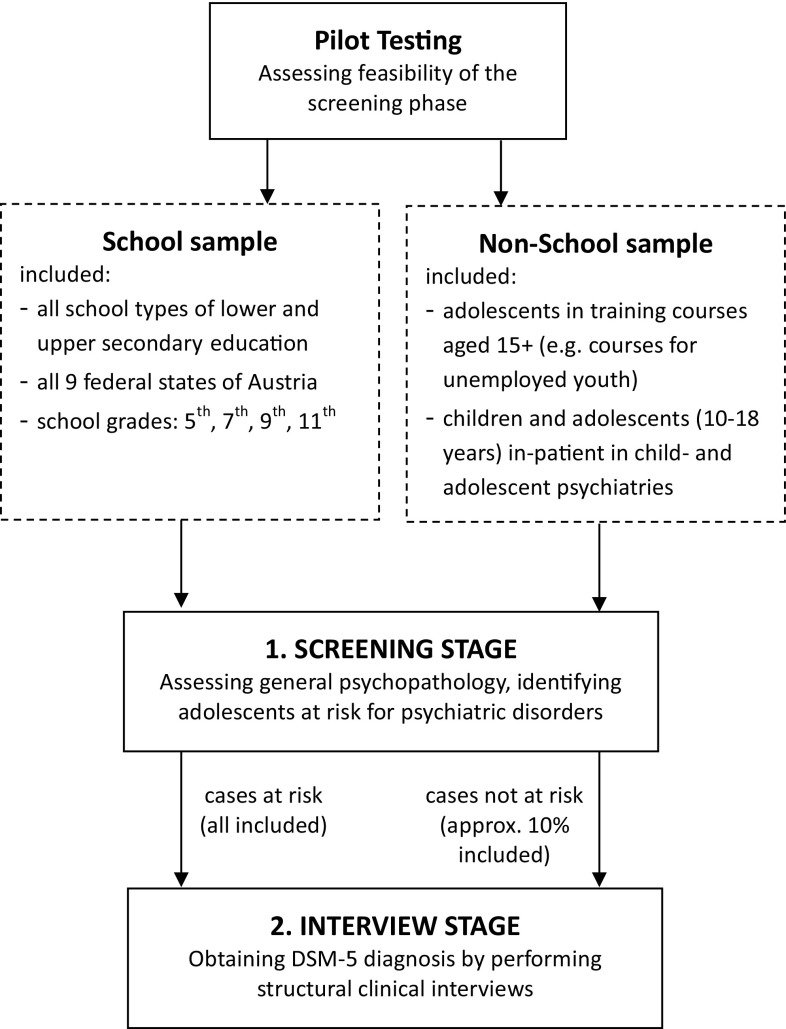
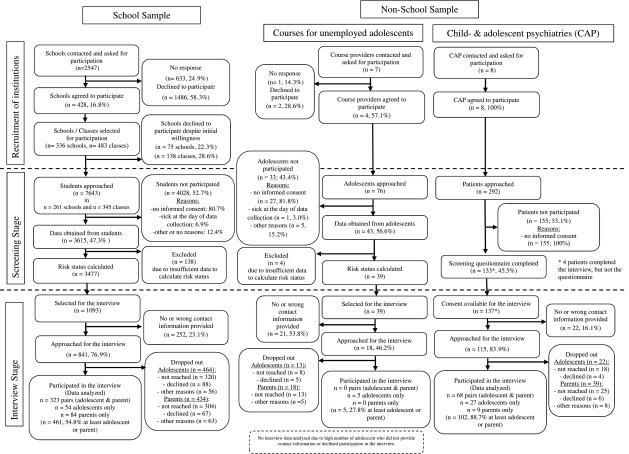
Profound epidemiological data on the prevalence of mental health disorders and respective risk and protective factors is a prerequisite for adequate prevention, intervention and service planning. Children and adolescents are regarded as high priority groups for prevention in this field because of the high chronicity and individual burden of mental health disorders. The Mental Health in Austrian Teenagers (MHAT)-Study is the first epidemiological study based on a large representative sample of adolescents (N > 3700) in Austria in order to obtain the prevalence of a wide range of behavioral problems and psychiatric disorders. Adolescents are recruited from multiple settings (schools, course providers for early school leavers and psychiatric clinics) in order to enhance the representativity of the sample. A "gold-standard" two-stage design (screening questionnaire and diagnostic interviews) is used to obtain psychiatric diagnoses that are based on the 5th edition of the Diagnostic and Statistical Manual of Mental Disorders which was published by the American Psychiatric Association in 2013. This paper aims at presenting the study design and methodology of the MHAT study, describing the study population as well as discussing relevant strengths and limitations.
关于心理健康障碍的患病率以及相应风险和保护因素的深入流行病学数据,是进行充分预防、干预和服务规划的先决条件。由于心理健康障碍具有高度的慢性和个体负担,儿童和青少年被视为该领域预防工作的重点人群。奥地利青少年心理健康(MHAT)研究是奥地利首个基于大量具有代表性的青少年样本(N>3700)开展的流行病学研究,旨在得出一系列行为问题和精神障碍的患病率。从多个场所(学校、早期离校生课程提供者和精神科诊所)招募青少年,以提高样本的代表性。采用“金标准”两阶段设计(筛查问卷和诊断访谈)来获得基于美国精神病学协会2013年出版的《精神疾病诊断与统计手册》第5版的精神科诊断。本文旨在介绍MHAT研究的研究设计和方法,描述研究人群,并讨论相关的优势和局限性。