Volunteer Research Group, University of TN Medical Center, 1928 Alcoa Highway, Suite 107, Knoxville, TN, 37920, USA.
Ardea Biosciences, Inc, 9390 Towne Centre Drive, San Diego, CA, 92121, USA.
Clin Drug Investig. 2018 Aug;38(8):703-713. doi: 10.1007/s40261-018-0652-2.
BACKGROUND AND OBJECTIVE: Verinurad (RDEA3170) is a high-affinity, selective URAT1 transporter inhibitor in development for treating gout and asymptomatic hyperuricemia. This Phase I, single-dose study investigated the pharmacokinetics, pharmacodynamics, and safety of verinurad in adults with renal impairment and controls with normal renal function.
Males aged 18-85 years were enrolled with serum urate (sUA) 4.5-10 mg/dl and creatinine clearance 60- < 90, 30- < 60, 15- < 30, or ≥ 90 ml/min (mild, moderate, severe renal impairment and controls, respectively; n = 7/8). Verinurad 15 mg was administered orally under fasted conditions. Serial plasma/serum and urine samplings were 30 min pre-dose to 72 h post-dose.
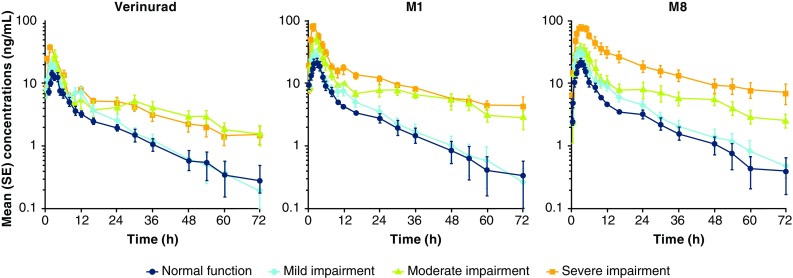
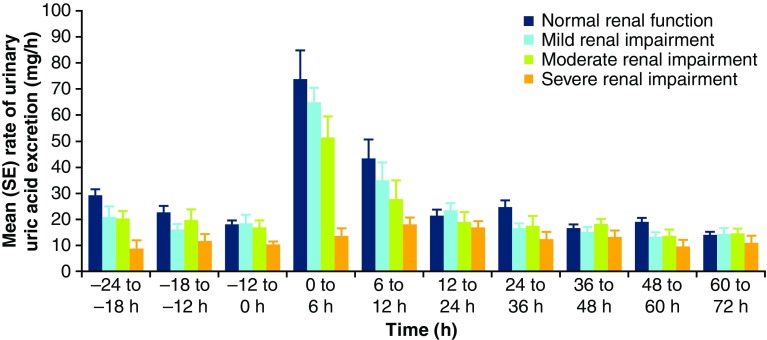
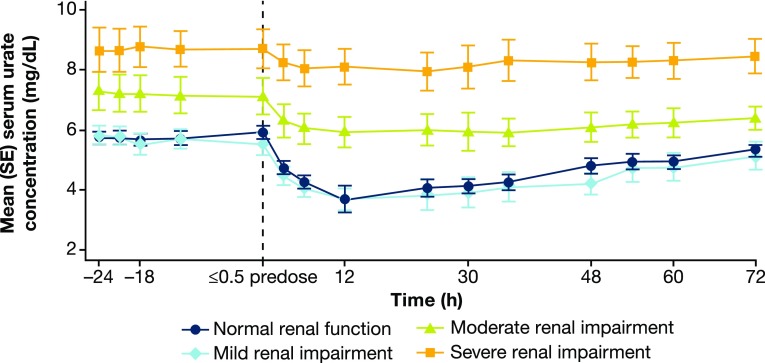
Compared to controls, verinurad maximum observed plasma concentration increased by 53, 73, and 128% and area under the concentration-time curve increased by 24, 148, and 130%, in subjects with mild, moderate, and severe renal impairment, respectively; renal clearance decreased by 5, 42, and 79%. Exposures of major verinurad metabolites also increased with increasing renal impairment. Verinurad decreased sUA in all groups, with greater maximal changes in control and mild renal impairment than moderate and severe impairment groups (- 38.3, - 36.9, - 20.5, - 12.6%, respectively). There were no adverse event-related withdrawals or clinically meaningful changes in laboratory values.
Exposures of verinurad and metabolites increased with decreasing renal function. Consistent with the renal-dependent mechanism of action of verinurad, increasing severity of renal impairment was associated with decreased sUA lowering. Verinurad safety assessments were similar regardless of renal impairment. Continued investigation of verinurad is warranted in patients with gout and renal impairment. CLINICALTRIALS.
NCT02219516.
维那鲁肽(RDEA3170)是一种高亲和力、选择性的 URAT1 转运体抑制剂,正在开发用于治疗痛风和无症状高尿酸血症。这项 I 期、单剂量研究调查了维那鲁肽在伴有肾功能损害的成年患者和肾功能正常的对照者中的药代动力学、药效学和安全性。
年龄在 18-85 岁之间的男性,血清尿酸(sUA)为 4.5-10mg/dl,肌酐清除率分别为 60-<90、30-<60、15-<30 和≥90ml/min(分别为轻度、中度、重度肾功能损害和对照组,n=7/8)。维那鲁肽 15mg 在禁食条件下口服给药。在给药前 30 分钟至给药后 72 小时进行连续的血浆/血清和尿液采样。
与对照组相比,维那鲁肽在轻度、中度和重度肾功能损害患者中的最大观察到的血浆浓度分别增加了 53%、73%和 128%,AUC 分别增加了 24%、148%和 130%;肾清除率分别下降了 5%、42%和 79%。主要维那鲁肽代谢物的暴露也随着肾功能损害的增加而增加。维那鲁肽降低了所有组的 sUA,与中度和重度肾功能损害组相比,对照组和轻度肾功能损害组的最大变化更大(分别为-38.3%、-36.9%、-20.5%、-12.6%)。没有与不良事件相关的停药或临床有意义的实验室值变化。
维那鲁肽和代谢物的暴露随着肾功能的下降而增加。与维那鲁肽的肾依赖性作用机制一致,随着肾功能损害程度的增加,sUA 的降低幅度减小。无论肾功能损害如何,维那鲁肽的安全性评估都是相似的。在伴有痛风和肾功能损害的患者中,继续研究维那鲁肽是合理的。
临床试验.gov 标识符:NCT02219516。