Hall Jesse, Gillen Michael, Liu Sha, Miner Jeffrey N, Valdez Shakti, Shen Zancong, Lee Caroline
Ardea Biosciences, Inc., San Diego, CA, USA.
AstraZeneca, Gaithersburg, MD, USA.
Drug Des Devel Ther. 2018 Jun 20;12:1799-1807. doi: 10.2147/DDDT.S152659. eCollection 2018.
Verinurad (RDEA3170) is a selective uric acid reabsorption inhibitor in clinical development for treatment of gout and asymptomatic hyperuricemia. This study evaluated verinurad pharmacokinetics, pharmacodynamics, and tolerability in healthy Japanese and non-Asian adult male subjects.
This was a Phase I, randomized, single-blind, placebo-controlled study. Panels of 8 Japanese subjects were randomized to receive oral verinurad (2.5-15 mg) or placebo administered as a single dose in a fasted and fed state and as once-daily doses for 7 days in a fed state. Eight non-Asian subjects received verinurad 10 mg as a single dose (fasted and fed) and multiple doses in the fed state. Serial plasma/serum and urine samples were assayed for verinurad and uric acid. Safety was assessed by adverse events and laboratory data.
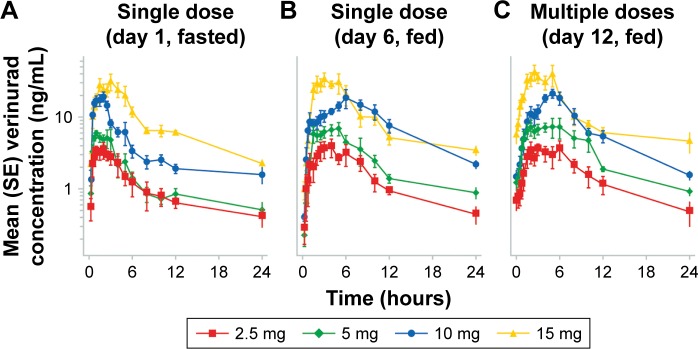
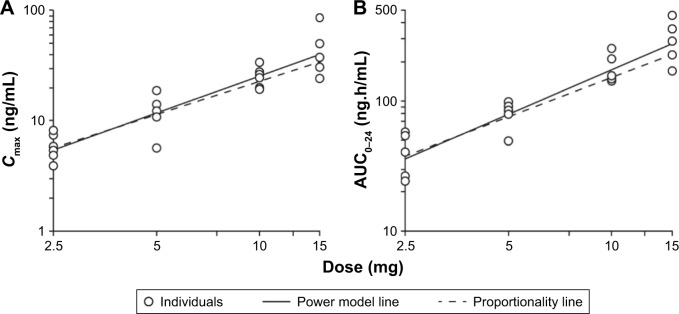
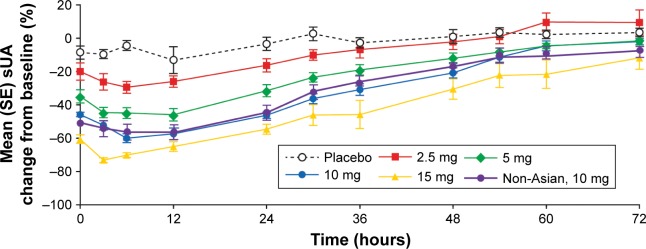
Of 48 randomized subjects, 46 (Japanese, 39; non-Asian, 7) completed the study. Following single or multiple doses in Japanese subjects, maximum plasma concentration () and area under the plasma concentration-time curve (AUC) increased in a near dose-proportional manner. Time to () was ~1.25-2.0 hours with fasting. A moderate-fat meal delayed (range 3.0-5.0 hours) and had a variable effect on AUC (0%-97% increase) and (0%-26% increase) across the dose groups. Following multiple verinurad 10 mg doses, and AUC were 38% and 23% higher, respectively, in Japanese vs non-Asian subjects, largely due to body weight differences. Mean reduction of serum urate following multiple verinurad 10 mg doses was 46% and 44% after 24 hours in Japanese and non-Asian subjects, respectively. Verinurad was well tolerated at all doses.
Verinurad monotherapy lowered serum urate and was well tolerated in both healthy Japanese and non-Asian males, while small differences in plasma pharmacokinetics were observed. These data support further evaluation of once-daily verinurad as a treatment for gout and asymptomatic hyperuricemia.
维立努拉(RDEA3170)是一种选择性尿酸重吸收抑制剂,正处于治疗痛风和无症状性高尿酸血症的临床开发阶段。本研究评估了维立努拉在健康日本成年男性和非亚洲成年男性受试者中的药代动力学、药效学和耐受性。
这是一项I期随机、单盲、安慰剂对照研究。8名日本受试者被随机分组,在禁食和进食状态下接受单次口服维立努拉(2.5 - 15毫克)或安慰剂,并在进食状态下每日一次给药,持续7天。8名非亚洲受试者接受单次口服10毫克维立努拉(禁食和进食)以及进食状态下的多次给药。对系列血浆/血清和尿液样本进行维立努拉和尿酸检测。通过不良事件和实验室数据评估安全性。
48名随机分组的受试者中,46名(日本受试者39名;非亚洲受试者7名)完成了研究。在日本受试者单次或多次给药后,最大血浆浓度()和血浆浓度 - 时间曲线下面积(AUC)以近似剂量比例的方式增加。禁食时达到()的时间约为1.25 - 2.0小时。一顿中等脂肪餐使(范围为3.0 - 5.0小时)延迟,并且对各剂量组的AUC(增加0% - 97%)和(增加0% - 26%)有不同影响。在多次服用10毫克维立努拉后,日本受试者的和AUC分别比非亚洲受试者高38%和23%,这主要归因于体重差异。在日本和非亚洲受试者中,多次服用10毫克维立努拉24小时后,血清尿酸平均降低分别为46%和44%。维立努拉在所有剂量下耐受性良好。
维立努拉单药治疗可降低血清尿酸,在健康日本男性和非亚洲男性中耐受性良好,同时观察到血浆药代动力学存在微小差异。这些数据支持进一步评估维立努拉每日一次给药作为痛风和无症状性高尿酸血症治疗方法的可行性。