Division of Marine Biotechnology, Faculty of Oceanography and Geography, University of Gdańsk, Marszałka J. Piłsudskiego 46, PL-81378 Gdynia, Poland.
Institute of Oceanology, Polish Academy of Sciences, Powstańców Warszawy 55, PL-81712 Sopot, Poland.
Mar Drugs. 2018 Jun 26;16(7):220. doi: 10.3390/md16070220.
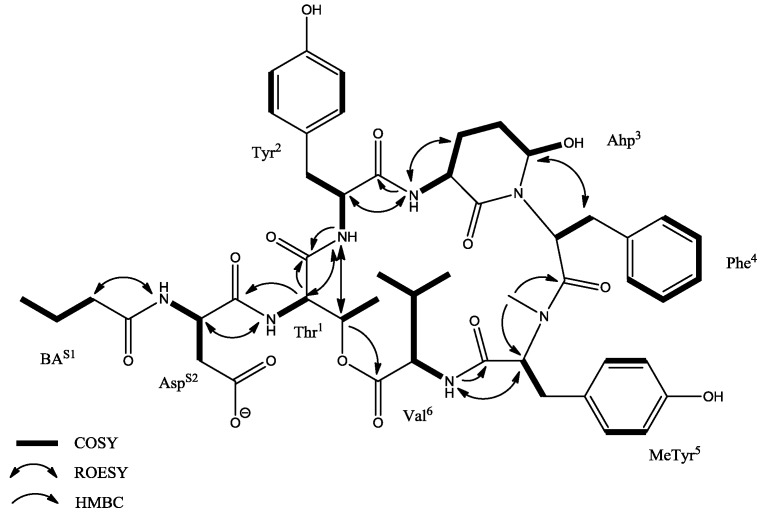
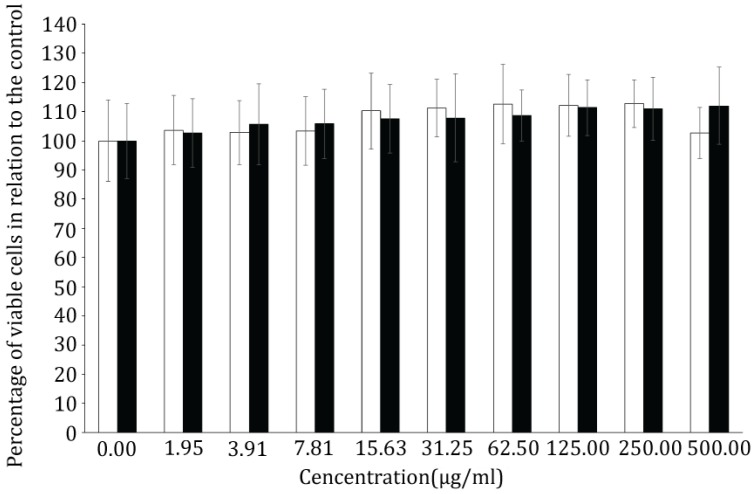
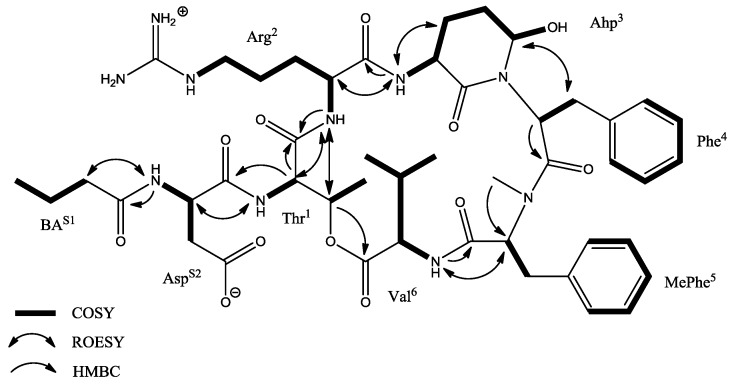
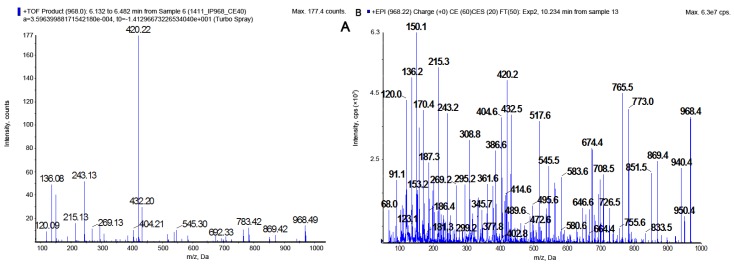
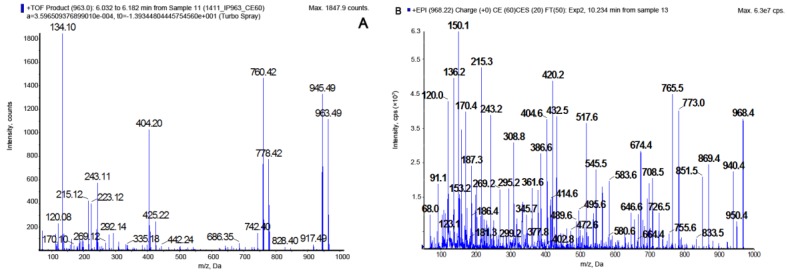
Cyanopeptolins (CPs) are one of the most frequently occurring cyanobacterial peptides, many of which are inhibitors of serine proteases. Some CP variants are also acutely toxic to aquatic organisms, especially small crustaceans. In this study, thirteen CPs, including twelve new variants, were detected in the cyanobacterium CCNP1411 isolated from the Gulf of Gdańsk (southern Baltic Sea). Structural elucidation was performed by tandem mass spectrometry with verification by NMR for CP962 and CP985. Trypsin and chymotrypsin inhibition assays confirmed the significance of the residue adjacent to 3-amino-6-hydroxy-2-piperidone (Ahp) for the activity of the peptides. Arginine-containing CPs (CPs-Arg²) inhibited trypsin at low IC values (0.24⁻0.26 µM) and showed mild activity against chymotrypsin (IC 3.1⁻3.8 µM), while tyrosine-containing CPs (CPs-Tyr²) were selectively and potently active against chymotrypsin (IC 0.26 µM). No degradation of the peptides was observed during the enzyme assays. Neither of the CPs were active against thrombin, elastase or protein phosphatase 1. Two CPs (CP962 and CP985) had no cytotoxic effects on MCF-7 breast cancer cells. Strong and selective activity of the new cyanopeptolin variants makes them potential candidates for the development of drugs against metabolic disorders and other diseases.
蓝细菌肽(CPs)是最常见的蓝藻肽之一,其中许多是丝氨酸蛋白酶抑制剂。一些 CP 变体也对水生生物,尤其是小型甲壳类动物具有急性毒性。在这项研究中,从加迪尼亚湾(波罗的海南部)分离出的蓝藻 CCNP1411 中检测到了 13 种 CP,包括 12 种新变体。通过串联质谱法进行结构解析,并通过 NMR 对 CP962 和 CP985 进行验证。胰蛋白酶和糜蛋白酶抑制试验证实了紧邻 3-氨基-6-羟基-2-哌啶酮(Ahp)的残基对肽活性的重要性。含精氨酸的 CP(CPs-Arg²)以低 IC 值(0.24-0.26 μM)抑制胰蛋白酶,并对糜蛋白酶表现出温和的活性(IC3.1-3.8 μM),而含酪氨酸的 CP(CPs-Tyr²)则对糜蛋白酶具有选择性和强效的活性(IC0.26 μM)。在酶试验过程中没有观察到肽的降解。这些 CP 都没有对凝血酶、弹性蛋白酶或蛋白磷酸酶 1 表现出活性。两种 CP(CP962 和 CP985)对 MCF-7 乳腺癌细胞没有细胞毒性作用。新蓝细菌肽变体的强选择性活性使它们成为开发针对代谢紊乱和其他疾病的药物的潜在候选物。