Department of Clinical Physiology, Clinical Sciences, Lund University and Lund University Hospital, Getingevägen 3, 221 85, Lund, Sweden.
Laboratory of Computing, Medical Informatics and Biomedical - Imaging Technologies, School of Medicine, Aristotle University of Thessaloniki, Thessaloniki, Greece.
J Cardiovasc Magn Reson. 2018 Jun 28;20(1):46. doi: 10.1186/s12968-018-0464-9.
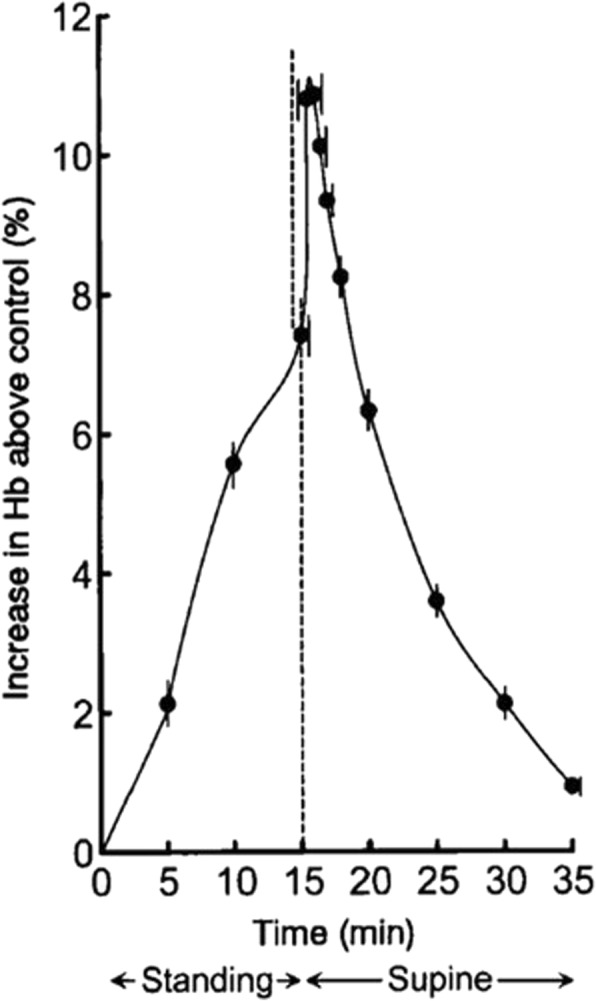
Cardiovascular magnetic resonance (CMR) can be used to calculate myocardial extracellular volume fraction (ECV) by relating the longitudinal relaxation rate in blood and myocardium before and after contrast-injection to hematocrit (Hct) in blood. Hematocrit is known to vary with body posture, which could affect the calculations of ECV. The aim of this study was to test the hypothesis that there is a significant increase in calculated ECV values if the Hct is sampled after the CMR examination in supine position compared to when the patient arrives at the MR department.
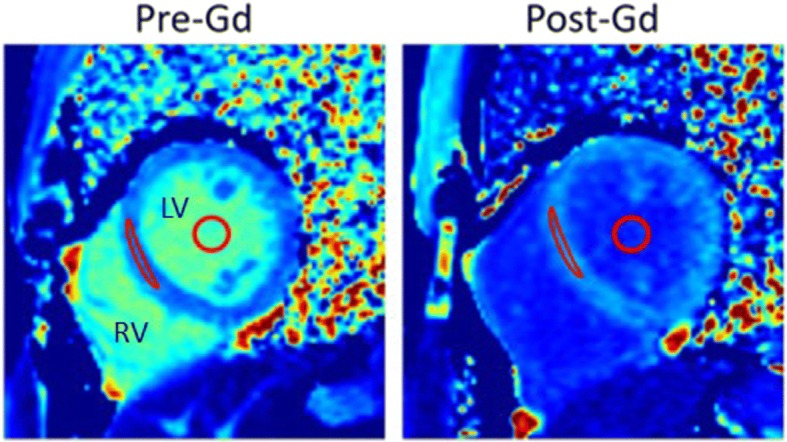
Forty-three consecutive patients including various pathologies as well as normal findings were included in the study. Venous blood samples were drawn upon arrival to the MR department and directly after the examination with the patient remaining in supine position. A Modified Look-Locker Inversion recovery (MOLLI) protocol was used to acquire mid-ventricular short-axis images before and after contrast injection from which motion-corrected T1 maps were derived and ECV was calculated.
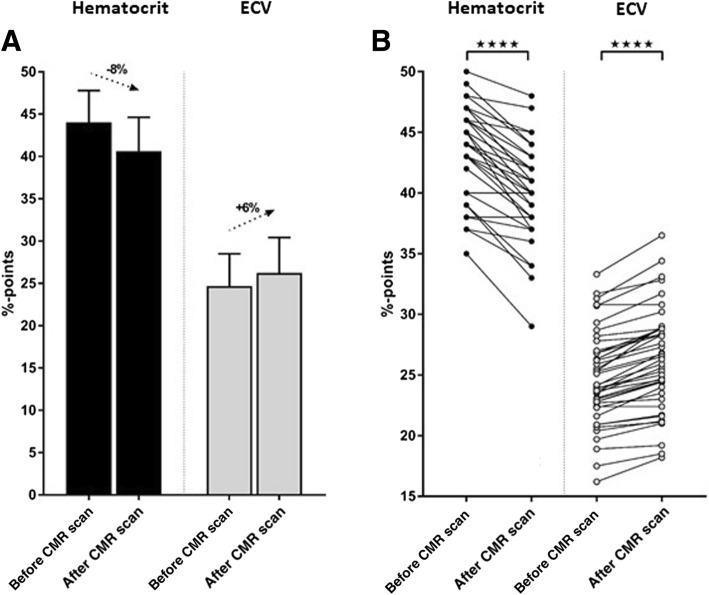
Hematocrit decreased from 44.0 ± 3.7% before to 40.6 ± 4.0% after the CMR examination (p < 0.001). This resulted in a change in calculated ECV from 24.7 ± 3.8% before to 26.2 ± 4.2% after the CMR examination (p < 0.001). All patients decreased in Hct after the CMR examination compared to before except for two patients whose Hct remained the same.
Variability in CMR-derived myocardial ECV can be reduced by standardizing the timing of Hct measurement relative to the CMR examination. Thus, a standardized acquisition of blood sample for Hct after the CMR examination, when the patient is still in supine position, would increase the precision of ECV measurements.
心血管磁共振(CMR)可用于通过比较血中和心肌内对比注射前后的纵向弛豫率与血红细胞压积(Hct)来计算心肌细胞外容积分数(ECV)。已知红细胞压积会随体位变化而变化,这可能会影响 ECV 的计算。本研究旨在验证以下假设,即在患者处于仰卧位时进行 CMR 检查后采集 Hct 样本,与患者到达磁共振科时采集 Hct 样本相比,计算出的 ECV 值会显著增加。
研究纳入了 43 例连续患者,包括各种病理和正常发现。患者到达磁共振科后和检查后立即采集静脉血样,此时患者保持仰卧位。采用改良 Look-Locker 反转恢复(MOLLI)序列在对比注射前后获取中室短轴图像,从这些图像中得出运动校正 T1 图,并计算 ECV。
Hct 从 CMR 检查前的 44.0±3.7%降至检查后的 40.6±4.0%(p<0.001)。这导致计算出的 ECV 从 CMR 检查前的 24.7±3.8%变为检查后的 26.2±4.2%(p<0.001)。除了两名患者的 Hct 不变外,所有患者在 CMR 检查后都比检查前的 Hct 降低。
通过使 Hct 测量的时间与 CMR 检查相对标准化,可以减少 CMR 衍生的心肌 ECV 的变异性。因此,当患者仍处于仰卧位时,标准化采集 CMR 检查后用于 Hct 的血液样本,将提高 ECV 测量的精度。