Emergency Medicine, New York University Langone Medical Center, New York City, New York, USA.
Emergency Medicine, Stanford University School of Medicine, Stanford, California, USA.
BMJ Open. 2018 Jun 27;8(6):e020188. doi: 10.1136/bmjopen-2017-020188.
Derive and validate a shortlist of chief complaints to describe unscheduled acute and emergency care in Uganda.
A single, private, not-for profit hospital in rural, southwestern Uganda.
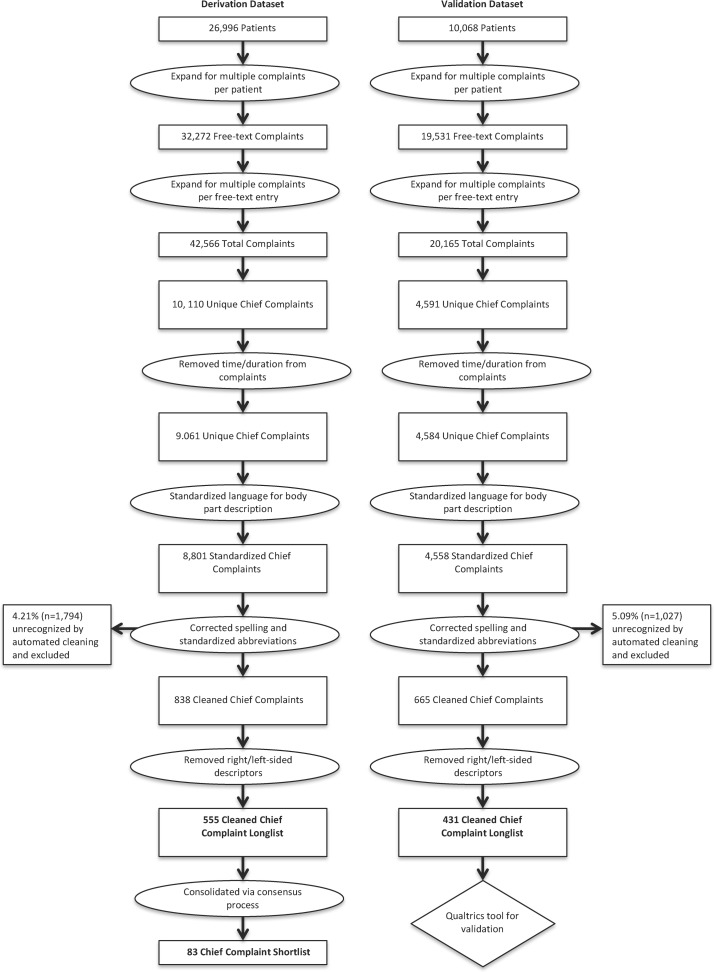
From 2009 to 2015, 26 996 patient visits produced 42 566 total chief complaints for the derivation dataset, and from 2015 to 2017, 10 068 visits produced 20 165 total chief complaints for the validation dataset.
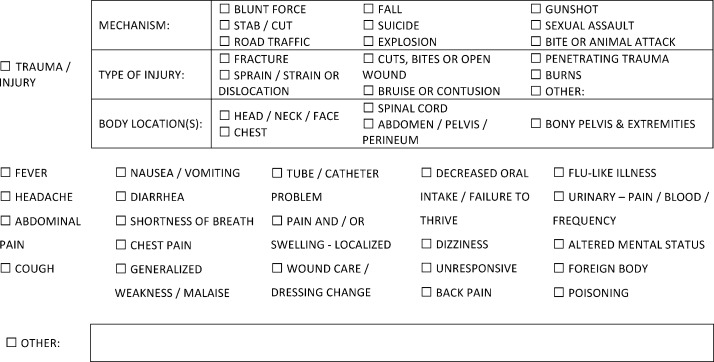
A retrospective review of an emergency centre quality assurance database was performed. Data were abstracted, cleaned and refined using language processing in Stata to produce a longlist of chief complaints, which was collapsed via a consensus process to produce a shortlist and turned into a web-based tool. This tool was used by two local Ugandan emergency care practitioners to categorise complaints from a second longlist produced from a separate validation dataset from the same study site. Their agreement on grouping was analysed using Cohen's kappa to determine inter-rater reliability. The chief complaints describing 80% of patient visits from automated and consensus shortlists were combined to form a candidate chief complaint shortlist.
Automated data cleaning and refining recognised 95.8% of all complaints and produced a longlist of 555 chief complaints. The consensus process yielded a shortlist of 83 grouped chief complaints. The second validation dataset was reduced in Stata to a longlist of 451 complaints. Using the shortlist tool to categorise complaints produced 71.5% agreement, yielding a kappa of 0.70 showing substantial inter-rater reliability. Only one complaint did not fit into the shortlist and required a free-text amendment. The two shortlists were identical for the most common 14 complaints and combined to form a candidate list of 24 complaints that could characterise over 80% of all emergency centre chief complaints.
Shortlists of chief complaints can be generated to improve standardisation of data entry, facilitate research efforts and be employed for paper chart usage.
制定并验证一份简短的主要投诉清单,以描述乌干达非计划性急性和紧急医疗保健情况。
乌干达西南部农村的一家单一、私立、非营利性医院。
在 2009 年至 2015 年期间,26996 次就诊产生了 42566 项主要投诉,用于推导数据集;在 2015 年至 2017 年期间,10068 次就诊产生了 20165 项主要投诉,用于验证数据集。
对一个急救中心质量保证数据库进行回顾性审查。使用 Stata 中的语言处理技术对数据进行提取、清理和精炼,生成一个主要投诉的长清单,通过共识过程将其合并成一个短清单,并将其转化为一个基于网络的工具。两名当地乌干达急救护理人员使用该工具对来自同一研究地点的另一个验证数据集生成的第二个长清单中的投诉进行分类。分析他们在分组上的一致性,使用 Cohen's kappa 确定组间可靠性。将自动和共识短清单中描述 80%患者就诊的主要投诉组合起来,形成一个候选主要投诉短清单。
自动数据清理和精炼识别了所有投诉的 95.8%,生成了一个 555 项主要投诉的长清单。共识过程产生了一个 83 项分组主要投诉的短清单。在 Stata 中将第二个验证数据集简化为一个 451 项投诉的长清单。使用短清单工具对投诉进行分类,产生了 71.5%的一致性,kappa 值为 0.70,显示出较强的组间可靠性。只有一项投诉不符合短清单要求,需要进行自由文本修正。两个短清单在最常见的 14 项投诉上是相同的,合并形成了一个候选清单,包含 24 项投诉,可以描述 80%以上的急救中心主要投诉。
可以生成主要投诉的短清单,以提高数据录入的标准化程度,促进研究工作,并用于纸质病历的使用。