University of Gothenburg, Department of Marine Sciences, Gothenburg, SE 405 30, Sweden.
University College London, Department of Statistical Sciences, London, WC1E 6BT, United Kingdom.
Sci Rep. 2018 Jun 27;8(1):9757. doi: 10.1038/s41598-018-28129-y.
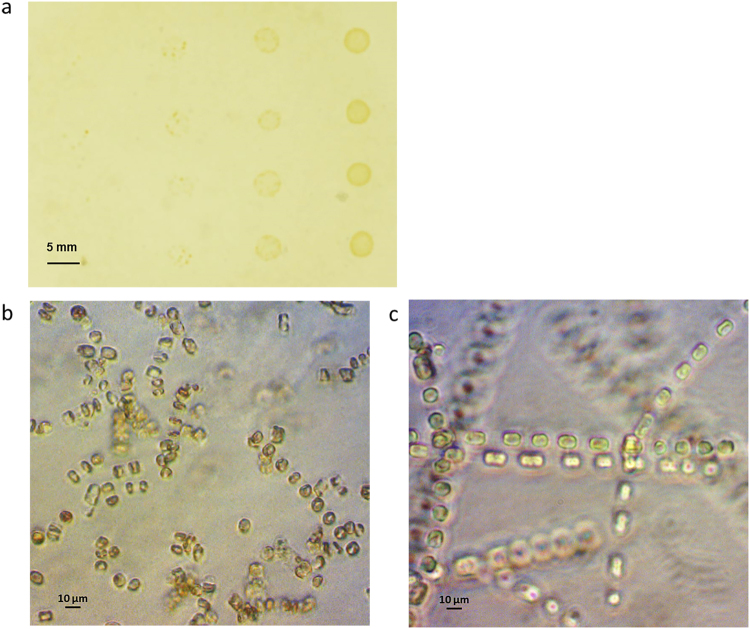
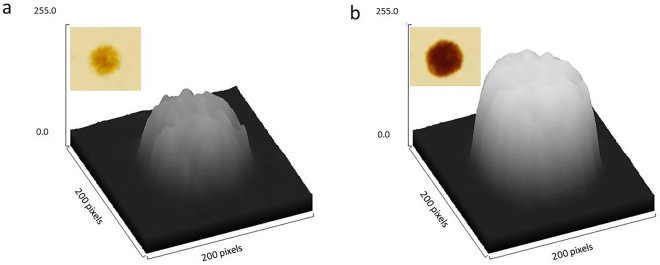
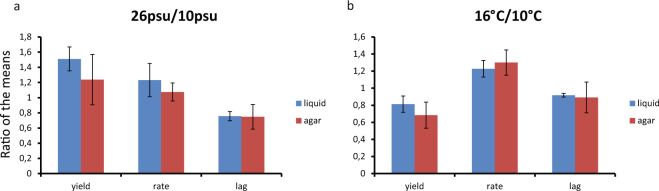
The ability to grow on solid culture medium is a pre-requisite for a successful microbial genetic model organism. Skeletonema marinoi, a bloom-forming, planktonic marine microalga, is widely used in ecological, evolutionary and population genetics studies. We have tested and confirmed the ability of this common organism to grow on solid culture medium (agar) under experimentally manipulated conditions. We established a protocol for quantifying growth characteristics - length of lag phase, growth rate, maximum biomass yield - on agar medium. The procedure was tested under experimental treatments and the resulting growth changes correlated with those observed in standard liquid culture. The ability to grow on solid medium broadens the use of S. marinoi as a molecular model, where agar is routinely used for various purposes (growth, selection, storage); and the possibility to quantify colony growth opens the way for high throughput, automated, or semi-automated phenotyping solutions.
能够在固体培养基上生长是成功的微生物遗传模式生物的前提条件。Marinoi 骨条藻,一种形成水华的浮游海洋微藻,广泛用于生态、进化和种群遗传学研究。我们已经测试并证实了这种常见生物在实验操纵条件下能够在固体培养基(琼脂)上生长。我们建立了一个在琼脂培养基上定量生长特性的方案——迟滞期长度、生长速率、最大生物量产量。该程序在实验处理下进行了测试,并且观察到的生长变化与在标准液体培养中观察到的变化相关。在固体培养基上生长的能力拓宽了 S. marinoi 作为分子模型的用途,其中琼脂通常用于各种目的(生长、选择、储存);并且量化菌落生长的可能性为高通量、自动化或半自动表型解决方案开辟了道路。