Kong Weihao, Cheng Yusheng, Liang Hao, Chen Qiangxing, Xiao Cuicui, Li Kun, Huang Zenan, Zhang Jian
Department of Liver Transplantation, The Third Affiliated Hospital of Sun Yat-sen University, Guangzhou, China.
Onco Targets Ther. 2018 Jun 19;11:3541-3549. doi: 10.2147/OTT.S150340. eCollection 2018.
Studies have shown that miR-17-5p plays an important role in the development of cancer. The aim of this meta-analysis was to quantitatively analyze the association of miR-17-5p with prognosis in various cancers.
We searched the PubMed, EMBASE, Web of Science, and Cochrane library databases for relevant studies through August 2017. The prognostic data and clinico-pathological features of overall survival (OS) and disease-free survival (DFS) were extracted to investigate the association between miR-17-5p expression and tumor prognosis. In addition, odds ratios (ORs) were used to assess the correlations between miR-17-5p expression and clinicopathological characteristics.
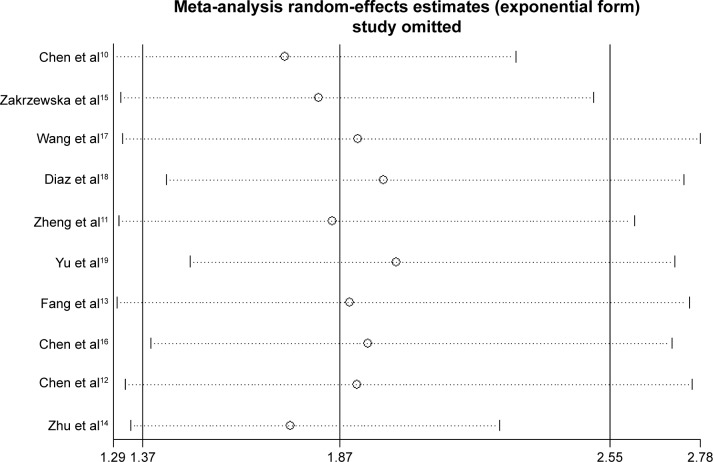
A total of ten studies were incorporated into this systematic review, and we found that high miR-17-5p expression can predict poor OS for malignancies (combined hazard ratio [HR]=1.87; 95% confidence interval [CI], 1.37-2.55; =0.000) as well as poor DFS (combined HR=1.60; 95% CI, 1.05-2.44; =0.027). Further subgroup analyses suggested that high miR-17-5p expression was related to poor OS in Asian patients (combined HR=1.92; 95% CI, 1.37-2.71; =0.000) and the serum/plasma sample source subgroup (combined HR=2.13; 95% CI, 1.36-3.31; =0.001). The combined OR indicated that the expression of miR-17-5p was associated with lymph node invasion (OR=1.28; 95% CI, 1.05-1.56; =0.016) and venous invasion (OR=1.92; 95% CI, 1.40-2.63; =0.000).
Elevated expression of miR-17-5p suggested a poor prognosis in cancer patients and may serve as a new tumor marker to monitor cancer development and progression.
研究表明,miR-17-5p在癌症发展中起重要作用。本荟萃分析的目的是定量分析miR-17-5p与各种癌症预后的相关性。
我们检索了截至2017年8月的PubMed、EMBASE、Web of Science和Cochrane图书馆数据库中的相关研究。提取总生存期(OS)和无病生存期(DFS)的预后数据及临床病理特征,以研究miR-17-5p表达与肿瘤预后之间的关联。此外,采用比值比(OR)评估miR-17-5p表达与临床病理特征之间的相关性。
本系统评价共纳入10项研究,我们发现miR-17-5p高表达可预测恶性肿瘤患者的OS较差(合并风险比[HR]=1.87;95%置信区间[CI],1.37 - 2.55;P=0.000)以及DFS较差(合并HR=1.60;95%CI,1.05 - 2.44;P=0.027)。进一步的亚组分析表明,miR-17-5p高表达与亚洲患者的OS较差(合并HR=1.92;95%CI,1.37 - 2.71;P=0.000)以及血清/血浆样本来源亚组的OS较差(合并HR=2.13;95%CI,1.36 - 3.31;P=0.001)相关。合并OR表明,miR-17-5p的表达与淋巴结浸润(OR=1.28;95%CI,1.05 - 1.56;P=0.016)和静脉浸润(OR=1.92;95%CI,1.40 - 2.63;P=0.000)相关。
miR-17-5p表达升高提示癌症患者预后较差,可能作为监测癌症发生发展的新型肿瘤标志物。