Chen Yifan, Yu Yanglan, Niu Ruoyu, Liu Ying
School of Kinesiology, Shanghai University of Sport, Shanghai, China.
Key Lab of Cognitive Evaluation and Regulation in Sport, General Administration of Sport, Shanghai, China.
Front Hum Neurosci. 2018 Jun 13;12:243. doi: 10.3389/fnhum.2018.00243. eCollection 2018.
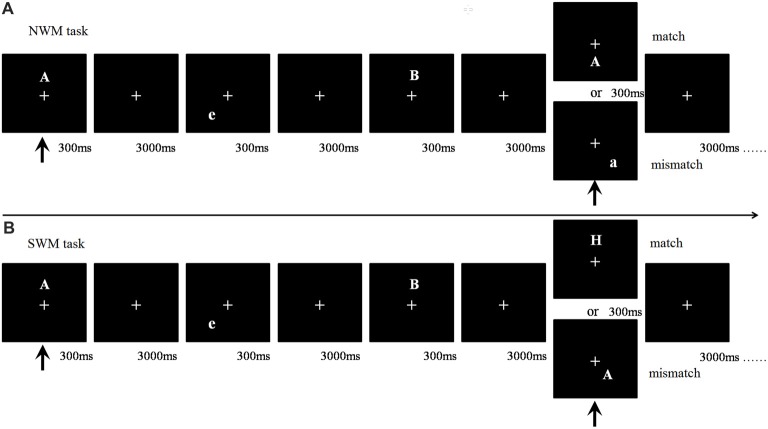
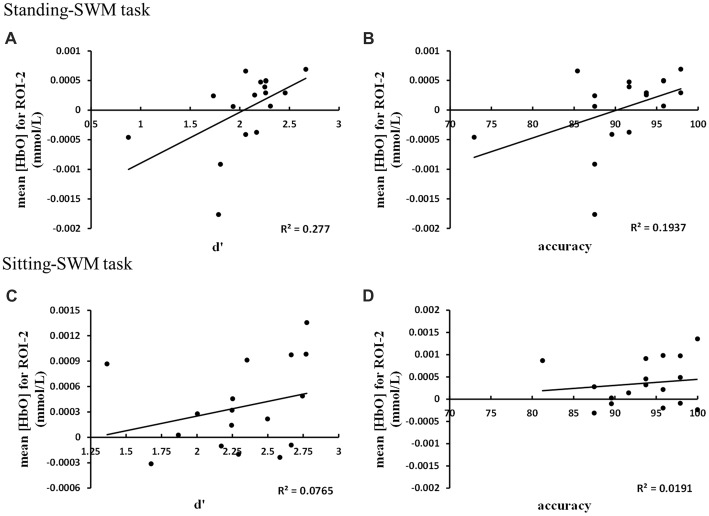
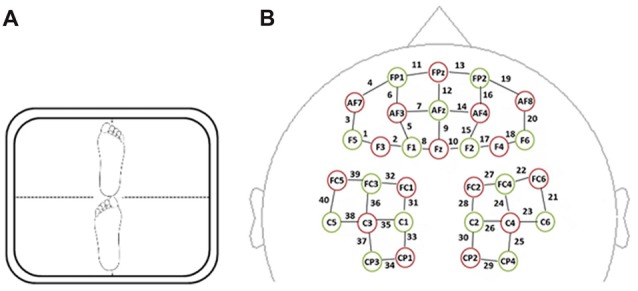
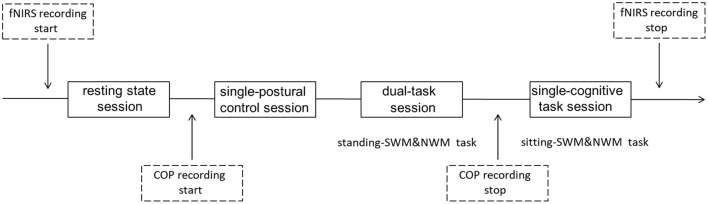
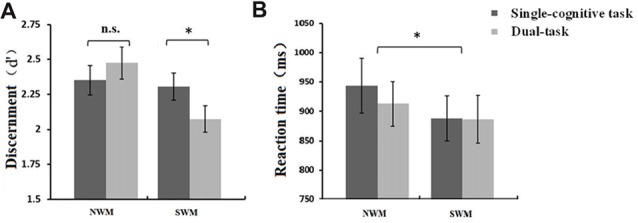
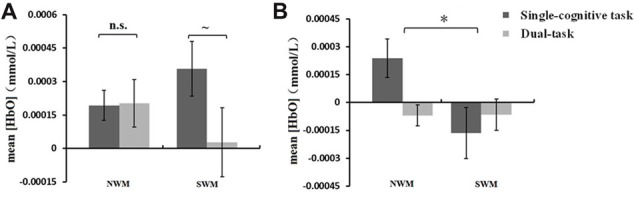
: Previous evidence suggests that postural control processing may be more related to spatial working memory (SWM) than to nonspatial working memory (NWM). Methodological discrepancies between spatial and nonspatial cognitive tasks have made direct comparisons between the two systems difficult. : To explore the neural mechanisms of SWM and NWM relative to that of postural control, participants were subjected a cognitive-posture dual-task paradigm, consisting of a 3-back letter working memory (WM) task, using physically identical stimuli with spatial and nonspatial components memorized in different sessions, and a standing balance task with a tandem stance. Additionally, there were two control sessions: a single-postural control session wherein participants pressed mouse buttons at random while standing; and a single-cognitive task control session wherein subjects completed a WM task while seated. The subjects underwent functional near-infrared spectral imaging (fNIRS) during task performance, wherein oxygenated hemoglobin concentration ([HbO]) was measured in frontal and parietal regions. : Postural control reduced discernment in the SWM task significantly, but did not affect NWM task performance. fNIRS showed that postural control had a significant tendency to decrease the [HbO] in the frontal-parietal network of the left hemisphere when participants completed the SWM task. No posture-associated differences in [HbO] were observed in NWM-related areas during NWM task performance. Behavioral and fNIRS data demonstrated that postural control had a selective interaction with SWM. Specifically, postural control reduced SWM discrimination and SWM-related brain activity (frontal-parietal network), but not NWM discrimination or NWM-related brain activity. Furthermore, the multiple linear regression analysis showed that SWM, but not NWM, was an important predictor of postural control. These results suggest that postural control may share more cognitive resources with SWM than with NWM.
先前的证据表明,姿势控制处理可能与空间工作记忆(SWM)的关系比与非空间工作记忆(NWM)的关系更大。空间和非空间认知任务之间的方法差异使得直接比较这两个系统变得困难。为了探究SWM和NWM相对于姿势控制的神经机制,让参与者接受一种认知 - 姿势双重任务范式,该范式包括一个3 - 回溯字母工作记忆(WM)任务,使用在不同阶段记忆的具有空间和非空间成分的物理上相同的刺激,以及一个串联站立姿势的平衡任务。此外,还有两个对照阶段:一个单一姿势控制阶段,参与者在站立时随机按下鼠标按钮;以及一个单一认知任务控制阶段,参与者在坐着时完成一个WM任务。在任务执行期间,对受试者进行功能近红外光谱成像(fNIRS),测量额叶和顶叶区域的氧合血红蛋白浓度([HbO])。姿势控制显著降低了SWM任务中的辨别力,但不影响NWM任务表现。fNIRS显示,当参与者完成SWM任务时,姿势控制有显著趋势降低左半球额顶网络中的[HbO]。在NWM任务执行期间,在与NWM相关的区域未观察到与姿势相关的[HbO]差异。行为和fNIRS数据表明,姿势控制与SWM有选择性相互作用。具体而言,姿势控制降低了SWM辨别力和与SWM相关的大脑活动(额顶网络),但不影响NWM辨别力或与NWM相关的大脑活动。此外,多元线性回归分析表明,SWM而非NWM是姿势控制的重要预测指标。这些结果表明,姿势控制可能与SWM共享比与NWM更多的认知资源。